
Bio-Path Holdings Confronts Operational Pause and Financing Hurdles
Bio-Path has paused operations since mid-2025 to conserve cash amid funding challenges, furloughing most employees while seeking strategic options to salvage its clinical pipeline.
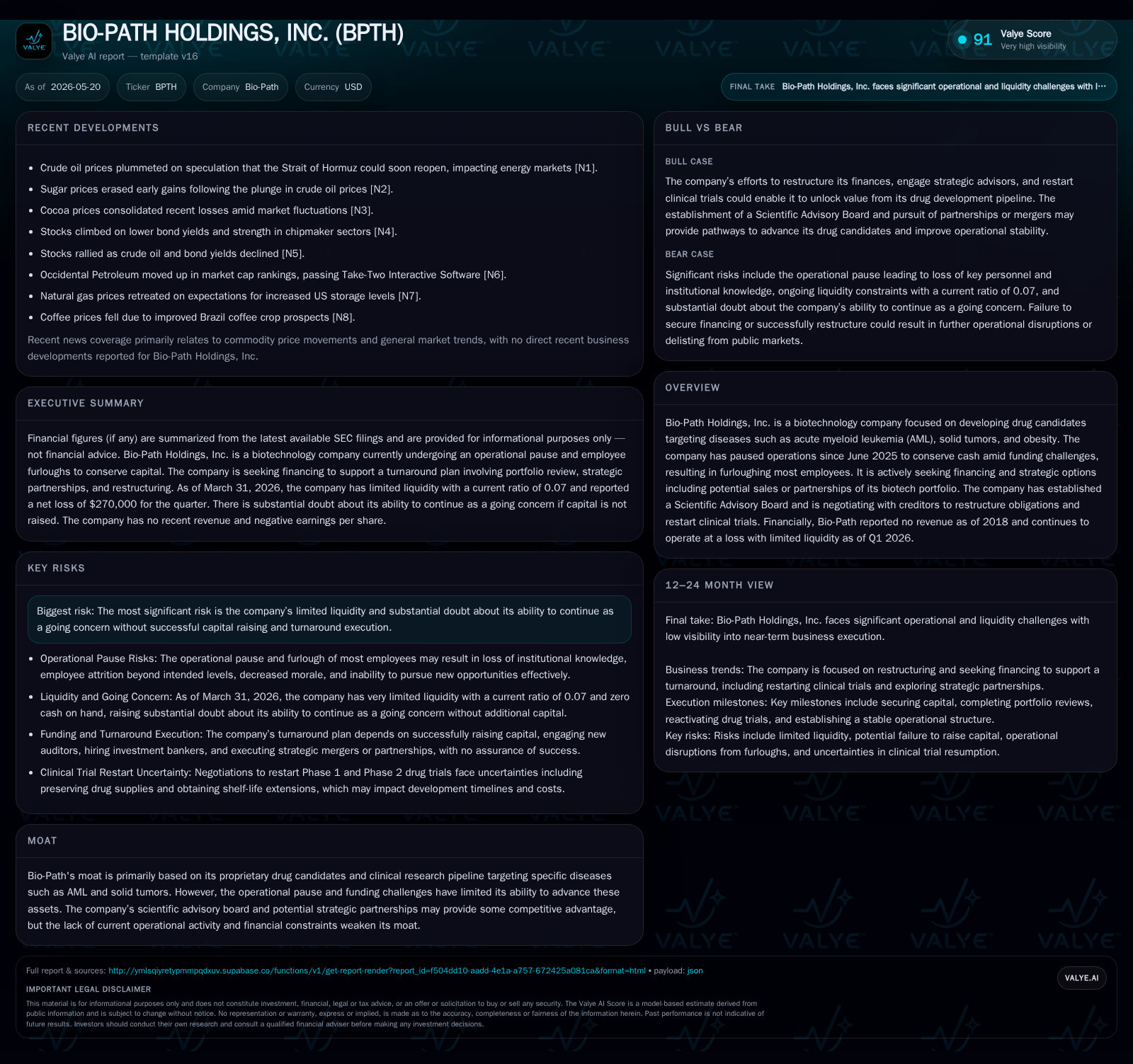
Bio-Path Holdings implemented an operational pause in June 2025 following unsuccessful capital raises, resulting in widespread employee furloughs and a halt to clinical trials. The company is actively negotiating with creditors and forming a Scientific Advisory Board to support potential restructuring and trial resumption efforts. Its proprietary drug candidates targeting acute myeloid leukemia (AML) and solid tumors provide a scientific moat but require financing and milestone progress to unlock value. Liquidity remains critically constrained as current liabilities vastly exceed assets, creating material uncertainty about Bio-Path’s viability absent successful fundraising or partnerships.
Latest Operating Update: The Cost of an Operational Pause
As disclosed in Bio-Path's latest 10-Q filing dated May 20, 2026 [S2], the company instituted an operational pause on June 24, 2025, driven by critical capital shortages after failing to secure meaningful funding. This pause included furloughing most employees to preserve cash while maintaining only essential functions necessary to support ongoing obligations. The company acknowledges that these measures carry significant trade-offs including loss of institutional knowledge, potential attrition beyond the targeted number of employees, lowered morale among remaining staff, and risks that the intended cash conservation benefits may not materialize fully.
This blend of aggressive cost reduction with strategic advisory formation signals proactive management intent; however, the extended operational lull inevitably degrades pipeline momentum and corporate coherence.
Business Model and Pipeline Focus: Specialty Drug Candidates Targeting AML and Solid Tumors
Bio-Path's revenue mechanics are primarily tied to progression through clinical development milestones rather than sales or royalties, given its focus on investigational drug candidates without commercialization history [F1][S2]. Its pipeline concentrates on treatments for acute myeloid leukemia (AML), solid tumors, and obesity – disease areas characterized by substantial unmet medical need but also intensive R&D requirements.
Value creation depends heavily on achieving clinical trial protocols successfully; each phase advancement reduces technical risk while enhancing licensing or acquisition appeal. Pricing power lies mostly downstream in transaction structures such as milestone payments or royalties post-approval rather than upfront sales; thus volume and price per se are not immediately relevant drivers.
The absence of any revenues since inception underscores extreme developmental stage reliance on external financing or partner inflows. Margin expansion hinges on later-stage commercialization economies which remain hypothetical while trials remain suspended.
Competitive Positioning Within Biotech Development Ecosystem
Operating within the highly competitive oncology biotech niche places Bio-Path among numerous small-cap peers similarly seeking venture capital or strategic alliance funding. These firms face comparable challenges including prolonged timelines, regulatory hurdles from agencies like the FDA or EMA, high capital burn rates typical for investigational therapeutics development cycles, and scientific uncertainty surrounding novel mechanisms.
While Bio-Path retains proprietary IP within oncology therapeutic development – a potential moat — its recent operational closure puts it at a disadvantage versus peers maintaining continuous trial operations that sustain investor interest and partnership momentum. Limited liquidity exacerbates vulnerability by increasing execution risk at a time when competitors may accelerate their pipelines.
Growth Opportunities: Financing, Partnerships, and Clinical Trial Restart Prospects
Despite the operational hiatus, Bio-Path’s strategy revolves around securing fresh capital injection or consummating strategic partnerships essential for trial reactivation [S18][S3]. The recently established Scientific Advisory Board plays a pivotal role by lending scientific validation that could assuage investor concerns over governance quality and research integrity. Further growth vectors incorporate negotiating shelf-life extensions for investigational drug lots held by vendors — pivotal for preserving asset value pending clinical restart — and engaging investment bankers tasked with evaluating portfolio sale or merger opportunities [S3][S10].
Should these efforts gain traction, financing coupled with partnership synergies could unlock milestone payments or licensing deals that substantially broaden enterprise value beyond current distressed levels.
Risks and Constraints: Liquidity Crisis, Talent Attrition, and Shelf-life Challenges
A paramount concern remains Bio-Path’s fragile liquidity profile as reflected by first-quarter 2026 balance sheet data showing approximately $677K in current assets against $9.15 million in current liabilities — translating into a starkly low current ratio near 0.07 [F1]. Cash reserves have been depleted entirely since September 2025 [F1], intensifying solvency pressure.
Concomitantly, the extended furlough risks permanent loss of critical scientific personnel eroding institutional competence needed for complex trial management. Restarting operations could therefore incur higher rehiring costs or delays affecting timelines.
Moreover, investigational drug inventories risk becoming obsolete if regulatory approval for dose shelf-life extensions is denied or delayed [S3]. Combined with the speculative nature of fundraising pursuits discussed in public disclosures [S18], these factors collectively enforce a material going-concern risk that if unresolved threaten irreversible pipeline degradation.
Near-term Catalysts and Milestones to Monitor
Monitoring Bio-Path’s trajectory centers on several actionable triggers:
- Completion status of ongoing debt restructuring discussions with creditors signaling whether short-term liabilities can be managed sustainably [S3].
- Success in finalizing equity or partnership financings sufficient to restart Phase 1/2 clinical trials.
- FDA interactions focusing on requests for investigational product shelf-life extension critical for maintaining pipeline asset viability [S3].
- Recruitment outcomes of Scientific Advisory Board members who provide credibility enhancement plus guidance on executing turnaround plans [S12].
- Any announcements related to sale mandates or merger processes initiated via engaged investment bankers [S3].
These milestones will serve as bellwethers for operation resumption feasibility versus further impairment.
Current Financial Leanings: A Snapshot of Cash Flow and Solvency
Though Bio-Path’s financial disclosure detail is limited in recent filings beyond operational commentary, available metrics paint a difficult solvency scenario. Cash & equivalents reportedly stood at zero as of September 30, 2025 [F1], evidencing total exhaustion of liquid reserves amid continued expense absorption. Total debt estimates remain modest based on best-effort historical data at approximately $511K last recorded in 2015 [F1], yet this pales compared to overwhelming current liabilities amounting to roughly $9.15 million reported as of March 31, 2026 [F1].
This imbalance between payables and assets contributes directly to an abysmal current ratio near 0.07 indicating severe short-term liquidity mismatch jeopardizing ongoing obligations coverage without immediate fresh capital inflows [F1][S2]
Lacking operating revenue since at least 2018 emphasizes reliance upon external funding sources which have so far failed to materialize adequately thereby sustaining recurring net losses that impair equity cushions further [F1]
This analysis incorporates only publicly filed information up to May 20, 2026. It does not constitute investment advice but serves as an objective examination of Bio-Path Holdings' business condition amidst significant challenges faced in preserving its biotechnology assets through operational restructuring efforts.
Disclaimer: This is research-only, informational analysis and not investment advice. It may include AI-generated interpretation and general industry context. Always verify important details using primary sources.

Comments