
EnerSys Expands Liquidity and Innovates in Energy Storage Amid Sector Volatility
Latest quarterly report reveals stable financial footing, segment performance nuances, and strategic investments supporting EnerSys’ energy solutions growth.
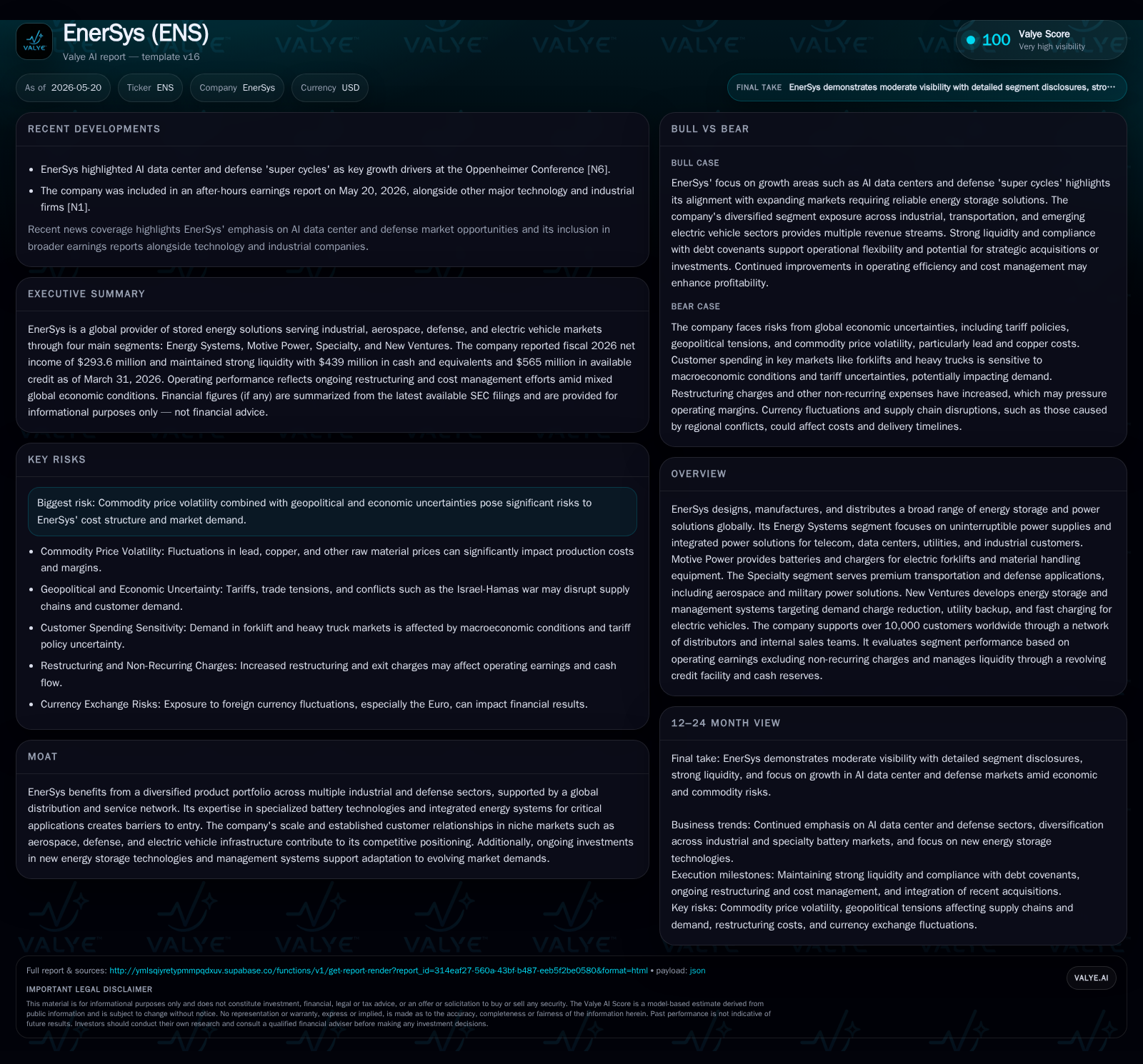
EnerSys’ Q3 FY2026 filing highlights strong liquidity with $439 million cash and manageable leverage despite $1.08 billion total debt, reflecting prudent capital management amid ongoing industry challenges. Segment profitability shows divergence, with Energy Systems improving margins through price/mix benefits while Motive Power faces margin pressures possibly linked to tariff uncertainties and supply chain impacts. The Specialty segment maintains its premium positioning serving defense and aerospace markets, bolstered by new ventures in EV fast-charging and demand charge management. Growth drivers include critical infrastructure upgrades for data centers and telecom, clean energy trends, and emerging EV infrastructure needs. Key risks involve raw material cost volatility, geopolitical disruptions affecting supply chains especially in maritime routes, and cyclical demand sensitivity in industrial end-markets.
Recent Operating Update
EnerSys’ latest quarterly report for Q3 FY2026 filed on February 4, 2026 [S2] reaffirms its strong liquidity position with $439 million in cash and equivalents alongside approximately $565 million available under revolving credit facilities. This liquidity profile underscores EnerSys' capacity to fund organic growth initiatives and acquisition strategies while navigating near-term industry headwinds.
Further confirming financial discipline, EnerSys announced on May 20, 2026 [S3] continued shareholder returns via a quarterly cash dividend of $0.2625 per share payable July 2, highlighting confidence in cash flow stability.
Business Model Overview
EnerSys operates as a global leader in stored energy systems spanning four core segments: Energy Systems, Motive Power, Specialty Batteries, and New Ventures as described in the detailed FY2026 Annual Report [S1]
Energy Systems: Provides integrated power solutions—including uninterruptible power supplies (UPS), power distribution units, thermal management enclosures—targeted at telecom networks, broadband providers, data centers, utilities, and industrial users. This segment leverages highly engineered battery technologies combined with precise power management systems.
Motive Power: Supplies motive batteries and chargers primarily for electric forklifts, automated guided vehicles (AGVs), warehouse vehicles, mining equipment, and airport ground support machinery. Dynamic usage patterns here are closely tied to manufacturing and logistics market cycles.
Specialty: Caters to premium transportation applications such as aerospace satellites and military vehicles along with portable power solutions for soldiers — a niche demanding high reliability and certifications.
New Ventures: Focuses on innovative energy storage platforms addressing demand charge reduction for commercial utilities, dynamic fast charging infrastructure for electric vehicles (EVs), and backup power solutions anchored on emerging technologies.
Revenue generation hinges on selling proprietary batteries and integrated systems directly or through an extensive distributor network servicing over 10,000 customers globally [S1]. Pricing dynamics reflect raw material costs (notably lithium and lead), product specifications tailored for critical applications often requiring certification-heavy manufacturing processes, plus aftermarket services enhancing recurring revenue.
Industry Structure & Competitive Position
EnerSys operates within fragmented yet specialized markets characterized by high technological complexity and regulatory barriers particularly in aerospace-defense segments. Its broad product portfolio differentiates it from competitors by spanning mature motive battery markets to emergent EV fast charging infrastructure innovation.
Competitive moats derive from:
- Deep technical expertise enabling customized energy solutions for critical uptime environments such as data centers.
- Scale advantages with global distribution facilitating wide geographic footprint.
- Advanced R&D investments maintaining relevance amidst evolving battery chemistries and integration challenges [N12].
Peers include diversified industrial battery manufacturers like Exide Technologies (private) or Blue Solutions (Bolloré Group), but EnerSys' distinctive presence in defense-grade batteries presents higher barriers to entry compared to commoditized motive power batteries.
Growth Drivers
Several structural factors underpin EnerSys’ potential growth trajectory:
- Critical Infrastructure Modernization: Increasing data center deployments powered by cloud computing demand reliable UPS systems where EnerSys is established.
- Telecom Networks Expansion: Rollouts of next-gen network technologies sustain demand for resilient power modules.
- Electrification of Material Handling: Manufacturing automation boosts Motive Power battery replacement cycles despite short-term tariff-driven slowdowns noted in the annual filing [S1].
- Defense & Aerospace Demand: Continued government spend on defense platforms supports Specialty segment growth due to stringent reliability requirements.
- Electric Vehicle Ecosystem Development: Through New Ventures’ focus on demand charge management solutions and dynamic fast charging stations for EVs, EnerSys addresses growing electrification needs aligned with regulatory shifts towards decarbonization.
- Aftermarket & Services Expansion: Consumable battery replacements and maintenance services generate recurring revenues supporting margin resilience.
Operational efficiency gains including tighter cost controls in Energy Systems contributed to improved operating margins (+210 basis points year-over-year) despite overall operating earnings softness due to Motive Power margin contraction (-170 basis points) reflecting cyclical challenges [S26]
Risks & Constraints
EnerSys faces notable risks that could impinge on growth or profitability:
- Commodity Price Volatility: Fluctuations in raw material prices such as lithium or lead can compress margins if not fully passed through pricing mechanisms.
- Geopolitical & Supply Chain Disruptions: The Israel-Hamas conflict has intermittently increased shipping costs via Red Sea routes impacting freight expenses temporarily [S1].
- Tariff Uncertainty: Customer hesitancy restraining capex projects related to tariffs influencing supply chains creates cyclical sales volatility especially in Motive Power heavy equipment sectors [S1].
- Cyclical Demand Profile: Exposure to industrial equipment replacement cycles introduces top-line sensitivity aligning more with economic cycles than steady recurring revenue streams.
- Technological Transition Risk: Battery chemistry advancements may require continuous R&D investment to maintain competitive differentiation.
What to Watch Next
Investors should monitor key indicators signaling execution momentum:
- Segment bookings updates revealing traction in New Ventures EV fast charging deployments.
- Pricing pass-through effectiveness amid commodity input inflation trends documented quarterly.
- Order backlog trends within Specialty defense contracts reflecting government spending commitments.
- Working capital metrics indicating inventory optimization or receivable collection improvements impacting free cash flow generation [S21].
- Management commentary around integration/expansion progress of new lithium battery plant projects initiated under New Ventures [S26].
- Quarterly dividend declarations that attest ongoing cash flow confidence as shown by the May 2026 payout announcement [S3].
Financial Profile Summary
Disclaimer: This is research-only, informational analysis and not investment advice. It may include AI-generated interpretation and general industry context. Always verify important details using primary sources.

Comments