
Flex Ltd. Accelerates Portfolio Streamlining and Technology Investment Amid Growing Digital Infrastructure Demand
Flex’s recent quarterly and strategic filings reveal an intensified focus on portfolio realignment and advanced manufacturing capabilities to capture expanding digital and regulated market opportunities.
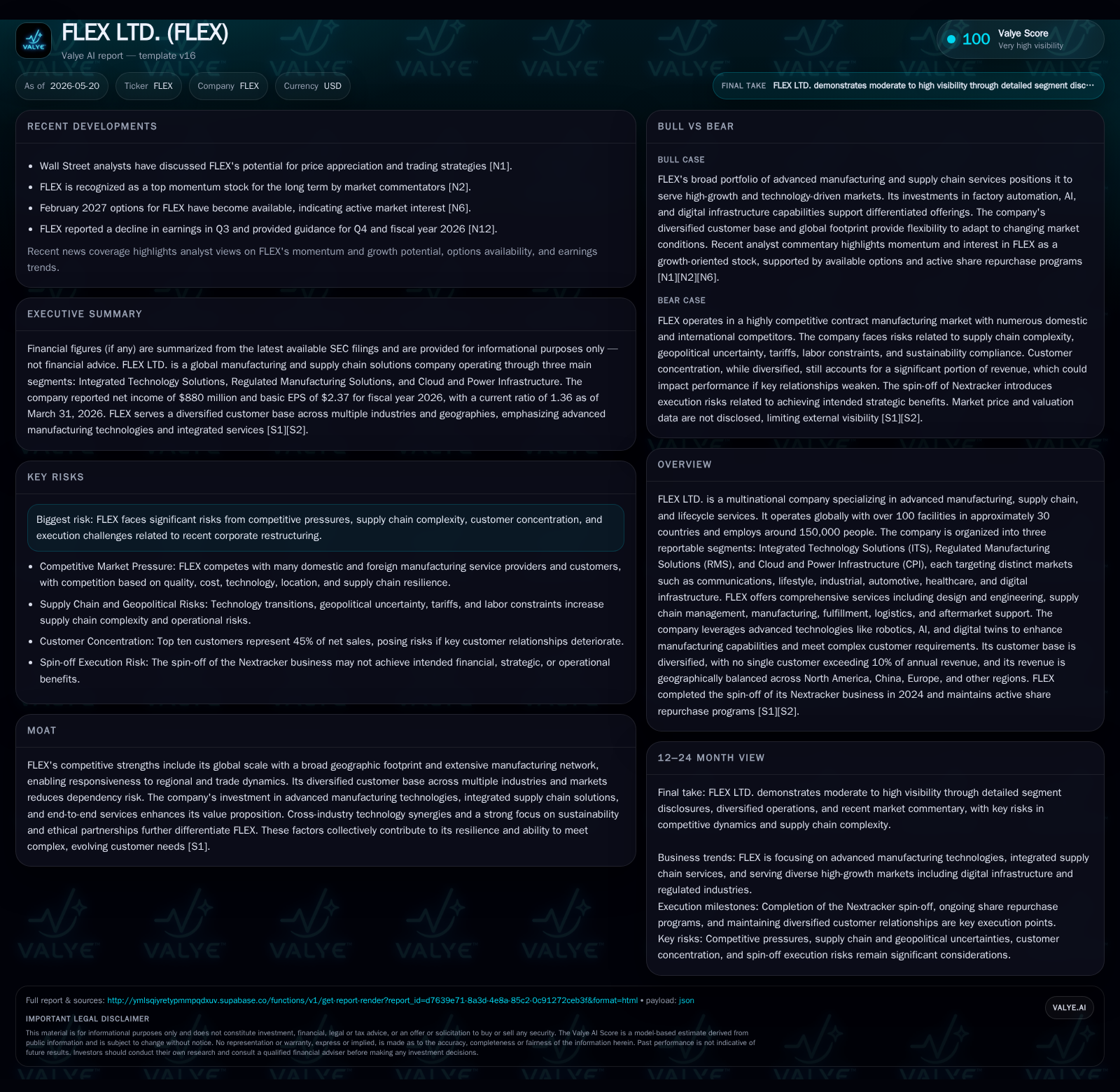
Flex Ltd.'s latest filings disclose a major strategic pivot toward simplification of its portfolio via a planned spin-off of its Cloud and Power Infrastructure (CPI) segment, aiming to unlock value and sharpen operational focus. The company’s integrated manufacturing and supply chain services, spread across three segments—ITS, RMS, and CPI—address differentiated markets from healthcare to digital infrastructure. With over 100 global facilities, Flex leverages scale, technology adoption such as AI and digital twins, and sustainability initiatives to maintain competitive resilience amid supply chain complexities. Key growth drivers relate to cloud and data center buildouts, automotive electrification, and lifecycle aftermarket services, while risks include execution challenges of restructuring and geopolitical supply risks. Financially, Flex maintains solid liquidity with $2.39 billion cash on hand against $3.77 billion total debt, supporting ongoing investments.
Recent Operating Developments Reflecting Strategic Shifts
Flex Ltd.'s latest quarterly filing dated February 6, 2026 [S2], augmented by a May 5, 2026 event filing [S3], articulate critical developments that frame the company's near-term trajectory. Most notably, Flex announced the planned spin-off of its Cloud and Power Infrastructure (CPI) segment into an independent publicly traded entity targeted for Q1 calendar year 2027 completion [S1][S4]. This strategic move follows the earlier successful separation of Nextracker in January 2024 [S4] and reflects management's intent to streamline operations by carving distinct value pools: capital-intensive CPI versus the broad-based manufacturing prowess housed in Integrated Technology Solutions (ITS) and Regulated Manufacturing Solutions (RMS).
Alongside this corporate restructuring initiative, the company reported active share repurchases authorized up to $1.7 billion as of late 2025 [S2], signaling confidence in cash-flow generation during reinvestment in advanced manufacturing capabilities. Supply chain dynamics remain complex due to geopolitical shifts, tariffs, labor constraints, and sustainability mandates; however, Flex emphasizes its global footprint as a key defensive asset enabling responsiveness across regional trade contexts [S4].
Business Model and Service Quality: Integrated Solutions Across Multiple Industries
Flex operates a multifaceted business model anchored in providing end-to-end manufacturing, supply chain management, design engineering, fulfillment logistics, and aftermarket lifecycle services worldwide [S1][S7]. Revenue streams are segmented mainly across three reportable divisions:
- Integrated Technology Solutions (ITS): Targeting dynamic markets requiring rapid product innovation such as communications equipment (high-speed networking, enterprise systems), lifestyle premium consumer products.
- Regulated Manufacturing Solutions (RMS): Addressing mission-critical sectors where regulatory compliance and precision are paramount — industrial automation platforms, automotive compute & power electronics systems, healthcare devices including drug delivery solutions.
- Cloud & Power Infrastructure (CPI): Focused on high-density data center infrastructure supporting cloud-scale compute workloads with integrated power delivery and advanced thermal management products.
The strategic segmentation allows Flex to tailor operational models reflecting product lifecycle differences—from short-cycle consumer tech requiring agile engineering (ITS) to longer-cycle regulated products demanding high-quality standards (RMS), while CPI demands complex coordination across facility-level power systems [S1][S7]. Customers pay for combinations of design services, volumetric manufacturing output under long-term contracts or program engagements, logistics coordination fees, and aftermarket support agreements. Pricing is influenced by volume commitments, technological complexity embedded in solutions (e.g., proprietary thermal components or AI-enabled systems), geographic cost structures due to production footprint diversity, and service-level expectations.
The company's deep engineering capabilities combined with its extensive global footprint—over 100 facilities spanning roughly 30 countries—and approximately 150,000 employees enable high service quality through geographic proximity to customers' end markets plus technology-enabled process efficiency [S1][S7]. Complex product integration fosters significant switching costs; customers benefit from Flex’s ability to manage end-to-end product lifecycles capturing intricate regulatory compliance nuances especially in regulated segments.
Competitive Positioning within Complex Global Manufacturing Ecosystem
Flex competes in a fragmented contract manufacturing services environment characterized by numerous domestic and international players alongside increasingly sophisticated customer internalization strategies [S23]. Key competitors include large diversified EMS providers who similarly serve technology-driven markets but often lack the breadth spanning CPS-focused regulated domains alongside cloud infrastructure solutions.
Flex's moat is anchored primarily in:
- Global scale: Its balanced geographic footprint (~44% North America sales base along with substantial presence in China at ~16%, Europe at ~20%, rest of world at ~20%) affords resilience against localized trade disruption while optimizing cost structures regionally [S23].
- Technology integration: Extensive deployment of robotics automation for precision assembly; AI-driven quality inspection systems; digital twin simulations bolstering predictive maintenance programs highlight operational differentiation factors [S1].
- Cross-industry synergies: Capability transfer between segments particularly on advanced power electronics informs cloud infrastructure innovation benefiting from regulated automotive & industrial tech pedigree.
- Sustainability commitment: Rigorous environmental audits coupled with human rights policy training per Responsible Business Alliance standards support brand integrity attracting clients with ESG mandates [S1].
While peers such as Jabil are also advancing AI infrastructure manufacturing positioning [N2], Flex's combination of scale plus cross-market expertise particularly around regulated environments offers distinctive barriers given higher compliance complexity that require specialized facilities.
Technology-Enabled Growth Drivers Fueling Future Potential
Several secular growth drivers underpin Flex’s evolving portfolio:
- Digital infrastructure expansion: The CPI segment captures robust demand related to hyperscale cloud data centers necessitating sophisticated power delivery architectures capable of managing dense computing racks with high thermal dissipation needs [S1].
- Automotive electrification: RMS benefits from regulatory-driven transitions towards electric vehicles demanding compute-intensive power electronics modules for battery management systems and integrated drivetrain controls [S1].
- Healthcare device innovation: Persistent innovation cycles around drug delivery devices leveraging stringent quality controls fuel RMS demand.
- Lifecycle aftermarket services: Deployment of digital twins enables predictive maintenance service contracts extending client relationships beyond original equipment manufacture enhancing recurring revenue potential [S1].
Portfolio realignment via planned spin-offs aims to sharpen investment focus allocating capital efficiently between high-growth CPI infrastructure versus more stable cyclical ITS/RMS businesses undergoing steady innovation improvements. Integration of emerging technologies into core operations is expected not only to improve yield/margin profiles but also create differentiated client value propositions supporting pricing power.
Risks and Execution Challenges in a Dynamic Operating Environment
Flex acknowledges several headwinds that could temper expected benefits:
- Spin-off contingencies: The planned CPI separation carries typical transaction risks including timing delays due to regulatory approvals or market conditions potentially impacting strategic rationale realization [S4].
- Supply chain complexity: Geopolitical tensions—trade tariffs especially affecting Asian operations—and labor availability constraints add unpredictability forcing lean inventory models that strain just-in-time delivery promises [S2][S4].
- Competitive intensity: Fragmented market structure puts continual pressure on pricing reducing margins particularly where commoditization risks rise.
- Customer concentration watch: While top ten customers make up about 45% sales with none exceeding single-digit percentages individually reducing outsized dependency risk, sudden volume shifts or loss of key programs could materially disrupt revenue flow [S4].
- Restructuring execution: Managing workforce talent through reorganization cycles while maintaining operational continuity poses integration risks given global diversity across regions.
Key Milestones and What to Monitor Next
Market participants should closely track:
- Progress toward CPI spin-off completion including board/shareholder approvals plus any regulatory hurdles expected before Q1 CY2027 target date [S3][S4].
- Quarterly operating margin trends reflecting restructuring efficiencies or capital deployment shifts post separation announcement.
- Customer acquisition updates within cloud & power verticals indicating scalable order intake aligned with secular digital infrastructure spend.
- Adoption rate metrics for AI/digital twin-enabled service offerings signaling margin expansion potential.
- Impact assessment of ongoing share repurchase programs executed per board authorization sustaining shareholder returns amidst capital expenditure cycles [S2].
These milestones will collectively provide clarity on execution pace validating strategic rationale underpinning the dual-company structure designed to optimize growth outcomes.
Current Financial Position Supports Operational Agility
As of March 31, 2026 end-of-fiscal-year reporting via companyfacts [F1], Flex held $2.39 billion in cash and equivalents against $3.77 billion in total debt yielding net debt approximately $1.38 billion. Current assets stood at $16.33 billion while current liabilities totaled $12.02 billion, implying a current ratio around 1.36, indicative of adequate near-term liquidity coverage [F1].
This financial profile underpins sufficient balance sheet flexibility enabling sustained investment into advanced manufacturing automation technologies alongside ongoing portfolio simplification efforts exemplified by recent acquisitions such as Electrical Power Products announced earlier in Q4 FY26 [S9][S11]. Consequently, the company remains well positioned financially to navigate structural changes arising from the impending spin-off without undue liquidity stress or elevated leverage concerns.
This analysis is based solely on publicly available information cited herein as of the dates referenced; it does not constitute investment advice or research views regarding FLEX LTD or any investment decisions.
Disclaimer: This is research-only, informational analysis and not investment advice. It may include AI-generated interpretation and general industry context. Always verify important details using primary sources.

Comments