
Bitwise 10 Crypto Index ETF’s Transition to ETF Structure Confronts Crypto Volatility and Regulatory Complexity
The Bitwise 10 Crypto Index ETF offers diversified crypto exposure but faces high volatility and evolving regulatory risks.
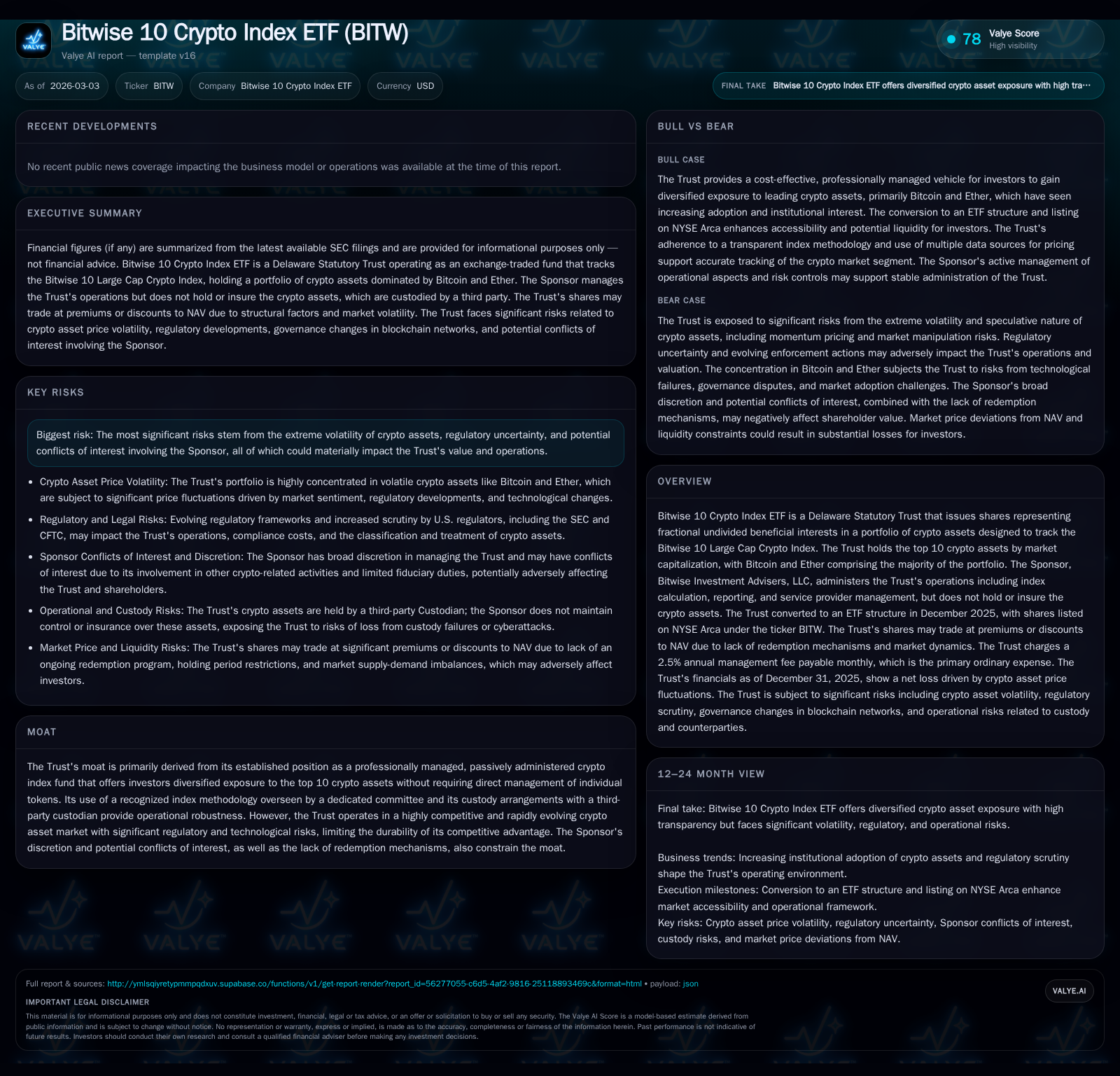
Bitwise 10 Crypto Index ETF (BITW) converted to an ETF structure in December 2025, providing exposure to the top 10 cryptocurrencies via the Bitwise 10 Large Cap Crypto Index. The fund's financials have exhibited significant variability with a notable net loss in 2025 following profitable years. Its future performance will be influenced by cryptocurrency adoption trends, regulatory developments, and adherence to index methodology. The Trust incurs a substantial management fee and faces operational challenges including lack of redemption mechanisms and cybersecurity risks.
Overview
Bitwise 10 Crypto Index ETF (BITW) offers passive exposure to leading cryptocurrencies by tracking the Bitwise 10 Large Cap Crypto Index. It transitioned from a Delaware Statutory Trust to an exchange-traded fund structure in December 2025, listing on NYSE Arca under ticker BITW [S1]. The portfolio is concentrated primarily in Bitcoin and Ether, reflecting their dominance in the crypto ecosystem.
The Sponsor, Bitwise Investment Advisers LLC—a wholly owned subsidiary of Bitwise Asset Management Inc.—is responsible for administration including index maintenance and reporting but does not hold or insure the underlying digital assets [S1]. Custodial duties are delegated to third-party custodians under formal agreements.
Historical Performance
BITW's financial results highlight volatility inherent in crypto assets. According to its latest SEC filing for fiscal year ending December 31, 2025 [F1], net income has fluctuated markedly:
Historical performance (annual)
| FY | Net ($mm) | Net YoY |
|---|---|---|
| 2025 | -166 | -125.0% |
| 2024 | 665 | +69.1% |
| 2023 | 393 | +159.0% |
| 2022 | -666 |
Source: SEC companyfacts cache [F1].
These swings mirror cryptocurrency price cycles with heavy losses during downturns and rebounds during recoveries. Cash and equivalents were minimal at $15,000 as of year-end 2025 [F1], consistent with its asset-holding nature.
Investment Strategy and Operations
BITW passively replicates its benchmark index composed of the top ten cryptocurrencies weighted by market capitalization as determined monthly by the Bitwise Crypto Index Committee [S1]. Eligibility criteria incorporate liquidity metrics, network maturity, and legal compliance considerations.
The Trust does not engage in active management or hedging strategies; it holds assets per index composition irrespective of market conditions [S18]. The Sponsor can remove assets deemed legally at risk or noncompliant with eligibility rules [S13].
Management fees are approximately 2.5% annually on assets under management, payable monthly—higher than typical equity ETFs—which reduces net returns amid volatile prices [S1].
Shares trade on secondary markets without a redemption mechanism, potentially resulting in premiums or discounts relative to NAV especially under stressed market conditions.
Regulatory Environment
BITW operates within a complex and evolving regulatory landscape affecting digital assets’ classification and oversight. U.S. federal legislation such as the GENIUS Act and Digital Asset Market Clarity Act aim to clarify frameworks for stablecoins and digital asset markets [S12][S15].
SEC enforcement actions have increased scrutiny on unregistered securities offerings within crypto markets [S11][S17]. The classification of portfolio holdings as securities or commodities remains unsettled, influencing compliance requirements [S4][S13]. State-level licensing regimes add further complexity.
The Sponsor actively engages policymakers but acknowledges comparatively limited industry advocacy may expose it to adverse regulations [S9]. Emerging data privacy laws also impact operations given the handling of personal information in trust administration [S8]. Compliance costs continue rising alongside regulatory developments.
Risks Summary
Key risks include:
- Market Volatility: Exposure to extreme cryptocurrency price fluctuations can significantly affect valuations.
- Regulatory Uncertainty: Changes in legal classifications may impose new costs or operational constraints.
- Operational Risks: Cybersecurity threats endanger asset security; the Sponsor does not directly custody or insure assets [S19].
- Structural Constraints: Lack of share redemption mechanisms allows persistent premiums/discounts.
- Sponsor Concentration: Reliance on a small executive team introduces key person risk; limited shareholder protections due to trust structure [S26].
- Legal Exposure: Potential litigation or regulatory investigations could disrupt operations or increase expenses [S24].
Growth Outlook
BITW’s growth depends on:
- Broad adoption and institutional acceptance of major cryptocurrencies,
- Regulatory clarity reducing legal uncertainty,
- Stable index methodology balancing relevance with turnover,
- Operational resilience including cybersecurity safeguards,
- Investor demand for diversified crypto investment vehicles amidst increasing alternatives.
No explicit forward guidance is available; monitoring sponsor communications on index updates or structural changes remains important.
Capital Allocation & Returns
As an asset-holding trust, BITW does not pay dividends or repurchase shares. Cash flow metrics such as operating cash flow are not applicable beyond management fees collected by the Sponsor. Returns derive entirely from underlying crypto asset performance net of fees.
Conclusion
Bitwise 10 Crypto Index ETF represents an innovative vehicle for passive exposure to large-cap cryptocurrencies via an ETF structure. It offers simplicity relative to direct crypto custody but faces significant challenges from volatile markets, evolving regulatory regimes, elevated fees impacting net returns, operational vulnerabilities including cybersecurity risks, and structural limitations on liquidity.
Investors should weigh these factors carefully given amplified risks compared with traditional equity ETFs due to asset class-specific volatility and nascent industry dynamics.
This analysis is for informational purposes only and does not constitute investment advice.
Disclaimer: This is research-only, informational analysis and not investment advice. It may include AI-generated interpretation and general industry context. Always verify important details using primary sources.

Comments