
Baker Hughes Advances Energy Technology Integration Amid Geopolitical Supply Risks
Baker Hughes’ Q2 2026 highlights a slight revenue dip with strategic gains in energy technology and sustained upstream sector investments amid Middle East tensions.
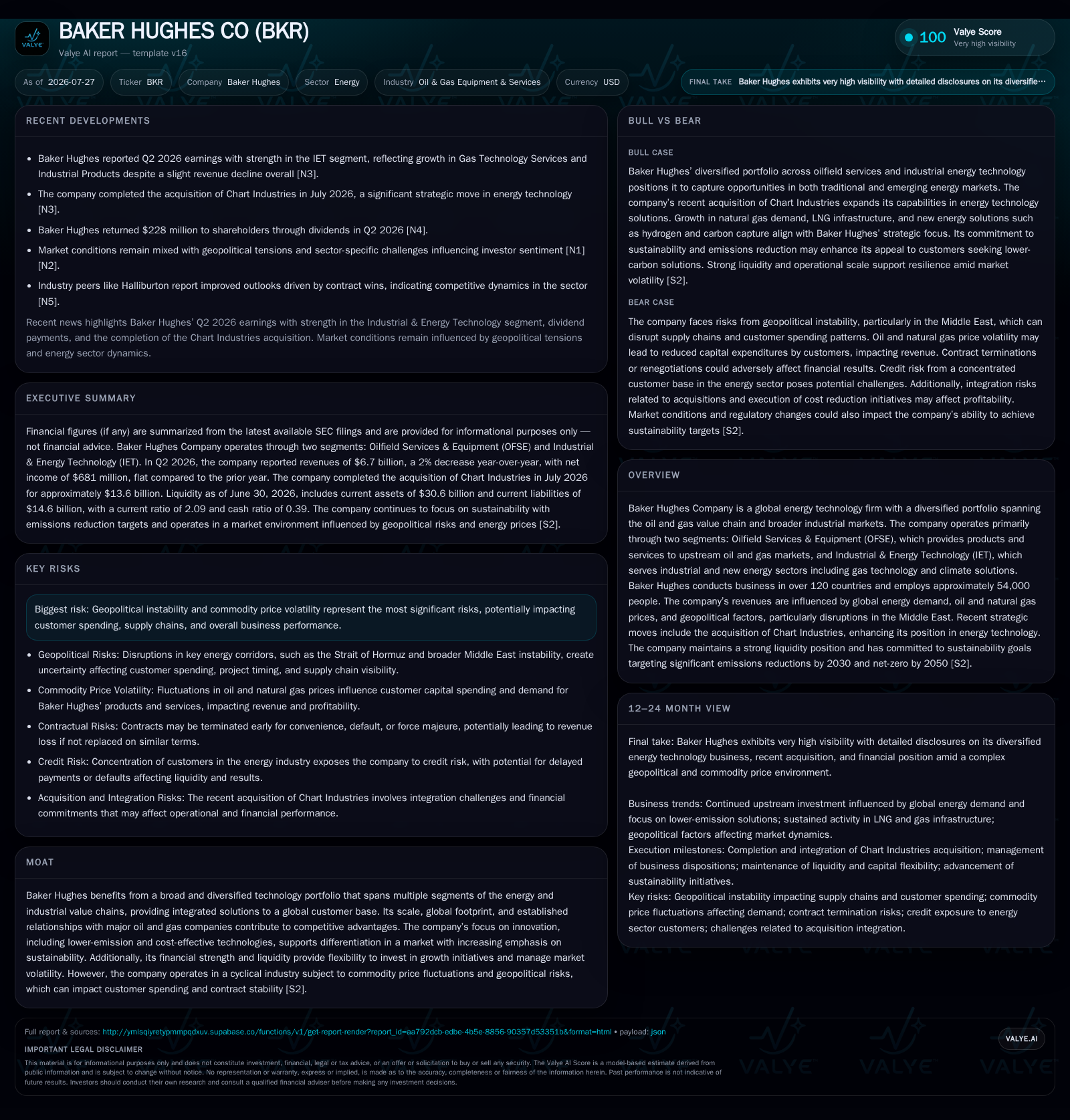
In Q2 2026, Baker Hughes reported a 2% revenue decline to $6.7 billion driven by lower oilfield services volume and business disposals, offset partly by growth in its Industrial & Energy Technology (IET) segment. The company's acquisition of Chart Industries strengthens its foothold in energy transition technologies. A volatile geopolitical landscape, particularly disruptions through the Strait of Hormuz, intensifies energy security concerns, underpinning sustained upstream investment needs. Baker Hughes' diversified portfolio spanning upstream oilfield equipment to industrial gas and climate tech positions it well for the evolving energy market despite cyclicality and inflationary pressures.
Recent Operating Update
Baker Hughes completed its $13.6 billion acquisition of Chart Industries in mid-July 2026, a strategic move that significantly enhances its capabilities in liquefied natural gas (LNG) infrastructure and energy transition technologies. This acquisition, funded through a combination of senior notes issued earlier in the year and cash on hand, broadens Baker Hughes’ Industrial & Energy Technology (IET) segment, positioning the company to capitalize on growing demand for industrial gas compression and climate technology solutions critical to decarbonization efforts [S14], [S5].
In the second quarter of 2026, Baker Hughes reported consolidated revenues of $6.7 billion, reflecting a 2% decline year-over-year primarily due to a 5% revenue decrease in the Oilfield Services & Equipment (OFSE) segment. This decline was driven by asset disposals, including the Surface Pressure Control business, and reduced international demand, particularly in the Middle East amid geopolitical tensions [S2]. Meanwhile, the IET segment maintained flat revenue year-over-year, supported by double-digit growth in Gas Technology Services, Industrial Products, and Climate Technology Solutions, offsetting declines in Gas Technology Equipment and Industrial Solutions following the Precision Sensors & Instrumentation disposition [S2].
Business Model
Baker Hughes operates through two main segments: OFSE and IET. The OFSE segment supplies upstream oilfield services and equipment, including drilling equipment, pressure control systems, and subsea hardware. Revenue in this segment is generated primarily from upstream operators—major international oil companies, national oil companies (NOCs), and independents—who pay based on rig count utilization, equipment rental days, and project-specific contracts. This segment’s performance is closely tied to upstream capital expenditure (CapEx) cycles and rig activity levels, with contract backlog and equipment utilization serving as key operating metrics.
The IET segment focuses on industrial gas compression equipment, distributed power generation, and emerging energy transition technologies such as carbon capture utilization and storage (CCUS), hydrogen solutions, and geothermal systems. Its revenue streams are more diversified, including sales and service contracts with both traditional oil and gas customers requiring LNG solutions and industrial clients pursuing sustainability-driven upgrades. The IET segment benefits from more stable recurring revenues through maintenance agreements and service contracts on installed equipment, contributing to a differentiated margin profile compared to OFSE’s more cyclical and volume-sensitive operations.
Baker Hughes leverages integrated technology offerings across these segments, combining digital oilfield solutions that optimize upstream recovery with industrial gas and climate technology innovations. This integration supports pricing power and customer retention by delivering operational efficiencies and sustainability benefits, which are increasingly valued by operators amid tightening regulatory environments and energy transition mandates.
Industry Structure and Competitive Position
The Oil & Gas Equipment and Services industry is characterized by high cyclicality, with revenue and profitability closely linked to upstream capital spending driven by commodity price fluctuations and geopolitical developments. Baker Hughes competes with peers such as Halliburton, Schlumberger, TechnipFMC, National Oilwell Varco, and Weatherford International, each with varying focuses across upstream services, equipment manufacturing, and energy transition technologies.
Baker Hughes’ broad portfolio spanning upstream drilling and pressure control equipment, digital services, and industrial gas compression provides a competitive advantage by reducing exposure to any single market segment or geography. The recent disposals of non-core businesses and the Chart acquisition reflect a strategic pivot toward higher-growth, technology-driven areas, particularly energy transition solutions that address sustainability and emissions reduction.
Geopolitical risks, especially disruptions in the Middle East and chokepoints like the Strait of Hormuz, create supply uncertainties that impact global oil and LNG markets. These dynamics influence customer spending patterns, project timing, and supply chain reliability, directly affecting Baker Hughes’ OFSE revenues and operational planning [S2], [S19].
Growth Drivers
Several structural factors underpin Baker Hughes’ growth outlook:
Sustained Upstream Investment: Despite near-term regional spending variability, global upstream CapEx remains essential for reserve replacement and production growth amid declining conventional fields. Mid-cycle oil prices, supported by geopolitical supply constraints, incentivize continued investment in drilling and production equipment.
Expanding LNG Demand: Natural gas’s role as a reliable, scalable, and lower-emission energy source drives steady growth in LNG infrastructure. Baker Hughes’ enhanced LNG capabilities post-Chart acquisition position it to capture opportunities in liquefaction, storage, and transport equipment markets.
Energy Transition Technologies: Increasing industrial demand for climate technology solutions such as CCUS, hydrogen production, and geothermal systems expands IET’s addressable market. These technologies benefit from regulatory incentives and corporate sustainability commitments.
Digital Transformation: Adoption of digital oilfield technologies accelerates efficiency and recovery optimization, creating value for upstream operators and supporting service revenue growth.
These growth drivers manifest in key operating metrics including order intake growth in new energy portfolios, stable contract backlog levels, and steady equipment utilization rates across core upstream services.
Risks and Watchpoints
Baker Hughes faces several risks that could impact its operating and financial performance:
Commodity Price Volatility: Fluctuations in oil and gas prices can compress customer capital budgets, reducing demand for high-margin drilling equipment and services.
Geopolitical Instability: Supply chain disruptions and project delays stemming from geopolitical tensions, particularly in the Middle East, may affect equipment delivery schedules and contract execution.
Inflationary Pressures: Rising raw material and labor costs challenge margin recovery despite pricing initiatives, necessitating ongoing cost management and productivity improvements.
Technological Competition: Accelerated innovation by competitors in digital automation and sustainability technologies could erode Baker Hughes’ market position if not matched effectively.
Regulatory Uncertainty: Changes in emissions regulations, export controls, or trade policies may impose additional compliance costs or restrict market access.
Capital Allocation Balance: Managing investment between sustaining legacy OFSE operations and funding emerging clean energy technologies requires disciplined financial planning amid evolving market dynamics.
Monitoring rig count utilization trends globally, geographic segmentation of order backlog, margin progression within IET’s climate technology verticals, and integration milestones post-Chart acquisition will be critical indicators of operational execution and strategic alignment.
What To Watch Next
Key upcoming developments to observe include:
Upstream Customer Spending: Regional spending patterns, particularly contrasting North America’s steady activity with expected short-term declines in the Middle East due to geopolitical uncertainties [S19].
Chart Integration Progress: Realization of synergies, cross-selling opportunities, and contract wins in LNG and industrial product lines.
Segment EBITDA Trends: OFSE’s recovery or further contraction alongside sustained IET growth driven by climate technology adoption.
Capital Expenditure Management: Pacing of CapEx at approximately 5% of annual revenue, reflecting responsiveness to market conditions and investment priorities [S25]
Cost Control Initiatives: Effectiveness of inflation mitigation and productivity programs impacting free cash flow generation.
Financial Discipline: Management of upcoming December 2026 debt maturities, covenant compliance, and liquidity position amid volatile credit markets [S2], [S5].
Customer Retention: Stability of high-value service contracts supporting recurring revenue streams in a competitive environment.
Financial Profile Discussion
As of June 30, 2026, Baker Hughes reported total consolidated debt of approximately $15.5 billion and net debt near $9.8 billion after accounting for cash and cash equivalents. The company maintained a strong liquidity position with a current ratio of about 2.09, supported by $30.6 billion in current assets against $14.6 billion in current liabilities [F1]. Compliance with all senior note covenants was affirmed at quarter-end, and no borrowings were outstanding under the $3.0 billion revolving credit facility, underscoring financial flexibility despite the upcoming December 2026 debt maturities [S2], [S5].
Disclaimer: This analysis is based solely on publicly available information including SEC filings up to July 27, 2026. It does not constitute investment advice or research views regarding any securities discussed. Readers should exercise their own judgment before taking any action.
Disclaimer: This is research-only, informational analysis and not investment advice. It may include AI-generated interpretation and general industry context. Always verify important details using primary sources.

Comments