
Celestica Boosts Revenue and Margins on Hyperscaler-Driven Cloud Demand Amid Capital Investment Phase
Strong Q2 2026 results highlight Celestica's growing exposure to cloud infrastructure and AI, supported by operational execution and supply chain management.
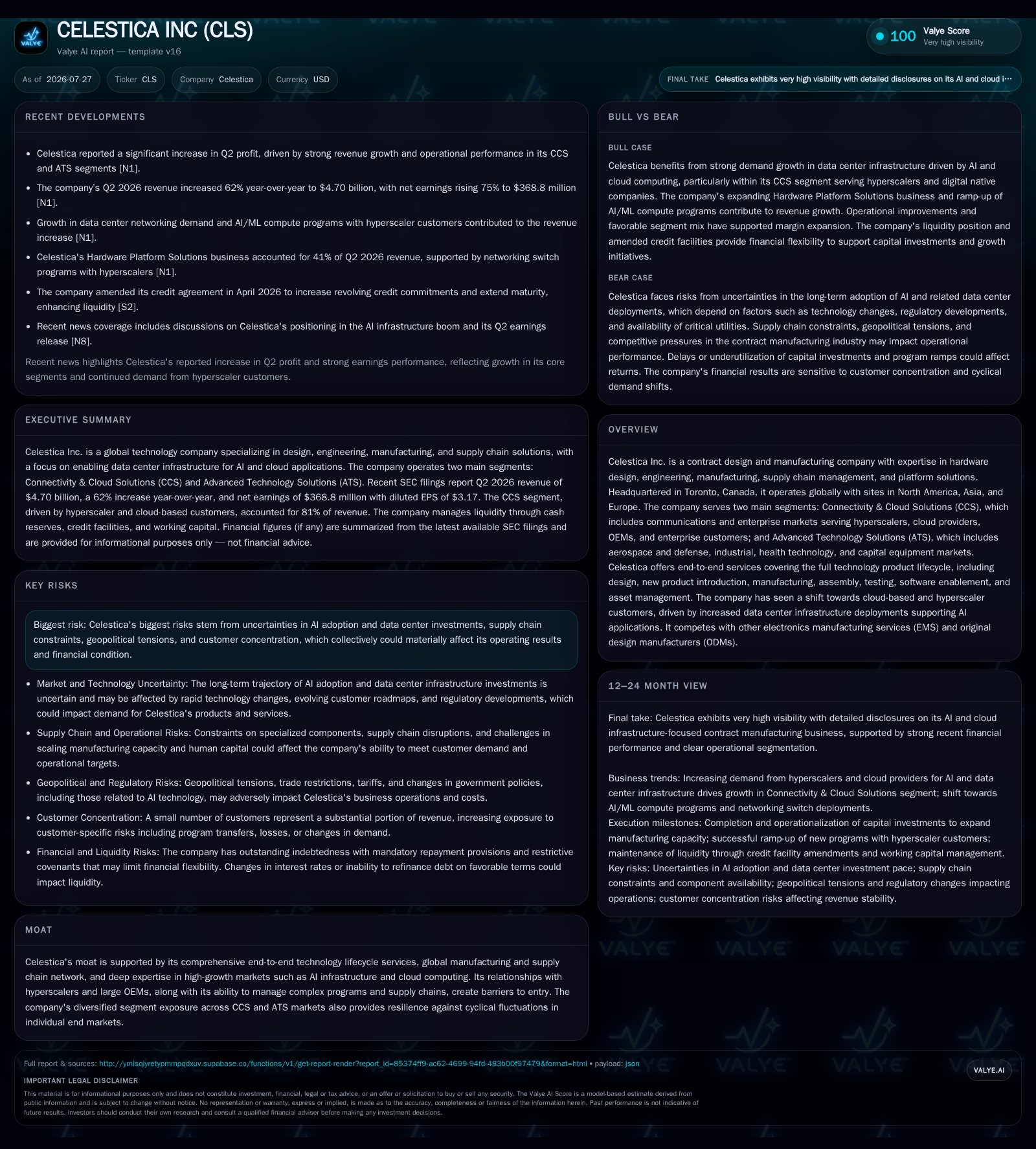
Celestica Inc. reported robust Q2 2026 financial results driven by accelerating demand from hyperscalers and cloud customers. Revenue surged 62% year-over-year to $4.7 billion, with gross margins improving on operational leverage and favorable equity-related adjustments. The company’s strategic shift toward Connectivity & Cloud Solutions (CCS) has expanded its footprint in high-growth AI infrastructure markets, while its Advanced Technology Solutions (ATS) segment showed steady improvement. Despite global supply chain risks and a capital-intensive outlook, Celestica maintains strong liquidity, having recently upsized and extended its credit facility to support ongoing investments. Continued program ramps, new product introductions, and repatriation of foreign cash remain key operational focal points.
Recent Operating Update: Q2 2026 Results Reflect Accelerating Hyperscaler Demand
Celestica Inc. reported strong second-quarter 2026 financial results, driven primarily by robust demand from hyperscalers and cloud infrastructure customers. Revenue surged 62% year-over-year to $4.7 billion, reflecting significant volume growth in the Connectivity & Cloud Solutions (CCS) segment, which accounted for 81% of total revenue, up from 72% in the prior year [S2][S21][S26]. Gross profit increased 56% to $577.5 million, with gross margin expanding to 12.3% from 10.8% in Q1 2026. This margin improvement was supported by operational leverage on higher production volumes and a favorable $48.4 million gain related to total return swap (TRS) fair value adjustments embedded in cost of sales [S2][S21]. Selling, general and administrative expenses rose moderately but declined as a percentage of revenue, aided by similar equity-linked valuation gains recorded within SG&A [S21]. Net earnings rose 75% to $368.8 million, reflecting stronger operating income partially offset by higher income taxes associated with increased pre-tax earnings [S16].
Cash flow from operations was robust at $410.9 million for the quarter and $767.2 million year-to-date, supported by disciplined working capital management despite significant inventory increases to support growth ramps [S28]
Business Model: Integrated Contract Manufacturing Serving High-Growth Technology Segments
Celestica operates as a global contract electronics manufacturer and design services provider, delivering end-to-end hardware lifecycle solutions to original equipment manufacturers (OEMs), hyperscalers, cloud service providers, aerospace and defense contractors, healthcare technology firms, and industrial equipment manufacturers [S1][S26]. Its service offerings encompass new product introduction (NPI), design for manufacturability (DFM), turnkey manufacturing including assembly and testing, component sourcing amid volatile supply chains, software enablement, and asset management including aftermarket services.
Revenue generation is primarily project- and contract-based, tied to production volumes ramped according to customer program schedules. Recurring revenue streams arise from supply chain management and software enablement agreements, providing some diversification beyond pure build activity. Pricing power depends on the complexity of technology platforms supplied and the strength of long-term contractual relationships, particularly with hyperscalers where switching costs are elevated due to rigorous qualification and logistical integration requirements.
Industry Structure and Competitive Positioning
Celestica competes within the contract electronics manufacturing and design services industry alongside peers such as Flex Ltd., Sanmina Corporation, and Jabil Inc. The company differentiates itself through a strategic focus on hyperscaler-driven AI infrastructure demand, which now dominates its CCS segment, while maintaining diversified exposure to advanced aerospace, defense, healthcare, and industrial technology markets via its Advanced Technology Solutions (ATS) segment [S26].
Its global manufacturing footprint across North America, Asia, and Europe provides scale advantages critical for efficient component sourcing and supply chain resilience amid ongoing semiconductor shortages and logistics challenges affecting the industry broadly. Celestica’s engineering capabilities, including design for manufacturability and integrated platform solutions, underpin its competitive moat by reducing customers’ time-to-market risks and enhancing supply chain agility.
Long-term contracts with hyperscalers, who invest heavily in AI and cloud data center infrastructure, provide durable revenue visibility beyond typical EMS spot projects, which are more susceptible to volatility from program shifts or geopolitical trade disruptions [S26]
Growth Drivers
Several secular trends underpin Celestica’s growth trajectory:
- Cloud Infrastructure Expansion: Hyperscalers continue to invest aggressively in AI-optimized data centers, driving volume ramps in Celestica’s CCS segment as evidenced by the 62% revenue growth in Q2 2026 [S21][S26].
- Artificial Intelligence Adoption: Accelerated AI integration across industries fuels faster new product introduction cycles, increasing demand for contract manufacturers capable of rapid scale-up, including specialized testing and software enablement services that Celestica provides [N10][S12].
- OEM Outsourcing Trends: Traditional OEMs increasingly outsource complex electronics manufacturing to reduce fixed costs and improve flexibility, supporting growth in Celestica’s ATS segment, which grew sequentially by 10% in Q2 2026, driven by aerospace, industrial, health tech, and capital equipment sectors [S21][S26].
- Technological Complexity: Shorter innovation cycles and increasing product complexity require integrated engineering support and sophisticated assembly/testing capabilities, areas where Celestica actively competes.
These growth drivers manifest in operational KPIs such as increasing production volumes, new program wins, and capacity expansion aligned with capital expenditure plans [S2][S26]
Risks and Constraints
Celestica faces several key risks that could impact future performance:
- Customer Concentration: Heavy reliance on a limited number of large hyperscalers exposes the company to demand shocks or program delays, given the volume-driven nature of contracts and limited recurring revenue streams [S1].
- Supply Chain Volatility: Persistent semiconductor shortages and raw material cost inflation may increase procurement lead times and costs, potentially compressing margins if price increases cannot be fully passed through [S9].
- Geopolitical Tensions: Trade restrictions and geopolitical uncertainties, particularly between North America and Asia, could disrupt component flows and manufacturing location decisions, complicating global supply chain logistics.
- Capital Intensity: Elevated capital expenditures to support new program ramps and capacity scaling carry risks of underutilized assets if volume growth does not meet forecasts; managing timing and alignment of capex with sales ramps is critical [S2].
- Pricing Pressure: Competitive bidding among EMS providers and customer leverage may exert downward pressure on unit pricing, requiring ongoing operational efficiency and cost discipline.
What to Watch Next
Key operational and financial indicators to monitor include:
- Quarterly revenue trends and segment mix shifts between CCS and ATS to assess sustainability of hyperscaler-driven growth.
- New program ramp announcements and backlog development, particularly in AI and cloud infrastructure platforms.
- Capital expenditure levels relative to prior guidance, indicating capacity scaling progress.
- Tax rate fluctuations following ongoing repatriation of foreign cash, which currently represents approximately 95% of total cash balances and carries associated tax liabilities [S2][S16].
- Working capital trends, especially inventory build-up, to evaluate supply chain health and demand visibility.
- Compliance with financial covenants under the expanded $1.75 billion revolving credit facility, which was upsized and extended to 2031 in April 2026 to support capital investments [S4][S22][S24].
- Resumption of share repurchases, currently paused due to debt service priorities and covenant thresholds [S19][S24].
Financial Profile Discussion
As of June 30, 2026, Celestica held $535.7 million in cash and cash equivalents against total debt of approximately $784 million, resulting in net debt near $248 million [S2][F1]. Current assets totaled $7.57 billion versus current liabilities of $6.18 billion, yielding a current ratio of 1.23x, indicating adequate short-term liquidity [F1]. The company’s credit facility was amended in April 2026 to increase revolving commitments from $750 million to $1.75 billion and extend maturities to 2031, providing financial flexibility to fund capital expenditures associated with new program ramps [S4][S22][S24].
Capital expenditures remain variable but elevated, reflecting timing of new business wins and forecasted sales levels [S2][S26]. The company’s ability to align capacity investments with production ramps will be critical to maintaining margin expansion and return on invested capital
Operating cash flow generation remains strong, supporting working capital needs and debt service, with $410.9 million generated in Q2 2026 and $767.2 million year-to-date [S28]. Share repurchases were paused in Q2 2026 due to debt service priorities but remain part of the capital allocation framework, subject to compliance with credit facility covenants [S19][S24].
Disclaimer: This analysis is for informational purposes only and does not constitute investment advice. All financial data and statements are sourced from Celestica’s SEC filings as of July 27, 2026.
Disclaimer: This is research-only, informational analysis and not investment advice. It may include AI-generated interpretation and general industry context. Always verify important details using primary sources.

Comments