
Badger Meter’s Integrated Water Solutions: Software-Driven Margins, Competitive Pressures, and the Stakes of Technology Evolution
Badger Meter’s Q3 2026 performance underscores its strong position in smart water management, but sustaining growth and margin expansion hinges on software adoption, innovation pace, and navigating both supply chain and technology disruption risks.
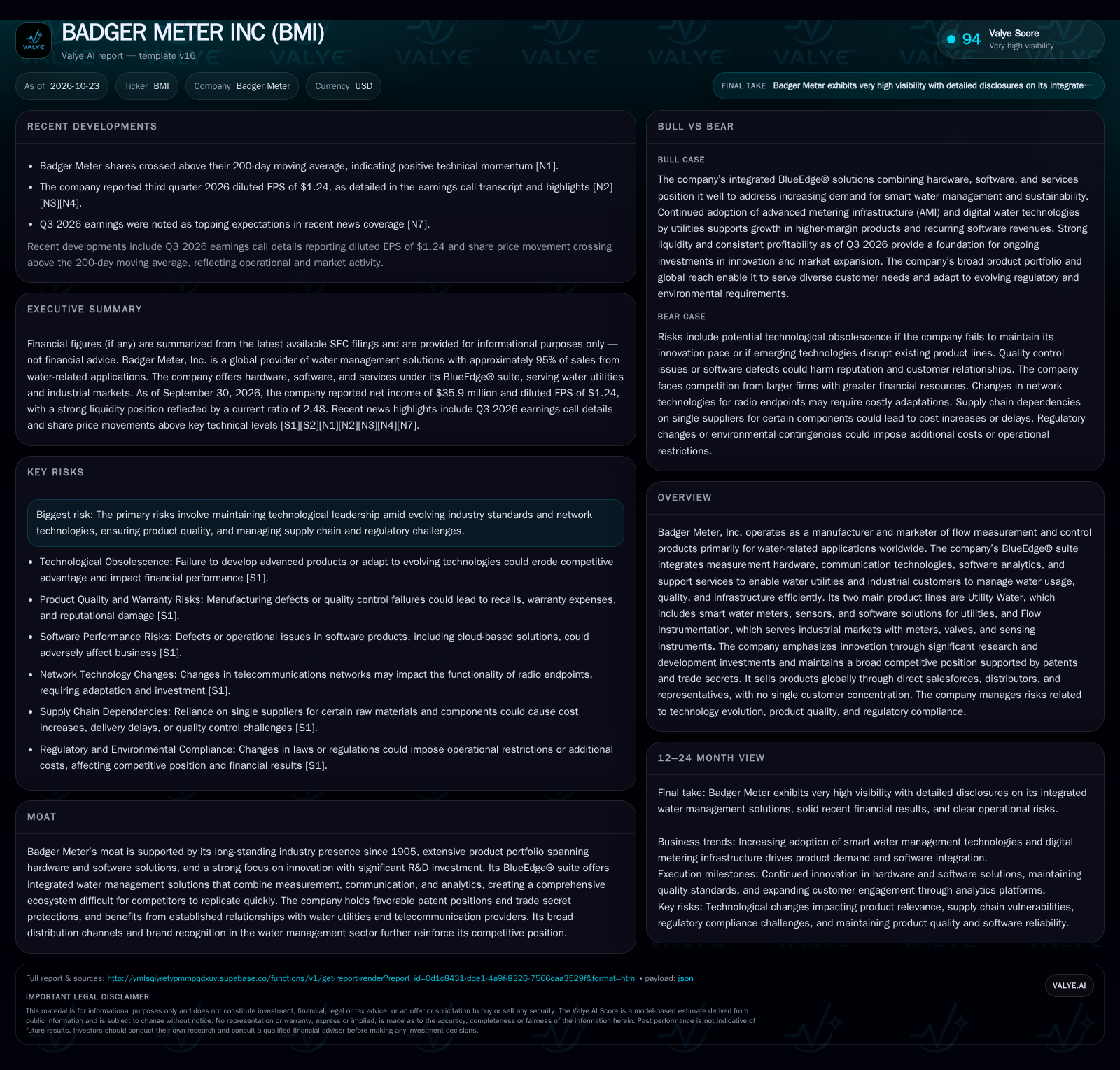
Badger Meter reported Q3 2026 diluted EPS of $1.24, exceeding expectations and reflecting robust demand for its water management solutions. With 95% of sales tied to water applications and a growing mix of software-driven offerings, the company’s future economics depend on the pace of digital adoption by utilities, ongoing R&D, and the ability to manage shifting technology and supply chain dynamics. Competitive pressures from larger and niche players remain intense, making execution on innovation and customer engagement critical for sustaining its advantages. [S1] [S2] [N2] [N3] [N4] [N7]
Badger Meter’s latest results reinforce its reputation as a leading provider of integrated water management technology, driven by a blend of hardware, communications, and increasingly software-centric solutions. With its Q3 2026 EPS exceeding forecasts and a high proportion of revenues from smart water applications, the company stands at the intersection of infrastructure modernization and digital transformation in utilities. Yet, future value creation will depend not just on current product strength, but on Badger Meter’s ability to accelerate software adoption, defend against evolving competition, and adapt to rapid changes in technology and supply chain dynamics.
Recent Outperformance and Product Mix Shape the Near-Term Narrative
Badger Meter delivered Q3 2026 diluted EPS of $1.24, exceeding analyst expectations and reinforcing the company’s operational momentum in a competitive market [N4] [N7]. The Utility Water segment remains the core driver, accounting for 89% of 2025 net sales, with nearly all of the company’s revenue—about 95%—tied to water-related applications [S1]. The BlueEdge® suite, which integrates measurement hardware, radio communications, and software analytics, continues to anchor Badger Meter’s value proposition and revenue mix [S1]. The company reported cash and liquidity metrics for the period; these figures do not by themselves establish operating runway, investment capacity, financial flexibility, or financing capacity. [S2]
How Software and Digital Infrastructure Could Reshape Badger Meter’s Margin Profile
Badger Meter’s business model is built on a foundation of engineered hardware—meters, sensors, and telemetry endpoints—augmented by software and analytics platforms. Historically, hardware sales have dominated revenue, but the company’s BlueEdge® suite and BEACON® SaaS offerings point to a strategic shift toward digital and recurring revenue streams [S1]. If software penetration increases, margins could expand, as SaaS and analytics typically command higher gross margins and recurring revenue compared to physical products.
The company’s economics hinge on the volume of new meter deployments (driven by utility infrastructure upgrades), the rate of software adoption by existing and new customers, and the mix between one-time hardware sales and ongoing service contracts. Fixed costs include R&D ($21.6 million in 2025) and manufacturing overhead, while variable costs are tied to raw materials (metals, electronics) and logistics [S1]. Operating leverage may improve as more utilities adopt integrated digital platforms, spreading fixed R&D and SG&A costs over a larger base. However, the extent of recurring revenue from software remains undisclosed, so the trajectory toward a more SaaS-like margin profile is still an open question.
Competitive Dynamics: From Metering Hardware to Digital Ecosystems
Badger Meter operates in a highly competitive environment, facing both large diversified competitors (such as Sensus/Xylem, Neptune/Roper Technologies, Itron, and Hach/Veralto) and niche or regional players [S1]. The company’s historical advantages—brand reputation, long-standing utility relationships, and a broad product portfolio—are now being tested by the accelerating shift to digital water management solutions.
The BlueEdge® suite’s integration of hardware, communication endpoints, and analytics creates switching frictions for utilities that have invested in the ecosystem. However, larger competitors may have greater resources to invest in R&D, M&A, and global distribution, while smaller players may offer niche solutions or aggressive pricing. The rise of open standards and interoperability could also erode some ecosystem lock-in over time. The competitive question is whether Badger Meter can maintain its pace of innovation and deepen customer engagement faster than rivals can replicate or surpass its offerings.
Accelerated Digital Adoption Unlocks Margin Expansion and Market Share Gains
A favorable scenario would see utilities and industrial customers rapidly accelerating the adoption of cloud-based analytics, remote monitoring, and automated leak detection—areas where Badger Meter’s BlueEdge® and BEACON® SaaS platforms are well-positioned [S1]. In this scenario, the company capitalizes on infrastructure stimulus, regulatory mandates for water conservation, and the rising cost of water to drive increased deployments of smart meters and software subscriptions.
Key confirming evidence would include a disclosed increase in software or recurring revenue as a percent of sales, rising gross margins, and new utility wins specifically citing digital differentiation. Further, continued positive earnings surprises and robust R&D output (measured by new product launches or patent filings) would reinforce the company’s ability to lead the digital transformation of water management. A falsification would be stagnating software adoption rates or margin compression despite rising sales, suggesting hardware commoditization is outpacing digital upsell.
Digital Growth Continues, but Hardware Remains the Revenue Anchor
The most plausible scenario is steady growth as utilities gradually modernize their infrastructure, with hardware deployments remaining the principal revenue driver and software adoption advancing incrementally. The BlueEdge® platform and related products maintain customer stickiness and support modest margin improvement, but the business mix remains weighted toward engineered products for the foreseeable future.
Confirmation would come from a continued high share of Utility Water in the revenue mix, stable gross margins, and ongoing R&D investment at or above recent levels. Incremental evidence of software adoption—such as references to new analytics features or customer engagement modules—would support the thesis, even if recurring revenue is not yet dominant. A falsification would be a sharp decline in hardware sales not offset by software growth, or if competitors’ new offerings trigger significant customer churn or pricing pressure.
Rapid Technology Shifts and Supply Chain Disruptions Undermine Advantage
The most adverse scenario would see disruptive changes in network technologies or metering standards rendering Badger Meter’s installed base or radio endpoints obsolete, requiring costly reengineering or leading to customer defections [S1]. Simultaneously, supply chain constraints—especially reliance on single-source components—could inflate costs or create delivery delays, eroding margins and goodwill.
Evidence confirming this scenario would include increased warranty claims, major product recalls, or publicized quality-control failures. A surge in R&D expense without corresponding revenue growth might signal forced adaptation rather than proactive innovation. Additionally, any regulatory changes that impose new compliance burdens could further compress profitability. Falsification would be stable cost structure, absence of major product or quality issues, and continued compliance with evolving standards.
What Will Determine Badger Meter’s Next Phase of Value Creation?
The percentage of total revenue derived from software, analytics, and recurring service contracts (if disclosed) would help test whether the business is achieving margin expansion from digital adoption.
Trends in gross margin and operating margin over time, especially as product mix evolves, would clarify whether software and analytics are contributing meaningfully to profitability.
New utility or industrial customer wins citing digital differentiation, analytics capability, or interoperability as a decisive factor would provide evidence of competitive advantage.
R&D spending levels and the number or significance of new product launches/patents would indicate ongoing innovation and responsiveness to technology shifts.
Any material supply chain disruptions, cost spikes, or delays—especially linked to single-source components—would directly test operational resilience.
Warranty claims, product recalls, or public disclosures of software defects would be critical for assessing quality control and reputational risk.
Disclosures or commentary on regulatory or standards changes impacting installed endpoints or software compliance would test the company’s ability to adapt to evolving requirements.
Disclaimer: This is research-only, informational analysis and not investment advice. It may include AI-generated interpretation and general industry context. Always verify important details using primary sources.

Comments