
GrafTech International: Vertical Integration Meets Steel Cycle Headwinds in the Graphite Electrode Market
Despite powerful vertical integration and proprietary manufacturing, GrafTech faces persistent losses as steel-sector cyclicality and global overcapacity weigh on pricing and margins. The company's strategic position in the electric arc furnace value chain offers both insulation from raw material shocks and risks from operational consolidation.
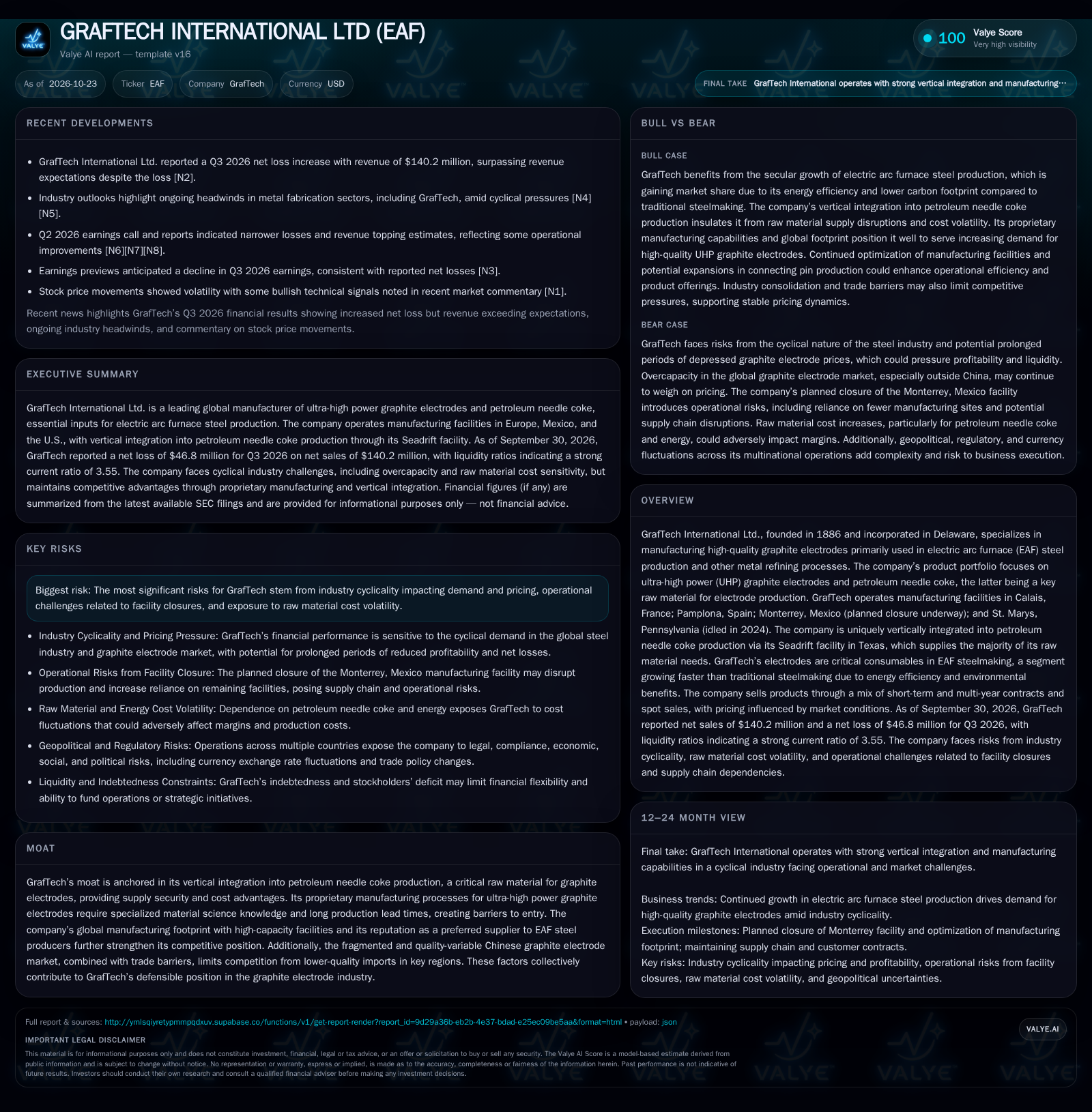
GrafTech International remains a leading supplier of ultra-high power graphite electrodes and is uniquely vertically integrated into petroleum needle coke, a key input for EAF steelmaking. However, the company reported a Q3 2026 net loss of $46.8 million on $140.2 million in sales, reflecting persistent industry headwinds. Facility closures and a stockholders’ deficit underscore the pressure from overcapacity and cyclical demand, even as EAF steel usage grows globally. The core thesis hinges on whether vertical integration, cost control, and secular EAF adoption can offset raw material volatility and operational complexity in a tough competitive landscape. [S1] [S2]
GrafTech International stands at the intersection of high-tech materials manufacturing and the cyclical dynamics of global steelmaking. As a top supplier of ultra-high power graphite electrodes—critical consumables for the increasingly favored electric arc furnace (EAF) steel production—GrafTech’s vertically integrated model is designed to shield against raw material shocks and supply disruptions. Yet the company’s Q3 2026 results show persistent losses, with a net deficit and facility closures reflecting the harsh realities of overcapacity, price pressure, and industry cyclicality. The strategic question is whether GrafTech’s cost advantages and technical prowess can overcome these external headwinds, or if structural challenges in the electrode market will continue to erode profitability and constrain potential financial flexibility. [S1] [S2]
Losses Persist Amid Stable Revenue and Plant Rationalization
GrafTech reported net sales of $140.2 million for Q3 2026, nearly flat versus the prior year, but registered a net loss of $46.8 million and basic and diluted EPS of -$1.76. This marks another quarter of red ink despite relatively stable top-line performance. The company’s balance sheet shows cash and cash equivalents of $120.7 million, current assets of $519.2 million, and current liabilities of $146.3 million, yielding a current ratio of 3.55 and a cash ratio of 0.83. However, a stockholders’ deficit of $388.2 million underscores the cumulative impact of recent losses and other comprehensive charges. Operationally, GrafTech is consolidating its footprint: the Monterrey, Mexico manufacturing facility is being closed and the St. Marys, Pennsylvania site was idled in 2024, concentrating production in Europe and the U.S. while maintaining vertical integration through its Seadrift needle coke facility in Texas. [S1] [S2]
How Vertical Integration and Contract Mix Shape Profitability
GrafTech’s business model relies on manufacturing ultra-high power (UHP) graphite electrodes, primarily for EAF steel producers. Its vertical integration into petroleum needle coke is a core economic advantage, reducing exposure to external supply shocks and volatile raw material prices. The company’s Seadrift facility supplies most of its needle coke needs, which can help stabilize input costs—crucial in a market where raw material price swings can rapidly erode margins. Revenue is generated through a blend of short-term, multi-year, and spot contracts, with pricing highly sensitive to global supply-demand dynamics and spot market volatility. When industry capacity exceeds demand, as is currently the case, spot prices fall and contract renewals reset at lower rates, compressing margins.
Fixed costs are significant due to the scale and technical requirements of electrode manufacturing, but the company’s ability to idle or close facilities (as seen in St. Marys and Monterrey) suggests some degree of operational flexibility. However, this also introduces restructuring costs and potential supply chain risks. Capital requirements are moderate for ongoing operations but rise during periods of facility investment or closure. Operating leverage amplifies both upside and downside in this cyclical market: utilization rates and pricing power are key determinants of profitability.
GrafTech’s Moat: Insulation from Raw Material Shocks Versus Global Overcapacity
GrafTech’s principal competitive differentiator is its vertical integration into petroleum needle coke, a critical raw material for UHP graphite electrodes. This insulates the company from global supply disruptions and some cost volatility, advantages not universally shared by competitors. Proprietary manufacturing processes and technical expertise provide further barriers to entry, particularly for the high-performance UHP segment required by EAF steelmakers.
However, the global market outside China remains oversupplied: GrafTech holds about 23% of non-China UHP capacity, but with demand (ex-China) averaging only 650,000 metric tons in recent years, pricing remains weak. Chinese producers, while generally lower in quality, act as a price anchor for the global market and could become a more formidable threat if trade barriers erode. GrafTech’s multinational footprint offers logistical and customer proximity advantages, but also exposes the company to regulatory, currency, and geopolitical risks. In sum, while technical and supply-chain moats are real, they are not absolute defenses against cyclical and structural industry pressures.
If EAF Adoption Accelerates and Overcapacity Eases, Margin Recovery Could Follow
A favorable outcome for GrafTech hinges on a sustained global shift toward electric arc furnace steelmaking, which is structurally more reliant on UHP graphite electrodes than traditional blast furnaces. If steelmakers accelerate EAF adoption—driven by environmental regulations, energy efficiency, and scrap availability—demand for GrafTech’s products could outpace current supply, absorbing excess capacity and firming up spot prices.
In this scenario, GrafTech’s vertical integration would magnify margin recovery by keeping input costs contained even as selling prices rise. Operational efficiency gains from facility rationalization could further boost profitability. Evidence confirming this scenario would include: a clear, sustained uptrend in EAF steel production volumes; rising spot and contract prices for UHP electrodes; higher plant utilization rates; and a return to net profitability with positive operating cash flow. Conversely, if EAF adoption stalls or global steel demand remains weak, this upside would be hard to realize.
Stability at Low Margins as GrafTech Optimizes Footprint Amid Industry Stagnation
The most plausible trajectory for GrafTech is a continuation of modest revenue stability with ongoing pressures on margins and profitability. The company is likely to operate near breakeven, with periodic losses as overcapacity and weak spot pricing persist. Facility closures and operational optimization may reduce fixed costs and improve efficiency, but these measures are unlikely to fully offset the structural headwinds of a slow-growth steel sector and volatile raw material environment.
GrafTech’s vertical integration and technical expertise will allow it to defend share in the UHP segment, but without a sharp rebound in demand or a major supply-side correction, material margin expansion is unlikely. This scenario would be confirmed by continued flat or slightly declining revenues, persistent (though possibly narrowing) net losses, and low plant utilization rates. A falsification would require a clear break in industry pricing or a step-change in cost structure.
Persistent Losses and Financial Strain if Overcapacity Deepens or Raw Material Costs Spike
The most adverse scenario arises if global steel demand weakens further or new capacity (including from China) exacerbates oversupply in the UHP electrode market. In this context, spot and contract prices could fall further, pushing GrafTech deeper into loss-making territory. If petroleum needle coke or energy costs spike—due to supply shocks or geopolitical events—even vertical integration may not fully insulate margins.
Additional risks stem from operational consolidation: if facility closures or supply chain disruptions impair production reliability or customer relationships, revenues could decline further. The company’s stockholders’ deficit and ongoing net losses would raise questions about long-term financial sustainability, potentially constraining access to capital or requiring further asset sales or restructuring. Confirmation of this scenario would be seen in accelerating revenue declines, widening losses, negative operating cash flow, or new disclosures around debt covenants, liquidity concerns, or additional plant closures.
Signals That Will Determine GrafTech’s Strategic Resilience in a Cyclical Market
Quarterly trends in UHP graphite electrode spot and contract pricing—if disclosed—would help test whether industry overcapacity is easing or worsening.
Utilization rates and production volumes at active facilities indicate whether operational optimization is yielding efficiency gains or masking underlying demand weakness.
Gross margin progression, especially relative to raw material input costs, would clarify the effectiveness of vertical integration in protecting profitability.
Progress on the Monterrey facility closure, including realized cost savings and any supply chain disruptions, is critical for assessing operational risk.
Quarterly net cash from operating activities—if disclosed—would provide a clearer picture of cash generation and financial resilience beyond headline losses.
EAF steel production growth rates in GrafTech’s core geographic markets would validate the secular demand thesis.
Changes in the stockholders’ deficit or new financing arrangements would signal balance sheet stress or improved potential financial flexibility.
Any developments in trade policy or regulatory barriers affecting Chinese UHP electrode exports could rapidly shift the competitive landscape.
Disclaimer: This is research-only, informational analysis and not investment advice. It may include AI-generated interpretation and general industry context. Always verify important details using primary sources.

Comments