
First American Financial: Title Market Cyclicality, Digital Leverage, and the Limits of Data Moats
First American Financial’s Q3 2026 results highlight the company’s exposure to real estate cycles and underscore the challenges and opportunities in digitizing a highly regulated, competitive industry. With a prominent position in title insurance and a growing emphasis on automation and data assets, the company’s future hinges on execution in technology, risk management, and navigating market volatility.
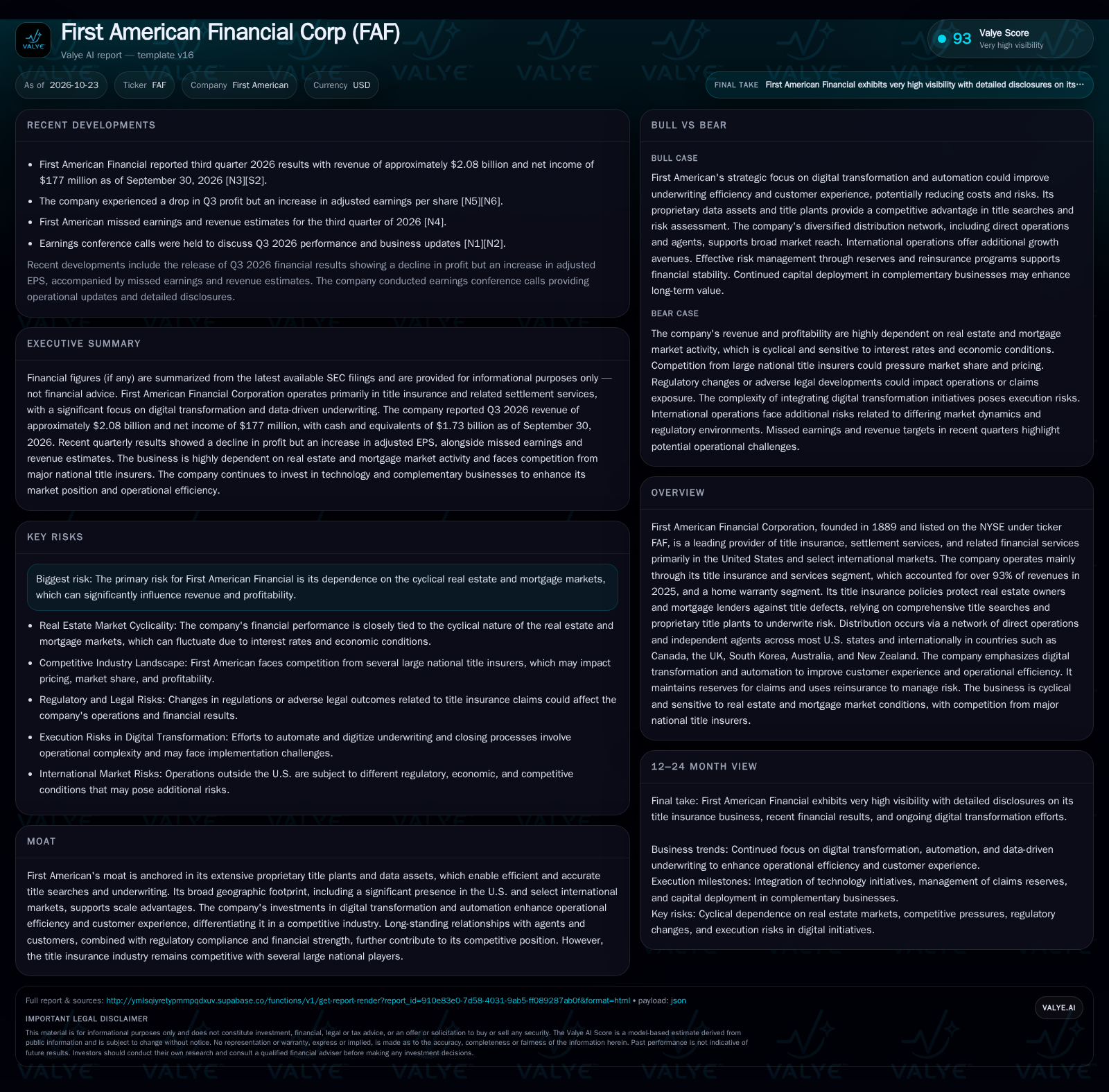
First American Financial’s third-quarter 2026 results showed a profit decline and missed expectations, despite an increase in adjusted EPS. The company remains heavily reliant on the U.S. real estate and mortgage markets, deriving over 93% of revenue from its title insurance segment. Its strategy centers on leveraging proprietary data and digital transformation to drive efficiency and differentiation, but faces persistent competition and cyclical headwinds. Execution in technology integration and risk management will be key levers for future performance. [S1] [S2] [N3] [N4] [N5] [N6]
First American Financial’s latest quarterly results put a spotlight on the company’s sensitivity to real estate market cycles and the importance of its ongoing digital transformation strategy. Despite a rise in adjusted EPS, headline profit fell and both revenue and earnings missed expectations for Q3 2026, mirroring broader market headwinds. As one of the largest title insurers in the U.S., First American’s core business remains deeply tied to transaction volumes in residential and commercial property, while its investments in automation and proprietary data aim to create differentiation and operational leverage. The next phase for the company will test whether digitization and risk management can offset cyclical volatility and competitive pressure.
Recent Financial Performance Underscores Market Sensitivity
First American Financial reported Q3 2026 revenue of roughly $2.08 billion and net income of $177 million, with the company missing both earnings and revenue estimates for the quarter. Profit declined year-over-year, but adjusted EPS rose, indicating some underlying margin resilience or cost control efforts [S2] [N3] [N4] [N5] [N6]. The overwhelming majority of revenue—approximately 93.6% in 2025—originates from the title insurance and services segment, revealing a high degree of concentration in a business model that is directly tied to real estate transaction volumes [S1]. The company’s cash and cash equivalents stood at $1.73 billion as of September 30, 2026 [S2]. These results highlight how closely First American’s financial outcomes track the broader real estate and mortgage cycle, and the limits of diversification from its smaller home warranty and international operations.
Title Insurance Economics: Volume-Driven Revenue and Expense Dynamics
First American’s revenue model is fundamentally transaction-based: title insurance premiums are collected at the time of property sales or mortgage originations, with relatively little recurring revenue. Fee income from settlement, escrow, and related services is similarly contingent on deal flow. This creates a highly variable topline that rises and falls with the volume and value of real estate transactions. While the company’s proprietary title plants and data assets may allow for some pricing power and cost efficiency, industry competition and regulatory scrutiny constrain margins and limit the ability to drive premium rates higher.
The cost structure blends high variable costs—underwriting, commissions, agent splits, and claims reserves—with a meaningful fixed-cost base tied to technology, compliance, and maintaining proprietary data infrastructure. Operating leverage is substantial in up-markets but can quickly reverse in downturns. Capital needs are moderate outside of technology investment, as claims reserves are funded on an actuarial basis and reinsurance helps manage tail risk. The company’s ongoing digital transformation and automation initiatives are intended to reduce manual labor and improve process throughput, potentially shifting the cost curve lower if successfully executed.
Can Data Assets and Digital Workflow Differentiate in a Crowded Title Market?
First American’s competitive advantages stem from its proprietary title plants, comprehensive data assets, and national (plus select international) distribution via direct operations and independent agents [S1]. These assets enable efficient and accurate title searches, which are critical for risk mitigation and customer experience. However, the industry features several large national players—including Fidelity National Financial, Old Republic International, and Stewart Title Guaranty—who possess similar scale and data capabilities, resulting in pricing discipline and limited opportunities for outsize share gains [S1].
Digital transformation and automation are areas of strategic focus, promising faster turnaround, lower error rates, and better customer interfaces. The question is whether First American can translate these investments into a durable moat—through lower unit costs, better risk analytics, or improved retention—before competitors replicate similar capabilities. The company’s ability to leverage its data for predictive underwriting, fraud prevention, and process automation could offer incremental advantage, but network effects are limited by the relatively one-off nature of title transactions and regulatory mandates for process transparency.
Digital Execution and Market Recovery as Catalysts for Outperformance
A favorable scenario for First American would see a sustained recovery in real estate transaction volumes—driven by falling interest rates, improved housing affordability, or increased commercial activity—restoring topline growth and expanding margins through operating leverage. If the company’s digital transformation efforts result in demonstrably lower costs per transaction, faster turnaround times, and improved customer satisfaction, First American could expand market share or defend pricing more effectively than peers.
Supporting evidence would include: acceleration in revenue and profit growth outpacing industry averages; disclosure of quantifiable cost savings from automation; increased agent and customer adoption of digital platforms; and lower claims ratios attributable to improved data-driven underwriting. Successful entry into complementary digital businesses or international expansion with positive operating leverage would further confirm the upside case.
Cyclical Stability and Incremental Gains from Technology Investment
The most probable outcome is that First American tracks the broader real estate market cycle, with revenue and profits fluctuating in line with transaction volumes. Margins remain relatively stable as digital investments yield incremental efficiency but are largely matched by similar efforts across the industry. The company retains its strong market position, but share gains are modest given the competitive parity among national title insurers.
Confirmation would come from revenue and net income trends that mirror housing and mortgage origination data, margin stability within historical ranges, and ongoing—but not transformative—disclosures about technology-driven improvements. If digital initiatives prevent margin erosion during market slowdowns and support modest profitability in down-cycles, the base case would be validated.
Prolonged Market Weakness and Stalled Digital Payoff Challenge Resilience
A negative scenario emerges if real estate transaction volumes remain depressed due to persistent high interest rates, affordability constraints, or macroeconomic shocks. In this environment, First American’s revenue base contracts, and operating leverage turns negative as fixed costs become burdensome. If digital transformation projects face execution delays, cost overruns, or fail to deliver the anticipated efficiency gains, the company could see margins compress and competitive position erode.
Downside confirmation would include: continued revenue and profit declines exceeding industry averages; rising expense ratios or claims costs; lack of tangible improvement in customer experience or process speed; and negative surprises related to technology integration or risk management. Regulatory or legal setbacks could further amplify downside risk.
Milestones That Will Clarify First American’s Digital and Market Resilience Thesis
Quarterly trends in title insurance and services revenue versus industry-wide real estate transaction volumes.
Disclosures of cost savings, process improvements, or margin impact directly attributed to digital transformation initiatives—if disclosed.
Customer and agent adoption rates of digital underwriting and closing platforms—would help test differentiation claims.
Movement in claims ratios and reserve adequacy, especially as digital risk analytics are rolled out.
Market share trends within U.S. title insurance, particularly in direct operations versus agent channels.
International segment growth and profitability, given its current small scale but strategic positioning.
Capital deployment into complementary businesses or technology partnerships, and subsequent financial impact.
Any regulatory, legal, or compliance developments that could materially impact claims exposure or operational flexibility.
Disclaimer: This is research-only, informational analysis and not investment advice. It may include AI-generated interpretation and general industry context. Always verify important details using primary sources.

Comments