
Element Solutions Inc: Specialty Chemicals Growth, Portfolio Shifts, and Integration Execution Risks
Record Q3 results, two major acquisitions, and a strong segment mix set Element Solutions apart in the specialty chemicals landscape. The company’s real test now lies in successfully integrating new businesses, sustaining innovation, and navigating cyclical end-markets as electronics and industrial demand evolve.
Element Solutions Inc posted record Q3 2026 results and completed two transformative acquisitions in early 2026, broadening its reach in high-value specialty chemicals for electronics and industrial markets. With the Electronics segment driving 70% of sales and fresh capabilities from EFC and Micromax, the company’s business model of low capex, high-margin formulations faces new integration and market-cycle tests. Future performance hinges on extracting synergies, defending pricing power, and adapting to customer and technological shifts in a competitive, innovation-driven industry. [S1] [S2] [N3] [N4] [N5]
Element Solutions Inc has emerged as a notable consolidator and innovator in the specialty chemicals sector, reporting record Q3 2026 earnings on the back of robust electronics demand and strategic portfolio moves. The twin acquisitions of EFC and Micromax in 2026 mark a deliberate push into high-value, technology-driven niches, but also introduce new complexity and integration risk to its operating model. As the company leverages its customer-centric innovation culture and broadens its intellectual property base, its ability to sustain margin stability and capitalize on cyclical upswings in electronics and industrial markets will be closely watched.
Element Solutions Posts Record Earnings with Strategic Portfolio Moves in 2026
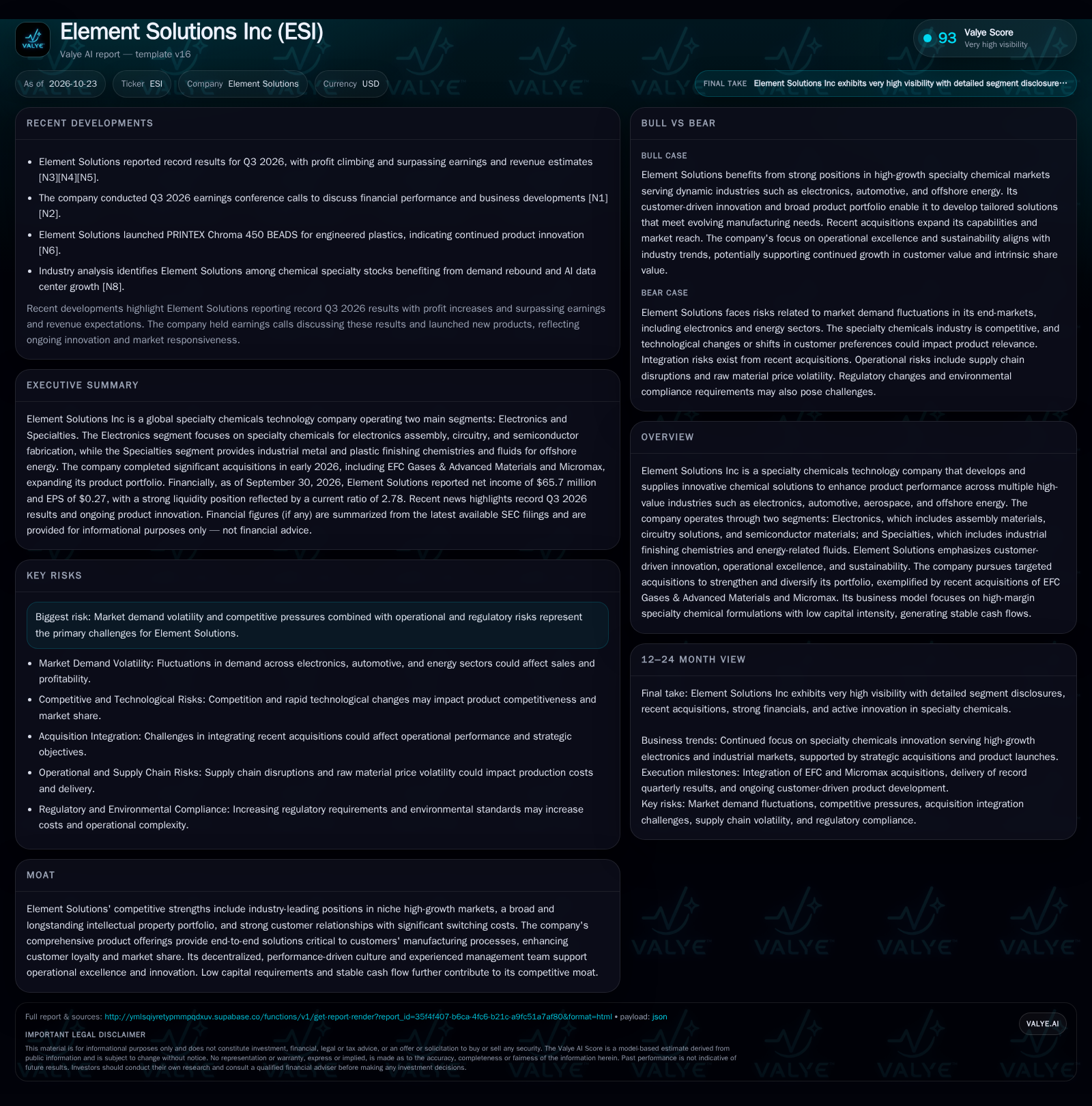
Element Solutions Inc delivered record results for Q3 2026, reporting net income of $65.7 million and basic and diluted EPS of $0.27, both exceeding analyst expectations for the period. This performance was accompanied by a cash balance of $224.9 million and a current ratio of 2.78 at quarter-end, providing the company with a reported liquidity position snapshot. [S2] [N3] [N4] [N5]
Two major acquisitions in early 2026—EFC Gases & Advanced Materials ($369 million) and Micromax ($500 million)—have expanded the company’s product offering into high-purity specialty gases and advanced electronics inks and pastes, respectively. EFC is now reported within the Specialties segment, while Micromax is integrated into Electronics. [S1]
The Electronics segment remains the core engine, representing approximately 70% of sales in 2025, and is diversified across assembly materials, circuitry solutions, and semiconductor materials. [S1]
These facts matter because they signal both operational momentum and a deliberate strategic shift, positioning Element Solutions at the intersection of high-value specialty chemistry and the evolving needs of electronics and industrial customers.
Leveraging Specialty Formulations and Scale to Maintain Low Capital Intensity
Element Solutions’ business economics rely on the formulation and supply of specialty chemicals that are deeply embedded in manufacturing workflows for electronics, automotive, industrial finishing, and offshore energy. The company’s value proposition is built on high-margin, low-volume products tailored to specific customer processes, allowing for pricing discipline and recurring application-driven demand.
The business model is capital-light: specialty chemical production typically requires modest fixed investment compared to commodity chemicals, as value is derived from proprietary formulations, process know-how, and close customer collaboration. This enables stable free cash flow generation and reduces exposure to commodity price swings, but it also means top-line growth depends on continuous innovation and customer intimacy.
Operating leverage is present, as incremental sales—particularly from proprietary products—can flow through with high contribution margins once fixed R&D, technical service, and SG&A costs are covered. However, the recent EFC and Micromax acquisitions introduce new integration costs and the risk that expected synergies or cross-selling opportunities may take time to materialize or may not fully offset associated costs.
A potential future challenge is sustaining high margins as end-markets (especially electronics) become more price-sensitive or as new entrants and substitutes emerge. The capital-light nature also theoretically enables nimble competitors to enter niche segments if IP or customer relationships are not sufficiently defensible.
Maintaining Niche Market Leadership Amid Evolving Customer and Tech Dynamics
Element Solutions operates in a specialty chemicals sector that is highly fragmented, with competition from both large diversified chemical companies and focused niche players. Its strength lies in customer-driven innovation, a broad intellectual property portfolio, and deep integration into customer manufacturing processes—factors that can create real switching frictions and long-term relationships.
However, the company’s end-markets—particularly electronics and semiconductors—are characterized by rapid technology cycles and demanding OEM customers. These customers often wield significant bargaining power and can drive price concessions or demand tailored solutions, requiring continuous investment in R&D and technical support.
Recent acquisitions broaden the portfolio and customer reach but also raise the bar for integration and cross-selling effectiveness. If Element Solutions can successfully blend EFC’s advanced materials and Micromax’s electronics inks into its existing channels, it may strengthen its competitive moat. Conversely, failure to realize integration or cross-selling synergies could enable rivals—be they global chemical majors or agile regional specialists—to capture share, especially as digital manufacturing and alternative materials evolve.
The company’s focus on operational efficiency and sustainability aligns with industry trends, but competitors are also investing in green chemistries and process innovation, keeping the competitive field dynamic.
Outperformance Fueled by Synergies and Strength in Electronics Markets
A favorable scenario for Element Solutions would see the company rapidly and efficiently integrating EFC and Micromax, extracting both cost and revenue synergies. Success would be evidenced by margin expansion in both the Electronics and Specialties segments, as new technologies are adopted by existing customers and cross-selling deepens wallet share.
This scenario would likely coincide with a sustained upcycle in electronics and semiconductor demand—driven by trends such as AI data center buildout, automotive electrification, and increased content per device—enabling Element Solutions to leverage its expanded portfolio for above-market growth.
Key confirming evidence would include higher gross and operating margins, increased R&D effectiveness (as measured by new product revenue or patent filings, if disclosed), and management commentary highlighting successful integration milestones and new customer contracts stemming from the acquisitions.
Diversified Portfolio Helps Manage Cyclicality While Integration Progresses
The most plausible outcome is that Element Solutions’ diversified exposure across Electronics and Specialties, coupled with its capital-light, high-margin model, provides a buffer against demand volatility in any single end-market. The company continues to grow modestly as new products from EFC and Micromax are gradually adopted, but integration costs and cultural challenges temper immediate margin improvement.
Revenue growth roughly tracks the weighted average of underlying end-market demand, with some lumpiness due to electronics and industrial cycles. Pricing remains disciplined but not immune to competitive pressure, especially as customers consolidate suppliers or seek lower-cost alternatives.
Evidence confirming this scenario would include continued positive—if unspectacular—quarterly EPS and cash flow, stable or slowly improving segment margins, and management commentary focusing on steady acquisition integration progress rather than step-change synergies or major new contract wins.
Margin Pressure Mounts as Integration Challenges and Market Weakness Surface
The adverse scenario unfolds if Element Solutions faces unanticipated integration challenges with EFC or Micromax, such as cultural misalignment, customer attrition, or operational disruptions. These issues could lead to higher-than-expected costs, delayed synergies, or even the loss of core technical talent and key accounts.
Simultaneously, a downturn in electronics or industrial demand—whether due to macroeconomic headwinds, inventory corrections, or technological shifts—could exert pressure on volume and pricing. If competitors seize the opportunity to undercut or out-innovate Element Solutions, margin compression and cash flow volatility could follow.
Falsifying evidence for this scenario would include a sudden drop in segment profitability, negative operating leverage, missed earnings guidance, or management revising integration timelines and synergy targets downward.
Assessing Element Solutions’ Progress on Integration and Innovation Efforts
Track quarterly segment gross and operating margins, especially in Electronics and Specialties, for signs of synergy realization or integration drag.
Monitor the pace and nature of new product introductions and customer design wins, particularly those linked to EFC or Micromax technologies—if disclosed.
Watch for commentary or disclosures on customer retention, wallet share gains, or cross-selling success post-acquisition.
Assess R&D spending as a percentage of sales and, if provided, the proportion of revenue from new products or technologies.
Follow trends in end-market demand for electronics and industrial finishing, using industry reports and peer commentary as context.
Review working capital and cash conversion metrics to detect any signs of operational disruption or integration-related inefficiency.
Listen for management updates on regulatory, environmental, or supply chain risks that could affect cost structure or product relevance.
A useful metric would be churn rate or customer concentration—if disclosed—to gauge the stickiness and risk profile of the revenue base.
Disclaimer: This is research-only, informational analysis and not investment advice. It may include AI-generated interpretation and general industry context. Always verify important details using primary sources.

Comments