
Lam Research 2026–2027: Margin Expansion, Geopolitical Risk, and the Realities of Scaling Semiconductor Complexity
Lam Research's 26% revenue surge and gross margin gains in 2026 reflect not just cyclical tailwinds, but also the company's leverage to rising wafer complexity and foundry investment. Yet, as the industry eyes a $200B+ equipment market in 2027, Lam must navigate escalating R&D intensity, shifting customer mix, and persistent geopolitical headwinds.
Lam Research delivered standout revenue and margin growth in fiscal 2026, driven primarily by foundry demand and service expansion, while maintaining a reported cash position. As the semiconductor equipment market approaches new highs, Lam’s leadership in deposition, etch, and clean technologies positions it for further upside—provided it can manage rising costs, supply chain volatility, and the ever-present threat of trade restrictions.
Lam Research enters late 2026 with momentum: revenue and profitability have climbed sharply as the company rides a wave of investment from foundries and memory producers grappling with ever more complex semiconductor manufacturing. Gross margin is up, R&D spending is surging, and the global wafer fab equipment market is forecast to top $200 billion in 2027. Yet beneath these headline numbers lies a more nuanced picture: Lam’s fortunes are deeply intertwined with customer capital cycles, shifting geographic exposures, and the unpredictable crosscurrents of global trade policy. The company’s ability to sustain margin gains and outpace competitors will hinge on how it manages both the economics of technology leadership and the operational hazards of the industry’s next inflection.
2026: Revenue Acceleration and Margin Expansion Define the Year
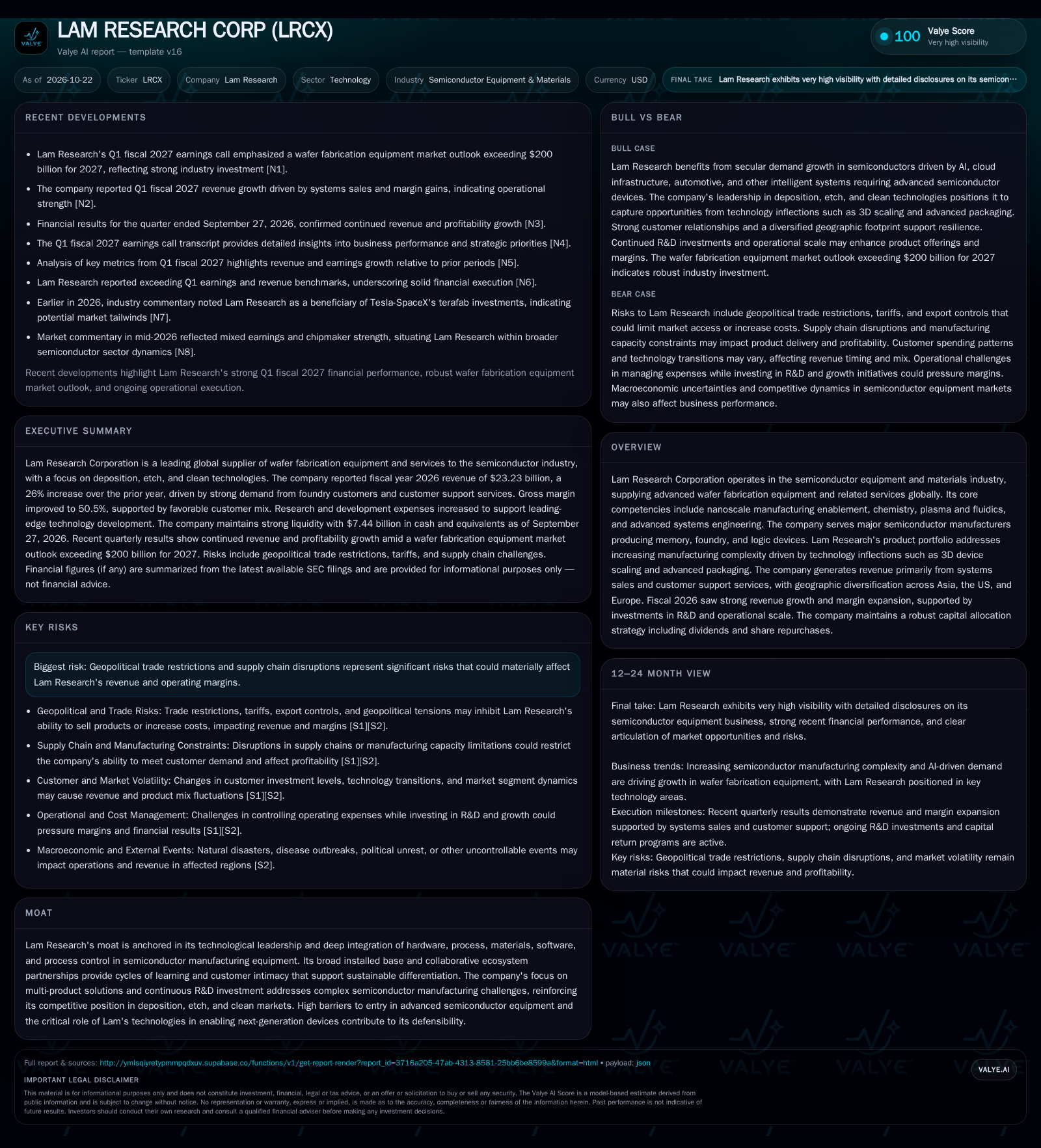
Lam Research reported fiscal 2026 revenue of $23.23 billion, a 26% increase over the prior year, with growth concentrated in foundry customers and customer support services [S1]. This surge reflects not just cyclical semiconductor demand, but also Lam’s positioning at critical technology inflections—namely, the transition to more complex, smaller-node devices and 3D architectures. Gross margin improved to 50.5%, up 180 basis points, driven by a favorable customer mix, even as tariffs imposed some cost drag [S1]. R&D expenses climbed 13.3% to $2.38 billion, underscoring the company’s commitment to staying ahead in process technology [S1]. As of September 27, 2026, Lam held $7.44 billion in cash and cash equivalents, with a current ratio of 2.48, indicating a strong, though not unassailable, liquidity position [S2]. The company’s Q1 fiscal 2027 results continued this trend, with $8.22 billion in revenue and net income of $2.75 billion [S2].
How Lam Converts Technology Complexity into Profits
Lam’s economics are fundamentally tied to the capital intensity and technological trajectory of its customers—semiconductor manufacturers investing in next-generation wafer fabrication. Revenue is a function of both new equipment sales (often lumpy and cyclical) and customer support services, the latter providing some recurring element as installed bases grow. The company’s reported 50.5% gross margin suggests meaningful pricing power and operating leverage, likely enhanced by a customer mix skewed toward advanced-node foundries and memory clients [S1]. As manufacturing complexity rises—think atomic-layer deposition, 3D NAND, and advanced etch processes—Lam’s ability to command premium pricing and attach higher-value service contracts may improve. However, this comes with escalating R&D and SG&A costs: R&D grew 13.3%, and SG&A 17.1% in 2026 [S1]. The business is capital-intensive but benefits from significant upfront customer investment, long product cycles, and high switching costs once equipment is installed. Still, margin durability will be tested as emerging competitors, technology shifts, and customer bargaining power evolve.
Technological Leadership Versus Geopolitical and Competitive Headwinds
Lam holds a defensible position in deposition, etch, and clean—three of the most technically demanding segments of wafer fabrication equipment. Its competitive moat is built not only on proprietary process technology, but also deep customer integration and a broad installed base, which together create cycles of learning and lock-in. However, the landscape is fiercely competitive, with global peers in Japan, Korea, and the US all vying for share in high-growth nodes and memory segments. The company’s geographic revenue mix—34% China, 22% Taiwan, 19% Korea—exposes it to region-specific risks, especially as trade restrictions and export controls target advanced semiconductor technologies [S1]. While Lam’s collaborative R&D approach and multi-product solutions enhance stickiness, the risk of customer vertical integration and the entry of new players using alternative process technologies (e.g., EUV, advanced packaging) cannot be discounted. Ultimately, Lam’s position will hinge on its ability to anticipate and respond to both customer technology roadmaps and shifting regulatory regimes.
If Semiconductor Capex Surges and Lam Stays Ahead in Process Innovation
The favorable scenario for Lam sees the wafer fab equipment market exceeding $200 billion in 2027, as leading-edge foundry and memory customers ramp capital expenditures to support AI, cloud, and automotive device demand [N1]. In this environment, Lam’s leadership in deposition, etch, and clean enables it to capture outsized share of new investments—particularly if technology transitions (like 3D NAND, gate-all-around FETs, or advanced packaging) require bespoke process solutions. Gross margin could further expand if the product mix continues to skew toward high-value, high-complexity tools and associated services. Evidence that would confirm this scenario includes sustained double-digit revenue growth, continued margin expansion, and rising service attachment rates. Conversely, a slowdown in customer capex, loss of share in major foundry accounts, or evidence of pricing erosion would challenge the upside thesis.
Cyclical Growth Moderates as R&D and Trade Risks Rise
The most plausible scenario is one of continued growth, but at a more measured pace as the industry digests recent investment cycles. Lam benefits from secular trends—AI, 5G, automotive electronics—but faces higher R&D intensity and cost headwinds. Gross margin remains strong but flattens as competitive pricing and tariff costs offset some mix benefits. Customer support services help dampen revenue volatility, but new system sales become more sensitive to macro and geopolitical shifts. Ongoing R&D investment is necessary to maintain technical leadership, but SG&A grows in tandem as global operations become more complex. Evidence supporting this scenario includes stable (rather than accelerating) revenue, gross margins holding near current levels, and steady—but not sharply rising—R&D outlays. Falsifying signals would include abrupt margin compression, major delays in product launches, or sudden customer deferrals.
Geopolitical Shocks or Supply Chain Disruptions Undermine Growth
In the adverse scenario, trade restrictions, export controls, or supply chain breakdowns materially impair Lam’s ability to deliver products to key markets—particularly China and Taiwan, which together account for over half of revenue [S1]. This could result in sharp revenue declines, margin compression due to underutilized capacity, and elevated inventory or working capital needs. Escalating tariffs or new export bans targeting advanced process technology would be especially damaging if Lam cannot quickly pivot to other regions or customer segments. Evidence confirming this scenario would include sudden drops in revenue from affected geographies, rising inventory balances, or management guidance highlighting order pushouts and cost absorption. Conversely, resilience in the face of external shocks, or rapid reallocation of capacity to less affected regions, would challenge the downside thesis.
Concrete Milestones That Will Shape Lam’s Thesis in 2027
Quarterly revenue by geography, especially China and Taiwan, to monitor the impact of trade policy and customer demand concentration.
Gross margin progression: further expansion would suggest sustained pricing power and favorable mix; compression could signal cost or competition pressures.
R&D expense trajectory versus revenue: a useful metric would be R&D as a percentage of sales to assess innovation investment discipline.
Customer support services as a share of total revenue, if disclosed, to gauge the durability of recurring revenue streams.
Order backlog and book-to-bill ratio, if available, as early signals of demand inflection or order volatility.
Updates on export controls, tariffs, or other regulatory changes affecting Lam’s ability to serve major Asian markets.
Major product launches or technology inflection points (e.g., adoption of new etch or deposition platforms) that could reset the competitive balance.
Management commentary on supply chain stability and cost management, especially in periods of global disruption.
Disclaimer: This is research-only, informational analysis and not investment advice. It may include AI-generated interpretation and general industry context. Always verify important details using primary sources.

Comments