
Rollins in 2026: Managing Cost Inflation, Demand Fluctuations, in Pest Control
Despite posting solid net income in Q3 2026, Rollins faces a convergence of weaker demand, rising costs, and reported liquidity position. The company’s ability to manage operational efficiency, adapt to evolving lead-generation trends, and address short-term financial constraints will shape its resilience and competitive stance.
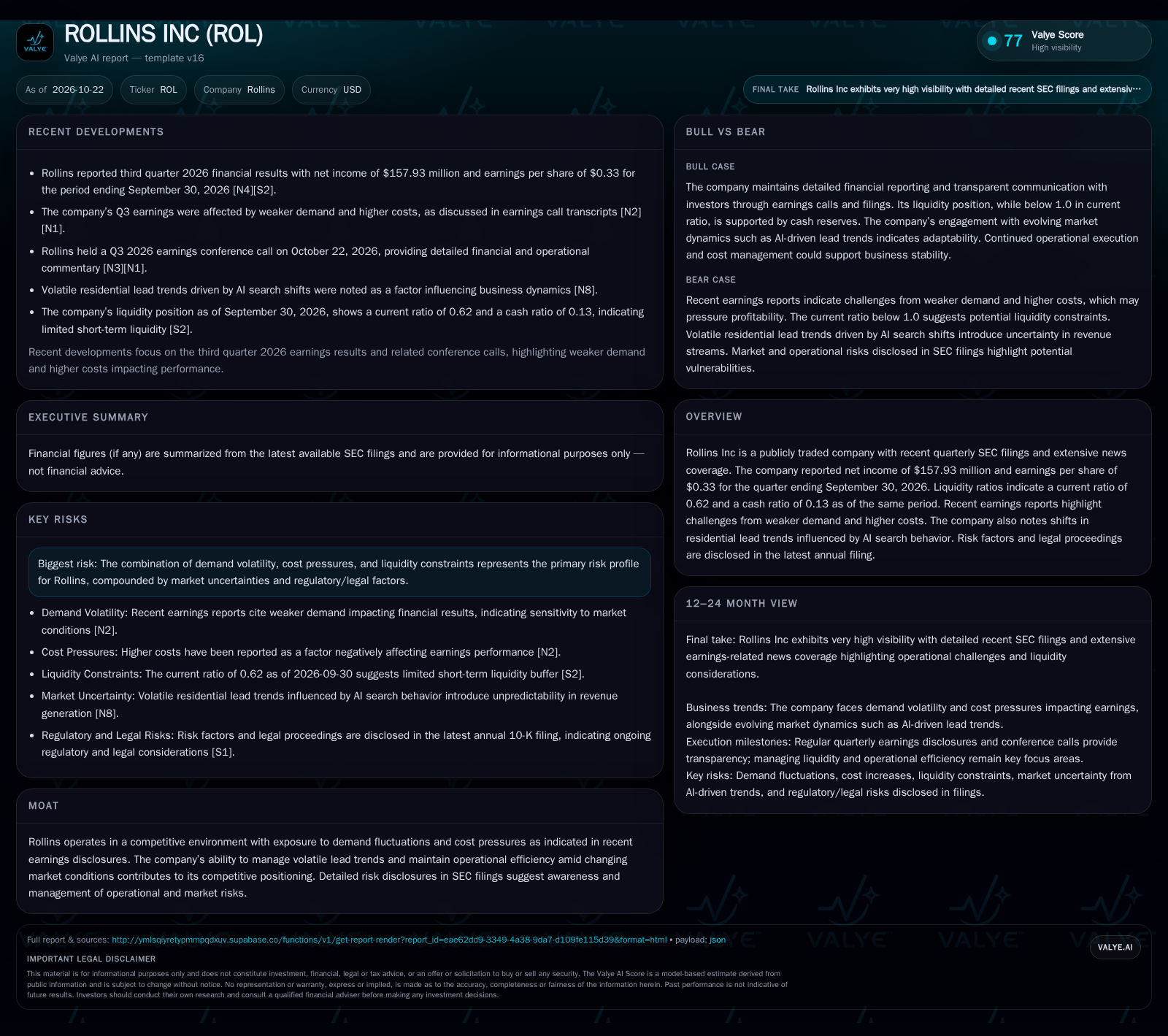
Rollins reported Q3 2026 net income of $157.93M, but faces weaker demand and higher costs. With a current ratio of 0.62 and a cash ratio of 0.13, its short-term liquidity is tight. The company’s challenge is to sustain profitability amid demand volatility and operational headwinds, while adapting to changing lead-generation dynamics and cost structures. Execution on cost management and maintaining customer relationships are pivotal for future stability. [S2] [N2]
Rollins Inc enters the final quarter of 2026 at a crossroads. Despite delivering a strong net income of $157.93 million in Q3, the company’s underlying performance is challenged by weaker demand and mounting cost pressures. As digital transformation and AI-driven shifts reshape how customers find pest control services, Rollins must simultaneously defend its operating margins and recalibrate its customer acquisition strategies. The coming quarters will test its adaptability and operational discipline as the competitive and macro landscape evolves. [S2] [N2]
Q3 2026 Overview: Profit Margins Under Pressure Amid Demand and Cash Flow Constraints
Rollins reported net income of $157.93 million and basic/diluted EPS of $0.33 for the quarter ending September 30, 2026 [S2]. While these headline earnings suggest ongoing profitability, the broader context is less benign. Management commentary and earnings coverage for Q3 highlight that results were pressured by weaker demand and higher costs, signaling that margin sustainability is under threat [N2] [N4].
Short-term liquidity is a notable concern: the company closed the quarter with cash and cash equivalents of $129.05 million against current liabilities of $986.64 million, yielding a current ratio of 0.62 and a cash ratio of 0.13 [S2]. This level of liquidity may limit Rollins’ flexibility to invest, absorb shocks, or weather further demand softening without near-term financing or working capital improvements.
Earnings calls also note shifts in residential lead trends, with AI-driven search behavior changing how potential customers discover pest control providers. This evolving dynamic could impact Rollins’ traditional customer acquisition channels and retention strategies going forward [N2] [N4].
Rollins’ Operating Model: Revenue Conversion, Leverage Points, and Risk Exposure
Rollins’ core business economics rest on recurring service revenues, typically from residential and commercial pest control contracts. The model historically benefits from high customer retention and recurring visits, which can provide revenue visibility and operating leverage—if volume and pricing are stable.
Pricing power is generally constrained by competitive intensity and customer price sensitivity, especially in commoditized service segments. While some upselling or premium services may carry higher margins, the bulk of revenues likely tracks industry norms. Volume is driven by new customer wins, retention, and periodic contract renewals, all of which are vulnerable to shifts in consumer search behavior and economic cycles.
Cost structure is a mix of fixed (route and technician labor, service fleet, support infrastructure) and variable (materials, fuel, seasonal labor) expenses. Rising labor and input costs, as cited in the Q3 2026 commentary, can compress margins if not offset by pricing or productivity gains. Operating leverage can work both ways: incremental revenue lifts margins when costs are stable, but demand softness or cost surges can rapidly erode profitability.
Capital needs are moderate for a service business, but short-term liquidity constraints—evident in the low current and cash ratios—could limit the company’s ability to finance growth, acquisitions, or respond to shocks without external funding [S2].
Technology Shifts and Competitive Dynamics in the Digital Lead Generation Battle
Rollins operates in a fragmented but competitive sector, facing a mix of national and regional pest control providers as well as local specialists. Barriers to entry at the service level are modest, though scale advantages can accrue through brand recognition, route density, purchasing power, and digital marketing sophistication.
A key emerging battleground is digital lead generation. The company’s own disclosures point to shifting residential lead trends driven by AI-powered search and recommendation platforms. If Rollins is slower than peers to adapt its digital marketing or optimize for new search paradigms, it could lose share of voice and lead flow to more agile competitors or digital-native entrants.
Substitution risk is relatively low for core pest control services, but switching costs for customers are also modest—making retention and seamless service experience critical. Regulatory and legal scrutiny, as detailed in the company’s filings, can impose compliance costs and reputational risks, but these factors generally affect the entire industry [S1] [S2].
Margin Improvement Potential Through Swift Digital Adoption and Cost Controls
The most favorable scenario for Rollins involves a combination of successful digital transformation and disciplined cost management. If the company quickly adapts its marketing and customer acquisition strategies to align with AI-driven search trends—capturing a disproportionate share of digital leads—top-line growth could resume even in a soft demand environment.
On the cost side, operational efficiency initiatives, route optimization, and technology-driven productivity gains could help offset labor and input cost inflation. If Rollins can pass on selective price increases or upsell higher-margin services without significant churn, margin expansion is feasible.
Evidence supporting this scenario would include improved new customer acquisition rates (particularly from digital channels), stabilization or growth in revenue per customer, and sequential margin improvement in future quarters. Management commentary highlighting successful adaptation to AI-driven customer behavior and tangible cost-control wins would further confirm this path.
Expected Path: Gradual Margin Compression and Revenue Recovery Efforts
The most plausible outcome is a period of margin compression and slow revenue stabilization. Rollins may make gradual improvements to its digital lead-generation capabilities but will likely face ongoing headwinds from softer demand and higher operating costs. Pricing actions could be constrained by competitive pressures, limiting the company’s ability to fully offset inflation.
Customer retention is expected to remain high, but new acquisition may lag historical norms until digital channel strategies are fully recalibrated. Liquidity constraints could force more conservative spending and limit opportunistic investments in technology or acquisitions.
Confirming this scenario would be continued profitability but with flat or modestly declining margins, subdued top-line growth, and management commentary focused on incremental progress rather than step-change improvements. Any evidence of working capital strain or increased reliance on short-term borrowing would reinforce this view.
Risks of Prolonged Demand Decline and Rising Costs Prompting Defensive Strategies
In a more adverse scenario, demand continues to soften—perhaps due to economic slowdown, further digital disruption, or loss of share to competitors more attuned to AI-driven search. If cost pressures persist, particularly in labor and materials, margins could contract sharply.
Liquidity tightness, if not addressed, could lead to delayed payments, reduced investment in customer acquisition, or even pressure on essential operations. If Rollins is unable to secure additional financing or rapidly adjust its cost base, it may be forced to consider asset sales, workforce reductions, or retrenchment in certain markets.
Evidence for this scenario would include a pronounced drop in revenue, negative operating cash flow, increases in accounts payable or borrowing, and management guidance indicating retrenchment or restructuring. Regulatory or legal setbacks, though not central to the thesis, could compound downside risks if they result in material settlements or operational restrictions.
Indicators of Rollins’ Ability to Sustain Margins and Strengthen Digital Footprint
Quarterly revenue and margin trends: Sequential improvement or further contraction in operating margins and top-line growth would clarify whether cost and demand pressures are abating or intensifying.
New customer acquisition rates: Particularly from digital and AI-driven lead sources, as these will show whether Rollins is capturing its share of evolving demand.
Customer retention and churn: A useful metric would be retention rates, as stable or improving retention would support the recurring revenue model.
Pricing actions and customer response: Evidence of successful price increases without material churn would indicate some pricing power and resilience.
Working capital movements: Changes in accounts receivable, payable, and inventory levels could flag emerging liquidity stress or improvement.
Management commentary on digital transformation: Updates on investments in digital marketing, AI-driven acquisition tools, or partnerships would help test the thesis.
Access to external financing: Any new credit facilities, debt refinancing, or equity raises would clarify Rollins’ ability to manage short-term liquidity constraints.
Disclaimer: This is research-only, informational analysis and not investment advice. It may include AI-generated interpretation and general industry context. Always verify important details using primary sources.

Comments