
Curbline Properties: Lease Risks, Inflation Pressures, and Acquisition Strategies in Convenience Retail
Curbline Properties Corp. operates at the intersection of convenience retail and real estate, with financial performance closely tied to tenant occupancy, lease renewals, and the evolving economics of brick-and-mortar retail. As the company balances acquisition-driven growth with sector headwinds from inflation and shifting consumer trends, the durability of its curbline-focused model faces critical tests in 2026 and beyond.
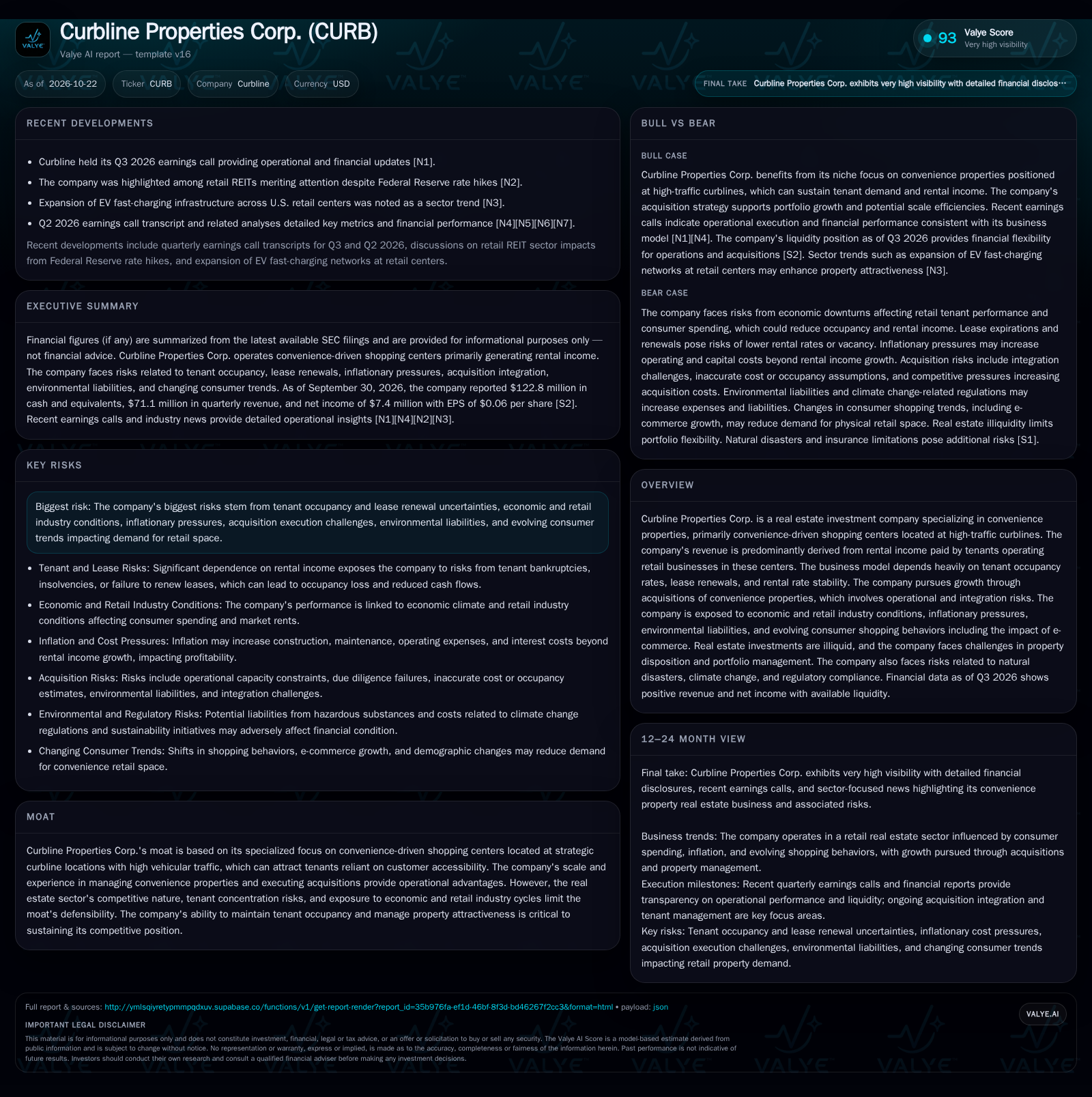
Curbline Properties’ Q3 2026 results show positive revenue and net income, but the company faces near-term lease expirations, inflation-driven cost pressures, and strategic risks from acquisition integration and evolving retail demand. The next year will likely hinge on tenant retention, the success of new property additions, and adaptation to consumer and regulatory shifts in convenience retail.
Curbline Properties Corp. stands at a complicated juncture for retail-focused real estate. Its core business—owning and managing convenience-driven shopping centers at high-traffic curblines—continues to generate solid rental income, as evidenced by Q3 2026 financials. Yet the company’s outlook is shaped less by past performance than by the interplay of lease expiration risk, inflationary cost escalation, and the uncertain payoff from its acquisition-led growth model. As retail tenants rethink physical footprints and inflation remains sticky, Curbline’s ability to maintain occupancy, integrate new assets, and adapt to changing consumer patterns will determine whether its specialized portfolio remains a source of durable cash flows or faces mounting headwinds.
2026 Outlook Shaped by Lease Expirations, Inflation, and Acquisition Activity
Curbline Properties reported Q3 2026 revenue of $71.1 million and net income of $7.4 million, maintaining positive operational momentum [S2]. The company reported cash and liquidity metrics for the period; these figures do not by themselves establish operating runway, investment capacity, financial flexibility, or financing capacity. However, approximately 10.1% of leased gross leasable area (GLA) is slated to expire in 2026, raising near-term risks around tenant retention and rental rate negotiation [S1]. Inflation continues to drive up construction, maintenance, and operating costs, pressuring margins if rental income fails to keep pace. The company’s strategy of acquiring additional convenience properties remains a growth lever but introduces operational risks, particularly related to integration and due diligence. These dynamics collectively frame Curbline’s risk/reward profile heading into 2027.
Occupancy Rates, Lease Conditions, and Expense Management Underpin Curbline’s Profitability
Curbline’s core economic engine is rental income from retail tenants—highly sensitive to occupancy rates, average rental rates, and the ability to renew or replace tenants without material downtime or concessions. Lease structures in this segment often provide for base rent plus escalators and, in some cases, reimbursement for certain operating expenses, but not always full pass-through of inflation-driven costs. Thus, profitability depends on maintaining high occupancy and negotiating favorable lease renewals, especially as a large tranche of leases approaches expiration.
Fixed costs—property taxes, insurance, and some maintenance—create operating leverage, amplifying the impact of both incremental revenue and lost occupancy. Variable costs (utilities, repairs, tenant improvements) may rise with inflation or new tenant fit-outs, and are not always fully recoverable. Acquisitions, while offering portfolio scale and potential rent roll growth, typically require upfront capital and can dilute near-term returns if integration lags or occupancy assumptions prove aggressive. Real estate’s illiquidity further limits the company’s ability to quickly rebalance the portfolio in response to sector shocks.
Capital needs are ongoing: maintaining assets, funding tenant improvements, and supporting acquisitive growth.
Curbline’s Niche Retail Focus: A Strategic Edge or Potential Vulnerability?
Curbline’s competitive position rests on its focus: convenience-driven retail properties at high-traffic intersections, which historically attract necessity-based tenants (e.g., quick-serve restaurants, pharmacies, convenience stores) with resilient customer demand. This specialization can enhance tenant demand and limit direct competition to other owners of similarly positioned assets.
However, the competitive moat is not absolute. Peer REITs, local real estate groups, and institutional investors also target convenience retail. Tenant concentration and limited bargaining power—especially with national tenants—can compress rent growth or increase renewal concessions. The broader shift toward e-commerce and changing consumer shopping habits threatens demand for some physical retail formats, though convenience locations may prove more defensible than traditional malls or big-box centers.
Emerging trends, such as the integration of EV fast-charging stations into retail centers, could support relevance and tenant traffic if adopted successfully. Still, these benefits are not guaranteed and may require additional capital investment without immediate rent uplift.
Environmental and regulatory risks also loom: older properties may face higher remediation costs or sustainability retrofits, while weather and climate-related events can disrupt operations and spike insurance costs.
Margin Growth Potential Linked to Tenant Retention and Acquisition Success
The most favorable outcome for Curbline would unfold if the company renews the bulk of 2026 lease expirations at stable or higher rents, preserving occupancy and limiting downtime. Successful integration of newly acquired properties—on time and on budget—could yield economies of scale, spreading fixed costs across a broader portfolio and enhancing bargaining power with vendors and tenants.
If inflation moderates or tenants accept higher common area maintenance (CAM) pass-throughs, cost pressures could ease, supporting margin recovery. Sector trends—such as the proliferation of EV charging stations or increased demand for convenience retail in suburban and exurban markets—could further boost tenant demand and rent growth.
Evidence supporting this scenario would include: renewal rates above historical averages, stable or rising same-property net operating income (NOI), acquisition cap rates exceeding weighted average cost of capital, and commentary on successful tenant mix upgrades or new revenue streams via property enhancements.
Expected Trends Include Modest Growth, Margin Challenges, and Targeted Risk Exposure
Absent a marked economic downturn or major integration misstep, Curbline may continue to deliver moderate revenue growth, with occupancy levels and rental rates largely stable but under modest pressure. Some lease expirations could result in short-term vacancies or concessions, but necessity-based tenants and location advantages should help fill most spaces within a reasonable timeframe.
Operating margins are likely to remain squeezed by persistent inflation in maintenance and insurance costs, only partially offset by contractual rent escalators. Acquisition activity continues, but with selective discipline and careful underwriting to avoid overpaying in a competitive environment. Environmental compliance and climate-related costs incrementally rise but do not materially disrupt operations.
Confirmation of this scenario would come from quarterly reports showing stable occupancy in the mid-90% range (if disclosed), modest same-property NOI growth, and acquisition yields in line with historical averages. Evidence against it would be a sharp drop in occupancy, outsized increases in expense ratios, or delays in integrating new assets.
Lease Turnover, Rising Costs, and Consumer Behavior Could Undermine Performance
The adverse scenario would materialize if Curbline struggles to renew a significant portion of expiring leases in 2026, resulting in elevated vacancies or the need to offer substantial rent concessions. If inflation accelerates further, operating and capital costs could rise faster than rental income, eroding margins and potentially forcing the company to defer maintenance, impairing long-term asset value.
Acquisition missteps—such as overpaying for properties based on aggressive rent or occupancy assumptions—could exacerbate financial stress, particularly if integration challenges delay expected returns. A cyclical downturn in retail, or an acceleration of consumer migration to e-commerce, could reduce tenant demand across the portfolio.
Evidence for this outcome would include a sustained drop in occupancy rates, rising accounts receivable from struggling tenants, negative same-property NOI trends, or management commentary on unexpected expense spikes or delays in backfilling vacancies.
Factors Influencing the Viability of Curbline’s Real Estate Strategy
Lease renewal rates and rental spreads on the 10.1% of GLA expiring in 2026—if disclosed—will be pivotal for revenue visibility.
Quarterly occupancy rates, particularly if they fall below historical averages, would signal stress in tenant demand.
Trends in same-property net operating income (NOI), if disclosed, would help isolate core performance from acquisition-driven growth.
Expense ratio trends—especially property-level operating expenses as a percentage of revenue—will indicate whether inflation is being offset.
Acquisition cap rates versus weighted average cost of capital (WACC), if disclosed, to assess the accretiveness of new deals.
Tenant concentration and exposure to at-risk categories (e.g., non-essential retail or single large tenants) would help gauge lease risk.
Capital expenditures and maintenance deferrals, if rising, could signal emerging stress or underinvestment.
Adoption and monetization of EV charging or other new property enhancements would help test the company’s ability to adapt to sector trends.
Disclaimer: This is research-only, informational analysis and not investment advice. It may include AI-generated interpretation and general industry context. Always verify important details using primary sources.

Comments