
Enova International: Technology-Driven Lending at Scale, with Securitization and Regulatory Complexity Shaping the Next Chapter
Enova International’s $1B+ quarterly revenue underscores the scale of its technology-driven consumer and small business lending model, but future trajectory hinges on credit performance, funding costs, and the evolving regulatory landscape.
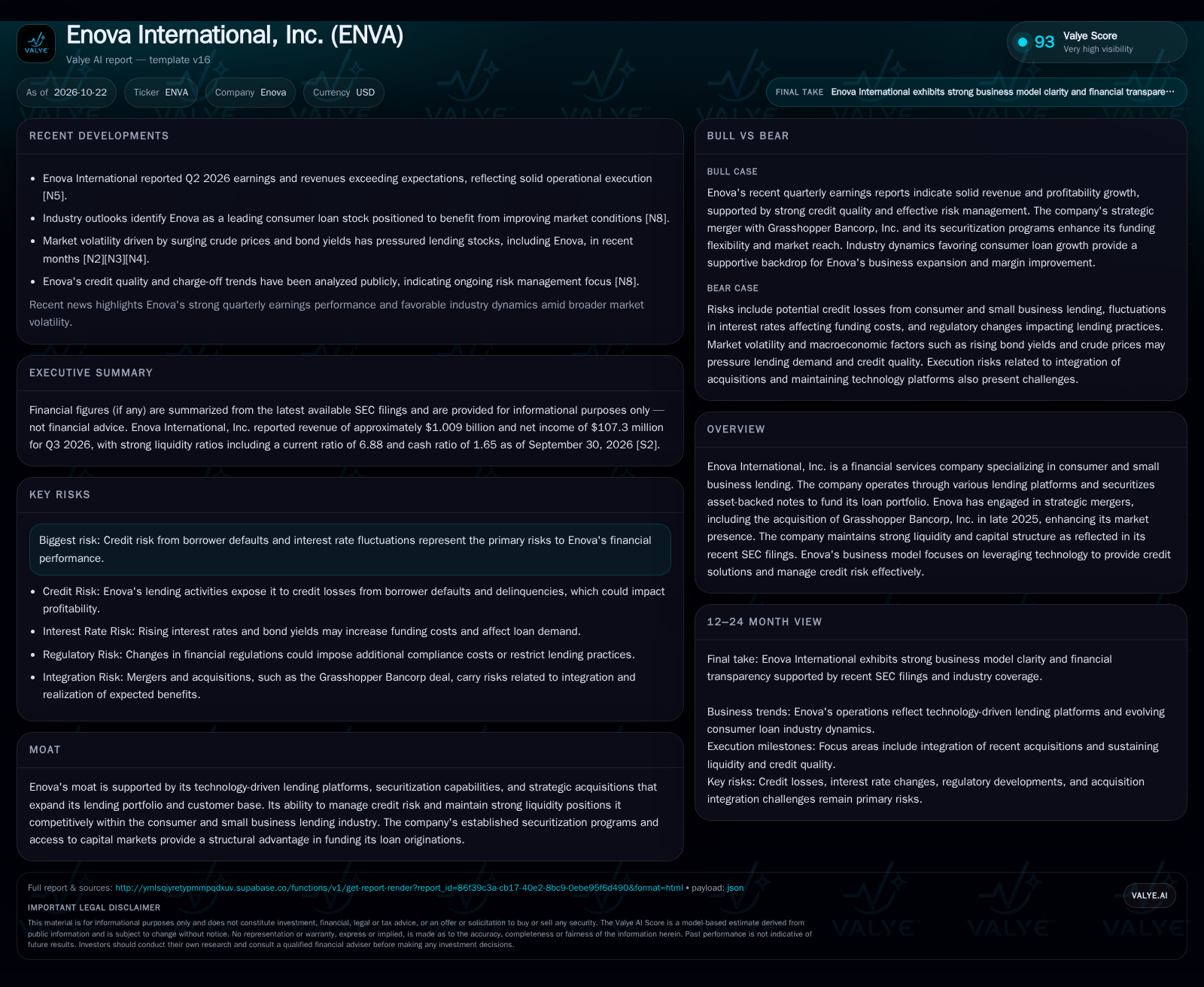
Enova International reported over $1 billion in Q3 2026 revenue and $107 million in net income, supported by reported liquidity position and a reported current ratio. The company leverages proprietary analytics and technology to originate and underwrite loans to consumers and small businesses underserved by traditional banks. Recent expansion includes a merger with Grasshopper Bancorp and ongoing securitization activity, but credit risk, funding cost pressures, and regulatory shifts remain central thesis variables. [S2] [S1]
Enova International, Inc. stands out in the digital lending space by combining proprietary analytics, a scaled online platform, and diversified funding through securitization. The company’s Q3 2026 results—over $1 billion in revenue and robust profitability—reflect the demand for alternative credit among consumers and small businesses underserved by traditional banks. But the company’s future growth and margin profile will be shaped by how well it manages credit losses through economic cycles, adapts to regulatory changes, and integrates recent acquisitions. The interplay between technology-driven underwriting and the cost of capital remains central to Enova’s competitive positioning and risk profile. [S2] [S1]
Recent Results Highlight Scale, Profitability, and Funding Flexibility
For the quarter ended September 30, 2026, Enova International reported revenue of approximately $1.009 billion and net income of $107.3 million, with diluted EPS at $4.06 [S2]. The company reported cash and liquidity metrics for the period; these figures do not by themselves establish operating runway, investment capacity, financial flexibility, or financing capacity.
Strategically, Enova executed a merger with Grasshopper Bancorp, Inc. in late 2025, expanding its product breadth and market access [S1]. The company continues to fund its loan portfolio through securitization of asset-backed notes, with multiple new indentures filed in 2025 and 2026 [S1].
Unit Economics and Funding Structure Drive Profitability and Risk
Enova’s business model hinges on originating and servicing unsecured or lightly collateralized loans to consumers and small businesses who often lack access to traditional bank credit. The company’s proprietary analytics—leveraging over 21 years of customer data and AI-driven underwriting—enable rapid credit decisioning and risk-based pricing [S2]. The core economics depend on net interest margin: the spread between loan yields (which can be high given the risk profile) and the cost of funding.
A critical mechanism is the company’s reliance on securitization, which allows Enova to match-fund loan originations with third-party capital and recycle balance sheet capacity. Securitization can lower the company’s cost of funding when markets are favorable, but exposes Enova to funding cost volatility if investor risk appetite shifts. Fixed operating costs—especially technology and compliance infrastructure—create the potential for operating leverage as volumes scale. However, the variable costs of loan losses and customer acquisition can swing sharply with credit cycles and competitive intensity.
Capital needs are ongoing, especially as Enova expands loan originations (over $7.2 billion in credit extended in the first nine months of 2026) and integrates new business lines from acquisitions [S2] [S1]. The ability to price loans appropriately for risk, manage acquisition costs, and maintain low funding spreads is central to sustaining attractive returns.
Technology and Data Depth Offer Edge, but Regulatory and Funding Dynamics Shape the Moat
Enova’s competitive positioning is defined by its early-mover status in online lending, proprietary data assets, and advanced analytics. The company’s ability to underwrite subprime or near-prime borrowers—drawing on 95 terabytes of behavioral and transactional data—may give it an underwriting edge versus traditional banks and newer fintech entrants [S2]. Speed, convenience, and digital access are core customer incentives, particularly for borrowers who value fast credit decisions and funding.
However, the company competes in a crowded field that includes other digital lenders, specialized non-bank lenders, community banks, and credit card issuers. Barriers to entry are moderate: while technology and data scale matter, capital is fluid and regulatory requirements are stringent. Securitization capacity and access to capital markets provide a funding advantage, but could be eroded if credit markets tighten or if regulatory scrutiny increases.
Regulatory risk is a persistent counterforce. Changes in state or federal lending laws, rate caps, or enforcement priorities could materially alter the economics or even the viability of certain products. The company’s ability to navigate these shifts, maintain compliance, and adjust product structures is a core determinant of its long-term moat.
If Credit Quality Holds and Funding Remains Stable, Earnings Leverage Could Accelerate
A favorable scenario would see Enova maintaining strong credit performance across its portfolio, with net charge-offs and delinquencies remaining below historical averages even as loan originations grow. If macroeconomic conditions remain benign and the company’s analytics continue to effectively price and manage risk, loss rates could stay controlled.
In this environment, stable or declining funding costs—supported by robust securitization demand—would allow Enova to expand net interest margins. The successful integration of Grasshopper Bancorp could unlock additional product cross-sell and customer acquisition synergies, broadening the addressable market.
Evidence supporting this scenario would include continued positive earnings surprises, stable or improving asset quality metrics (if disclosed), low funding cost spreads in securitization, and visible synergies or revenue growth from the Grasshopper acquisition. Confirmation could also come from sustained or improving return on equity and operating margin expansion.
Most Likely: Growth Moderates as Credit and Funding Headwinds Emerge
The most plausible trajectory is one where Enova continues to grow loan originations and revenue, but faces a gradual normalization in credit quality as economic growth slows or consumer stress rises. Funding costs may drift higher if interest rates rise or investor appetite for asset-backed securities wanes, putting some pressure on net interest margins.
The company’s technology and underwriting analytics may mitigate the worst of credit losses, but some increase in delinquencies and charge-offs is likely. Integration of Grasshopper Bancorp delivers incremental market access and product breadth, but also adds complexity and cost. Regulatory scrutiny remains elevated, requiring ongoing compliance investment and possible product modifications.
Evidence for this scenario would be stable but not accelerating revenue and earnings, gradual increases in provision for loan losses, and modest compression in net interest margins. Disclosures of integration costs, regulatory compliance investments, or funding spread increases would further support the base case outlook.
Credit Deterioration or Regulatory Intervention Could Disrupt the Model
A negative scenario emerges if consumer or small business credit quality deteriorates sharply—due to economic downturn, rising unemployment, or sector-specific stress—leading to elevated charge-offs and loss provisions. This would directly erode profitability and could trigger tighter lending standards, reducing loan growth.
A second risk vector is a spike in funding costs or a disruption in securitization markets, which could squeeze net interest margins or even constrain Enova’s ability to fund new originations. Regulatory intervention—such as new rate caps, lending restrictions, or adverse legal rulings—could force product withdrawals, increase compliance costs, or limit market access.
Evidence for this downside would include a material spike in delinquency and charge-off rates (if disclosed), sharp increases in provision expenses, widening funding spreads in securitization deals, or public regulatory actions affecting Enova’s products or business model. Integration setbacks or unanticipated costs from the Grasshopper deal would further pressure the downside case.
Concrete Metrics and External Factors That Will Shape Enova’s Thesis
Net charge-off and delinquency rates across the consumer and small business loan portfolio, if disclosed, would clarify credit risk trajectory.
Funding cost spreads on recent and future securitization transactions would help gauge capital market access and margin pressure.
Revenue and profitability trends in newly acquired units, particularly post-Grasshopper integration, would illuminate synergy realization and execution risk.
Any new or proposed regulatory actions or legal proceedings impacting lending products, underwriting practices, or rate structures could materially alter the outlook.
Customer acquisition cost (CAC) trends and marketing efficiency, if disclosed, would clarify competitive intensity and scalability.
Provision for loan losses as a percentage of originations would indicate management’s view on forward credit risk.
Disclosures about technology platform investments or AI/analytics enhancements would help test the durability of Enova’s underwriting edge.
Disclaimer: This is research-only, informational analysis and not investment advice. It may include AI-generated interpretation and general industry context. Always verify important details using primary sources.

Comments