
Vita Coco’s Category Leadership, Asset-Light Model, and the Tug-of-War Between Scale and Supply Chain Risk
Vita Coco Company, Inc. holds dominant market share in coconut water across its core regions, leverages an asset-light supply chain, and maintains profitability—but faces persistent risks tied to demand concentration, sourcing volatility, and the challenge of broadening its portfolio beyond coconut-based beverages.
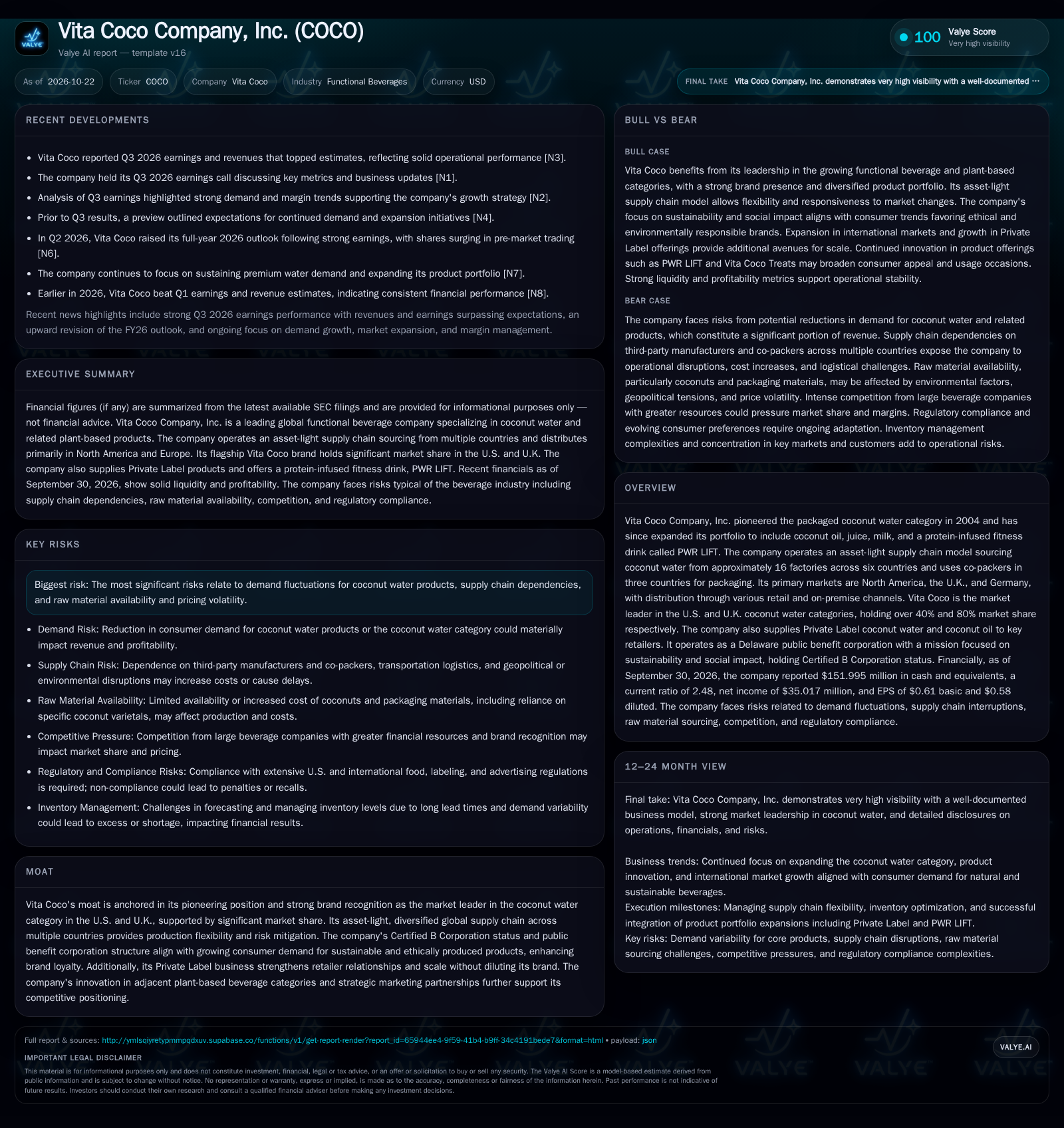
Vita Coco’s latest results show continued category strength and profitability, with its flagship coconut water accounting for a large majority of revenues and commanding over 40% U.S. market share. An asset-light supply chain and Private Label business enhance scale and flexibility. However, the company faces notable risks from supply chain dependencies, raw material sourcing volatility, and potential demand shifts in core products. Expansion efforts—including PWR LIFT and international growth—are key levers, but execution will be tested by evolving consumer preferences and intensifying competition from large beverage conglomerates. [S1] [S2] [N1] [N2] [N3]
Vita Coco Company, Inc. stands as the preeminent brand in the packaged coconut water category, boasting dominant market shares in both the U.S. and U.K. Its asset-light, globally distributed supply chain and balanced portfolio—including Private Label and newer fitness offerings—have underpinned recent profitability and operational flexibility. Yet, the company’s fortunes remain tightly linked to the coconut water category, exposing it to supply chain shocks, raw material price swings, and shifting consumer preferences. As Vita Coco pursues international growth and product innovation, the key question is whether its scale and brand equity can offset intensifying competition and the inherent volatility of its supply base. [S1] [S2] [N1] [N3]
Recent Results Underscore Category Dominance and Exposure
Vita Coco reported Q3 2026 earnings and revenues that exceeded analyst expectations, continuing a string of quarterly outperformance and prompting a raised FY26 outlook earlier in the year. As of September 30, 2026, the company had $151.995 million in cash and equivalents, a current ratio of 2.48, and net income of $35.017 million. The flagship Vita Coco coconut water brand contributed approximately 73% of quarterly revenue, reflecting both the strength and the concentration of the business. The company’s U.S. and U.K. market share—over 40% and 80%, respectively—cements its leadership in core geographies. However, this concentration heightens exposure to category-specific demand trends and supply chain disruptions. [S2] [N1] [N3]
How Vita Coco Converts Brand and Scale into Profits—and Where Margins Are Vulnerable
Vita Coco’s asset-light supply chain model allows it to scale production without heavy investment in owned manufacturing infrastructure, sourcing coconut water from 16 factories across six countries and using co-packers for packaging in three countries. This structure reduces fixed costs and capital intensity, offering flexibility to respond to demand fluctuations and geographic shifts. Variable costs, however, are highly sensitive to raw coconut prices, shipping, and packaging costs. The Private Label business leverages the same supply chain, enhancing purchasing power and production efficiency without diluting the core brand, but likely at lower margins than branded products.
With the flagship coconut water representing 73% of sales, the company’s gross margin profile is tightly linked to coconut input costs and global logistics trends. The PWR LIFT fitness drink—targeted at the protein and recovery market—could improve product mix and margin if retail distribution scales, but its impact remains limited relative to the flagship. Inventory management is a persistent challenge due to long lead times and the perishability of coconut products, requiring tight alignment between procurement, production, and sales forecasts. While operating leverage is possible through volume growth and international expansion, any supply chain or demand shock can quickly erode margin gains.
Market Leadership, Brand Equity, and the Shadow of Beverage Giants
Vita Coco’s competitive advantage stems from its first-mover status, strong brand recognition, and a dominant share of the coconut water market in the U.S. and U.K. The company’s Certified B Corporation and public benefit corporation status align it with consumer trends around sustainability, providing differentiation in a crowded functional beverage landscape. Its asset-light supply chain offers flexibility but is not unique—large beverage conglomerates can replicate or acquire similar capabilities.
Competitive threats are intensifying, especially from global beverage companies with deeper distribution networks, broader portfolios, and greater marketing resources. These players can erode Vita Coco’s share through pricing, innovation, or bundling coconut water with other beverage offerings. Substitutes such as flavored waters, plant-based alternatives, and electrolyte drinks target similar health-conscious consumers. While Vita Coco’s Private Label business strengthens retailer relationships, it also risks commoditizing the core coconut water value proposition if not carefully managed.
Expanding the Functional Beverage Playbook—If Innovation Sticks and Supply Holds
A favorable outcome for Vita Coco hinges on several reinforcing dynamics: continued expansion of the coconut water category, successful scaling of new offerings like PWR LIFT, and deepening penetration in international markets. If consumer interest in plant-based, sustainable beverages accelerates, Vita Coco could maintain or grow its market share while benefiting from premium pricing. The asset-light model would amplify operating leverage as volumes rise, enhancing margins and cash generation.
Evidence that would confirm this scenario includes sustained double-digit revenue growth in non-core products (e.g., PWR LIFT), increasing international sales mix, and stable or expanding gross margins despite input cost volatility. Retailer adoption of Private Label offerings without cannibalizing flagship brand sales would further validate the scale advantage. Conversely, this scenario would be challenged if new products fail to gain meaningful traction or if raw material costs outpace pricing power.
Sustaining Profitable Leadership Amid Supply and Demand Volatility
The most plausible path for Vita Coco is one of continued category leadership with moderate growth, punctuated by periodic supply chain and input cost disruptions. The company is likely to sustain its dominant share in the U.S. and U.K. coconut water markets, with incremental gains from Private Label expansion and selective international push. Profitability remains positive, but gross margins fluctuate in line with coconut prices and logistics costs.
This scenario is confirmed by stable or gradually increasing market share and steady net income, even as the product mix evolves. Evidence against this path would include a sharp drop in flagship product sales, persistent supply chain bottlenecks, or a material decline in gross margin due to rising input costs or intensified competition.
What Happens If Demand Falters or Supply Shocks Hit Hard?
Vita Coco’s risks are acute if demand for coconut water softens—whether due to shifting consumer preferences, category fatigue, or aggressive moves by competitors. Given that 73% of revenue is tied to the flagship product, any sustained volume decline would have disproportionate impact on financials. Simultaneous supply chain disruptions—such as shortages of coconuts, shipping delays, or geopolitical events in sourcing regions—could drive cost spikes or inventory shortages, squeezing margins.
Confirmation of this adverse scenario would include declining coconut water sales, shrinking market share in core regions, rising inventory write-offs, and margin compression from raw material or freight inflation. Early warning signs would be negative revisions to revenue or margin guidance, or increased reliance on promotional activity to move inventory.
Milestones and Metrics to Test the Durability of Vita Coco’s Growth Thesis
Trends in flagship Vita Coco coconut water sales volumes and market share in the U.S. and U.K.—a decline would challenge the core thesis.
Gross margin evolution quarter-over-quarter, particularly in relation to coconut input cost movements and logistics expenses.
PWR LIFT’s sales trajectory, retail penetration, and share of total revenue as a barometer for successful product diversification.
International revenue mix and growth rates, especially in Germany and emerging markets, as evidence of geographic expansion.
Performance and margin contribution of Private Label business versus branded products.
Inventory days and write-offs as indicators of supply chain and demand forecasting effectiveness.
Frequency and impact of supply chain disruptions—such as raw material shortages, shipping delays, or geopolitical events in sourcing regions.
Competitive activity: new launches or price moves by large beverage companies in the coconut water or adjacent plant-based beverage categories.
Disclaimer: This is research-only, informational analysis and not investment advice. It may include AI-generated interpretation and general industry context. Always verify important details using primary sources.

Comments