
Southwest Airlines in 2026: Product Differentiation, Yield Expansion, and the Challenge of Rising Costs
Southwest Airlines enters late 2026 with record revenue, a new suite of product upgrades, and the introduction of ancillary fees—but faces a cost structure increasingly exposed to fuel volatility and a liquidity profile that demands careful execution of its modernization and partnership initiatives.
Southwest Airlines reported a record $8.4 billion in Q3 2026 revenue, driven by higher fares, new ancillary offerings, and product enhancements. Fuel costs and labor expenses surged, pushing operating expenses up 16.3% year-over-year. The company is betting on product upgrades, international partnerships, and loyalty program enhancements to sustain yield and engagement, while the rollout of the 737 MAX 7 and new lounge network represent critical execution tests for 2027. The strategic question is whether these initiatives deliver enough margin expansion to offset structurally higher input costs.
Southwest Airlines is undergoing its most significant product and commercial transformation in decades, layering legacy low-cost DNA with premium-like upgrades and a growing portfolio of ancillary revenue streams. The airline’s Q3 2026 results capture this transition: record revenues driven by higher fares and new paid options, but also sharply higher costs, especially from fuel and labor. As Southwest rolls out airport lounges, upgrades its loyalty program, and seeks to modernize its fleet, the company is betting on differentiation and customer monetization to protect margins. The central uncertainty is whether these moves can create enough incremental value to outpace a structurally rising cost base and heightened competitive pressure.
Record Revenue Meets Surging Costs: The 2026 Operating Landscape
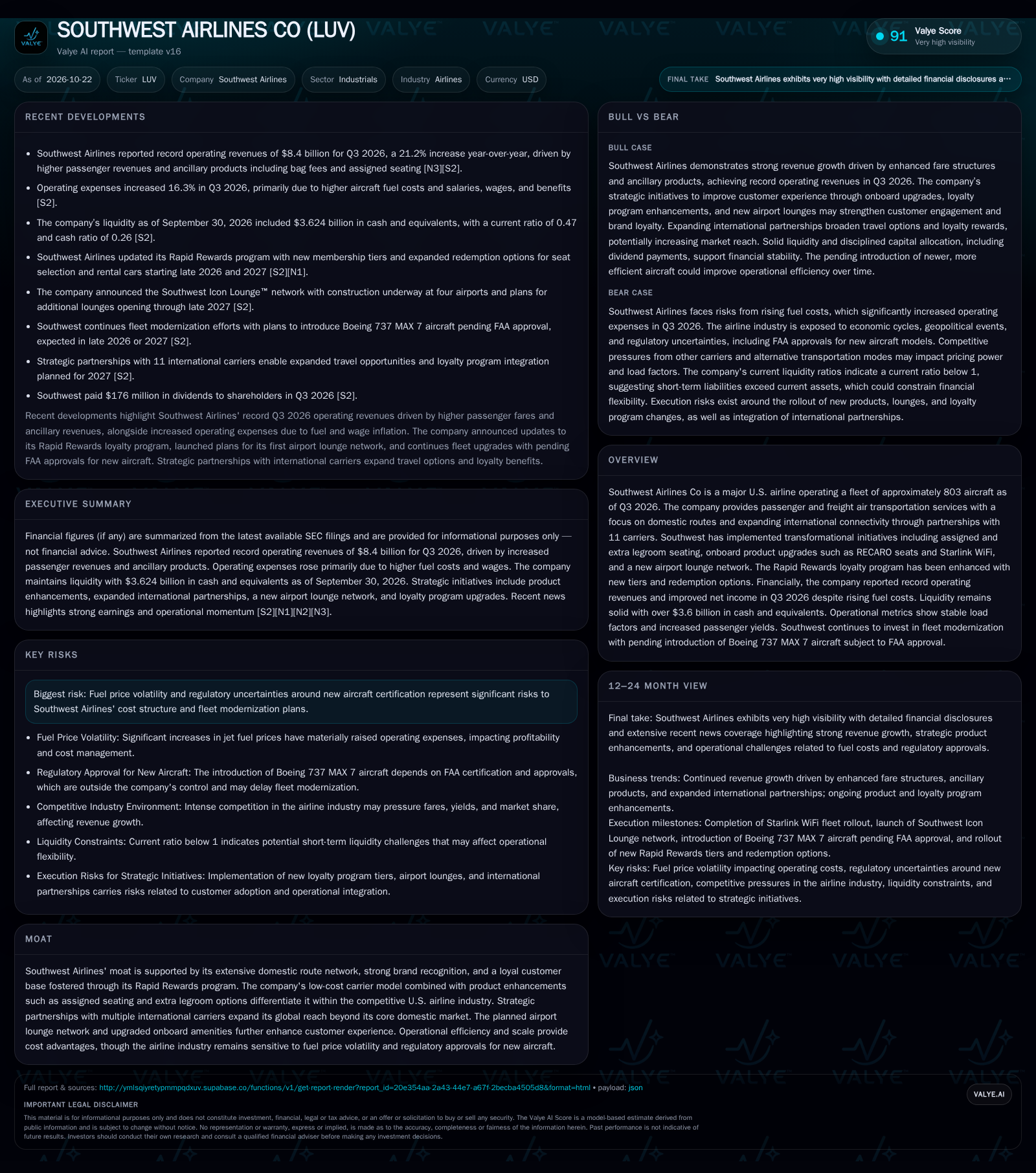
Southwest Airlines reported Q3 2026 GAAP net income of $270 million and diluted EPS of $0.55, with operating revenues reaching an all-time high of $8.4 billion—a 21.2% year-over-year increase. This growth was driven by a 22.8% rise in passenger revenue, enabled by fare hikes and the introduction of new ancillary products including bag fees and extra legroom/assigned seating. However, operating expenses climbed 16.3% year-over-year, fueled by a 61.7% jump in aircraft fuel and related taxes and increased labor costs. The company’s liquidity position stood at $3.624 billion in cash and equivalents as of September 30, 2026, with a current ratio of 0.47 and a cash ratio of 0.26 [S2]. These facts highlight a business at the intersection of strong topline momentum and sharply rising input costs, setting the stage for a critical period of execution.
How Southwest’s Revenue Model Is Evolving—and the Margin Levers That Matter
Historically, Southwest’s business model has centered on high aircraft utilization, rapid turnarounds, and a focus on point-to-point domestic routes with a single aircraft type. This has allowed for cost discipline, operational simplicity, and price-sensitive mass-market appeal. In 2026, however, Southwest is deliberately shifting its revenue model by layering ancillary products—such as bag fees, assigned and extra legroom seating—onto its traditional fare structure. These offerings allow for price discrimination and yield management, extracting more revenue from travelers willing to pay for optional premium experiences while preserving a value proposition for core customers.
The introduction of airport lounges, upgraded seating (RECARO seats, in-seat power), and enhanced WiFi (Starlink) suggests a bet on capturing higher-yield business and loyalty-driven travelers. If successful, these changes could raise average revenue per passenger and improve revenue quality, potentially offsetting some margin pressure from volatile fuel and labor costs. However, these upgrades also bring new fixed and variable costs—lounge operations, premium seating inventory, and technology investments—which could pressure margins if uptake is below expectations.
Operating leverage remains a double-edged sword. Rising load factors and fare hikes amplify profit in strong demand environments, but cost spikes (especially in fuel, which rose 61.7% YoY in Q3 2026) can rapidly erode profitability. Capital needs are also rising: Southwest continues to invest in its fleet (pending 737 MAX 7 introduction) and product, requiring discipline in balancing modernization against liquidity constraints.
Premiumization and Partnerships: Southwest’s Bid to Redefine Its Moat
Southwest’s traditional competitive edge has been rooted in low-cost operations, a simple fare structure, and a strong brand associated with customer-friendly policies. The new wave of product enhancements and international partnerships marks a pivot toward hybridization: retaining low-cost DNA while adding premium features that have historically differentiated legacy network carriers.
The rapid expansion of ancillary offerings puts Southwest in closer competitive alignment with major U.S. airlines that have long monetized seat selection, baggage, and premium seating. The planned Icon Lounge network and integration with international carriers (11 partnerships announced) aim to extend Southwest’s relevance to frequent flyers and global travelers—segments that are lucrative but fiercely contested.
However, these moves also expose Southwest to new counterforces. The introduction of fees may risk alienating price-sensitive loyalists. Larger rivals can match amenities and have deeper international networks. Ultra-low-cost carriers (ULCCs) remain aggressive on base fares, and alternative modes (high-speed rail, regional buses) are expanding in select corridors. Southwest’s ability to maintain a differentiated value proposition—balancing cost, experience, and network reach—will determine whether these changes reinforce or dilute its moat.
Yield Expansion Outpaces Cost Inflation: The High-Value Traveler Thesis
The most bullish scenario for Southwest is that its suite of upgrades—assigned seating, lounges, enhanced WiFi, and revamped loyalty tiers—successfully attracts higher-yield travelers, boosts ancillary revenue per passenger, and increases wallet share from both leisure and business segments. If the international partnerships drive meaningful cross-bookings and loyalty program integration delivers measurable retention gains, Southwest could see sustained double-digit revenue growth and margin expansion even if fuel remains elevated.
Confirmation would come from continued growth in average fare, rising ancillary revenue as a percentage of total ticket sales, and expanding Rapid Rewards membership and redemption rates. If disclosed, a meaningful uptick in business traveler mix, higher utilization of Icon Lounges, and positive unit revenue (PRASM) trends would further validate the thesis. Market share gains in key business and international gateway markets would also support the upside case.
This scenario is more plausible if airline capacity remains rational, macroeconomic conditions stay supportive, and Southwest executes product rollouts without major service disruptions.
Incremental Gains, Margin Pressure: Product Upgrades Meet Real-World Constraints
The most likely path is a blend of incremental revenue gains from new products and partnerships, partially offset by persistent cost inflation and competitive catch-up. Southwest is likely to see continued improvement in average fares and some ancillary revenue growth, but operating margins may remain under pressure as fuel and labor costs remain structurally higher and capital spending on product/fleet upgrades continues.
Load factors and passenger numbers may stay roughly stable, with modest shifts in segment mix as premium features attract some new business but also risk some churn among price-sensitive travelers. The rollout of the 737 MAX 7 and Icon Lounges may slip into 2027, and the integration of international partnerships could be gradual, limiting near-term revenue impact.
Evidence for this scenario would include steady but not accelerating passenger yields, stable or marginally improving profitability, and successful but measured uptake of new offerings.
Cost Shocks and Execution Stumbles: When Transformation Bites Back
The downside scenario materializes if Southwest faces a combination of sustained fuel price spikes, wage pressures, and operational disruptions—potentially exacerbated by delays in 737 MAX 7 certification or slow uptake of new product offerings. In this case, the fixed costs of lounges, premium seating, and technology upgrades may outpace incremental revenue gains, leading to margin erosion or even operating losses.
If competitive responses force fare rollbacks or if legacy customer loyalty erodes due to new fees, Southwest could see declining load factors and softening yields. Regulatory setbacks (such as FAA delays) or execution missteps in loyalty program integration and international partnerships would compound the risk.
Evidence confirming this scenario would include declining or stagnant revenue per available seat mile (RASM), persistent negative free cash flow, worsening liquidity ratios, or market share losses to both legacy majors and ULCCs. A spike in customer complaints or negative sentiment around product changes would further validate the bear case.
Benchmarks for Southwest’s Product-Led Transformation and Margin Defense
Monthly and quarterly trends in average passenger fare and ancillary revenue per passenger—key indicators of customer willingness to pay for new products and fare structures, if disclosed.
Load factor and revenue passenger miles versus prior-year periods, providing insight into demand elasticity as fare and fee structures evolve.
Unit revenue (PRASM/RASM) and unit cost (CASM, especially ex-fuel), to monitor whether yield expansion is keeping pace with rising costs.
Progress on 737 MAX 7 certification and first deliveries, as delays would impact both cost efficiency and network flexibility.
Icon Lounge utilization rates and customer satisfaction metrics, if available, to gauge the value of premiumization efforts.
Rapid Rewards membership growth, engagement, and redemption patterns following program enhancements.
Execution milestones for international partnership integration, including cross-booking volumes and loyalty program interoperability, which would help validate the global expansion thesis.
Disclaimer: This is research-only, informational analysis and not investment advice. It may include AI-generated interpretation and general industry context. Always verify important details using primary sources.

Comments