
Bloom Energy in 2026: Profitability Inflection, Capital Structure, and the Push for Scalable Green Solutions
Bloom Energy’s recent swing to profitability and reported liquidity position mark a turning point for the company as it scales its clean energy platform. With a business model spanning product sales, installations, managed services, and electricity sales, Bloom faces key questions about the durability of margins, the path to recurring revenue, and its ability to maintain an innovation edge amid capital-intensive competition.
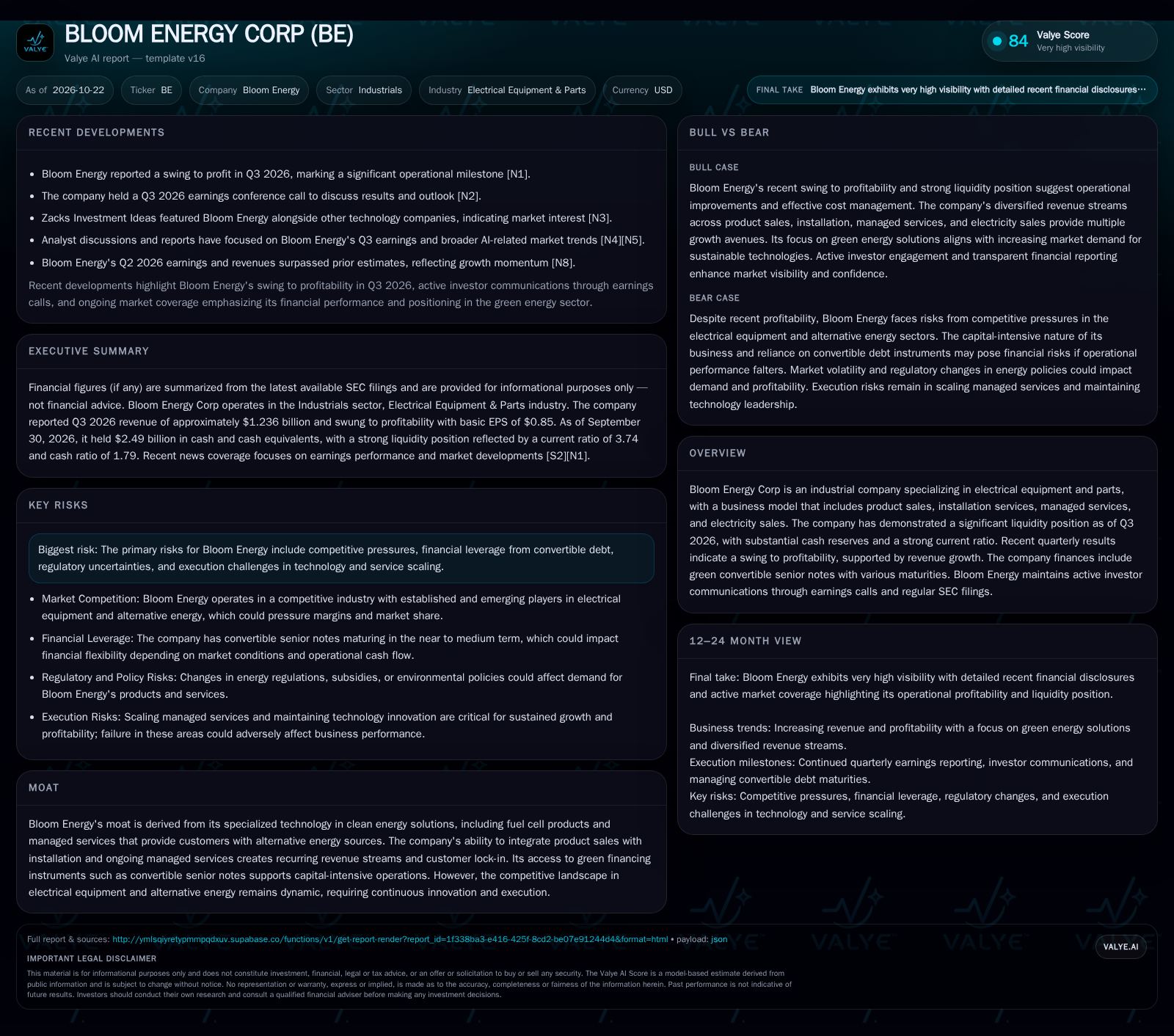
Bloom Energy reported Q3 2026 revenue of $1.236 billion and achieved its first profitable quarter, underpinned by a reported cash position and a diversified business model. The company’s challenge now shifts to sustaining profitability, managing upcoming convertible debt maturities, and defending its position in a dynamic green energy market [S2] [N1].
Bloom Energy’s Q3 2026 results mark a pivotal operational milestone, as the company swung to profitability after years of investment-heavy growth. With $1.236 billion in quarterly revenue and $2.49 billion in cash, Bloom now commands the financial resources to pursue its multi-pronged clean energy strategy. Yet, as it faces a maturing convertible debt stack and intensifying competition in the alternative energy sector, the real test lies in sustaining margins, scaling service-based revenue, and proving out the economics of its technology platform in a market defined by rapid innovation and regulatory flux.
Profitability and Liquidity Define the 2026 Pivot
Bloom Energy reported revenue of $1.236 billion for the quarter ended September 30, 2026, and delivered a swing to profitability with basic EPS of $0.85 and diluted EPS of $0.78 [S2] [N1]. This inflection point follows a period of significant investment and signals that the company’s cost structure and revenue base have reached sufficient scale to generate positive earnings. The company reported cash and liquidity metrics for the period; these figures do not by themselves establish operating runway, investment capacity, financial flexibility, or financing capacity. [S2] The company’s balance sheet includes green convertible senior notes maturing in 2025, 2028, and 2029, which will demand attention as maturities approach [S2]. The business model is diversified across product sales, installation, managed services, and electricity sales, providing multiple levers for growth and margin improvement [S2].
How Bloom’s Multi-Segment Model Could Scale Returns
Bloom Energy’s revenue streams span upfront product sales (fuel cell systems), installation services, recurring managed services, and electricity sales. This mix allows for both transactional and recurring revenue, but the margin profile and cash flow dynamics depend heavily on the relative contribution of each segment. Product sales and installations are typically capital-intensive and may generate lower margins due to hardware costs and competitive pricing. Managed services and electricity sales, if structured as long-term contracts with customers, could drive more predictable, higher-margin recurring revenue, but require substantial installed base and service infrastructure.
Operating leverage is plausible as the company’s installed base grows—incremental managed service contracts and electricity sales could carry higher margins once fixed costs for R&D, service infrastructure, and platform integration are absorbed. However, the capital needs remain significant, particularly for financing customer deployments and maintaining technology leadership. The presence of convertible senior notes suggests Bloom has used debt to fund growth, which can amplify returns if profitability is sustained, but increases refinancing and interest-rate risk if cash flows falter.
Innovation, Integration, and the Realities of a Crowded Green Energy Market
Bloom competes in a crowded landscape of industrial electrical equipment providers and alternative energy innovators—ranging from established conglomerates to pure-play fuel cell and distributed energy startups. Its core advantage may stem from proprietary fuel cell technology and the ability to offer integrated solutions (product + installation + managed service), creating potential customer lock-in and switching frictions. However, this moat is not absolute: rapid technology advances, price competition, and the entry of larger, better-capitalized players could compress margins and erode differentiation.
Moreover, substitutes such as solar, battery storage, and traditional grid solutions may limit pricing power, especially for cost-sensitive or risk-averse customers. Regulatory support for green energy is a tailwind, but policy volatility or shifts in subsidy structures could quickly change the demand landscape. To defend and extend its position, Bloom will need to maintain technical superiority, lower total cost of ownership for customers, and demonstrate tangible economic value from its managed services.
Recurring Revenue and Margin Expansion Through Service Scale
If Bloom Energy successfully shifts its revenue mix toward managed services and electricity sales—supported by a growing installed base of fuel cell systems—the company could achieve a more stable, higher-margin earnings profile. This scenario depends on winning multi-year service contracts, demonstrating high customer retention, and leveraging data or platform integration to create further lock-in. The conversion of initial product deployments into long-term service relationships would reduce revenue cyclicality and improve cash flow visibility.
Confirmation of this scenario would come from disclosures showing a rising proportion of revenue from managed services and electricity sales, expansion in gross margin, and evidence of contract renewals or multi-year backlog growth. If disclosed, a declining customer churn rate and increasing average revenue per installed system would also support the thesis. Falsification would occur if service revenue stagnates, gross margins compress, or if customer adoption of managed services lags behind initial product sales.
Sustained Profitability, but Margin Pressure and Capital Demands Persist
The most plausible trajectory is that Bloom Energy maintains profitability, but faces ongoing margin pressure as it balances growth investments with the need to service and refinance its convertible debt. Revenue growth is likely to remain solid, supported by a mix of new deployments and incremental service uptake, but the transition to a service-dominant business model will be gradual. Competitive pricing and input cost inflation may cap margin expansion, and the company will need to carefully manage working capital and capital expenditures.
This scenario would be confirmed by continued positive operating income, stable or modestly expanding gross margins, and regular refinancing or conversion of debt maturities without liquidity stress. Falsification would be seen in a return to losses, sharp declines in gross margin, or difficulty rolling over or repaying convertible notes as they come due.
Debt Maturity Wall and Competitive Disruption Threaten Stability
A less favorable outcome would involve Bloom Energy struggling to manage its debt maturities amid tightening credit markets or operational setbacks. If technology advances from competitors, regulatory headwinds, or customer adoption slowdowns erode revenue growth, Bloom could see margin compression, negative free cash flow, and refinancing at punitive terms. The company’s capital-intensive model could become a liability if the shift to recurring service revenue stalls or if product pricing comes under severe competitive pressure.
Evidence for this scenario would include missed debt repayments, rising interest expense, dilutive equity raises to meet obligations, or a spike in customer churn. Deteriorating gross margins, shrinking service revenue, or the loss of major contracts would also support a bearish view.
Benchmarks for Testing Bloom Energy’s Shift to Durable Profitability
The quarterly and annual mix of revenue from managed services and electricity sales versus product and installation, if disclosed, would help gauge the shift toward recurring, higher-margin revenue.
Gross margin trends by segment—particularly for managed services—would indicate whether the business is achieving operating leverage and improved profitability.
Disclosure of contract renewal rates, customer retention, and churn (if available) would clarify the durability of Bloom’s service-based revenue.
Updates on the refinancing or conversion of convertible senior notes due in 2025, 2028, and 2029 will be critical for assessing near- and medium-term capital structure risk.
The pace of new system installations and the expansion of the installed base, as reported, would indicate future service revenue potential.
Trends in working capital needs and cash flow from operations, if disclosed, would provide insight into the sustainability of growth and liquidity under capital-intensive conditions.
Announcements of major customer wins, new long-term service agreements, or significant competitive displacements would validate Bloom’s technology and market positioning.
Any regulatory developments or policy changes in core markets that affect green energy adoption or subsidy structures could materially shift demand and margin outlook.
Disclaimer: This is research-only, informational analysis and not investment advice. It may include AI-generated interpretation and general industry context. Always verify important details using primary sources.

Comments