
Ryder System in 2026: Managing Liquidity, Capital Returns, and the Dynamics of Integrated Logistics
The durability of its integrated logistics model and hedging strategies will be tested as economic cycles and sector volatility challenge the company’s potential financial flexibility.
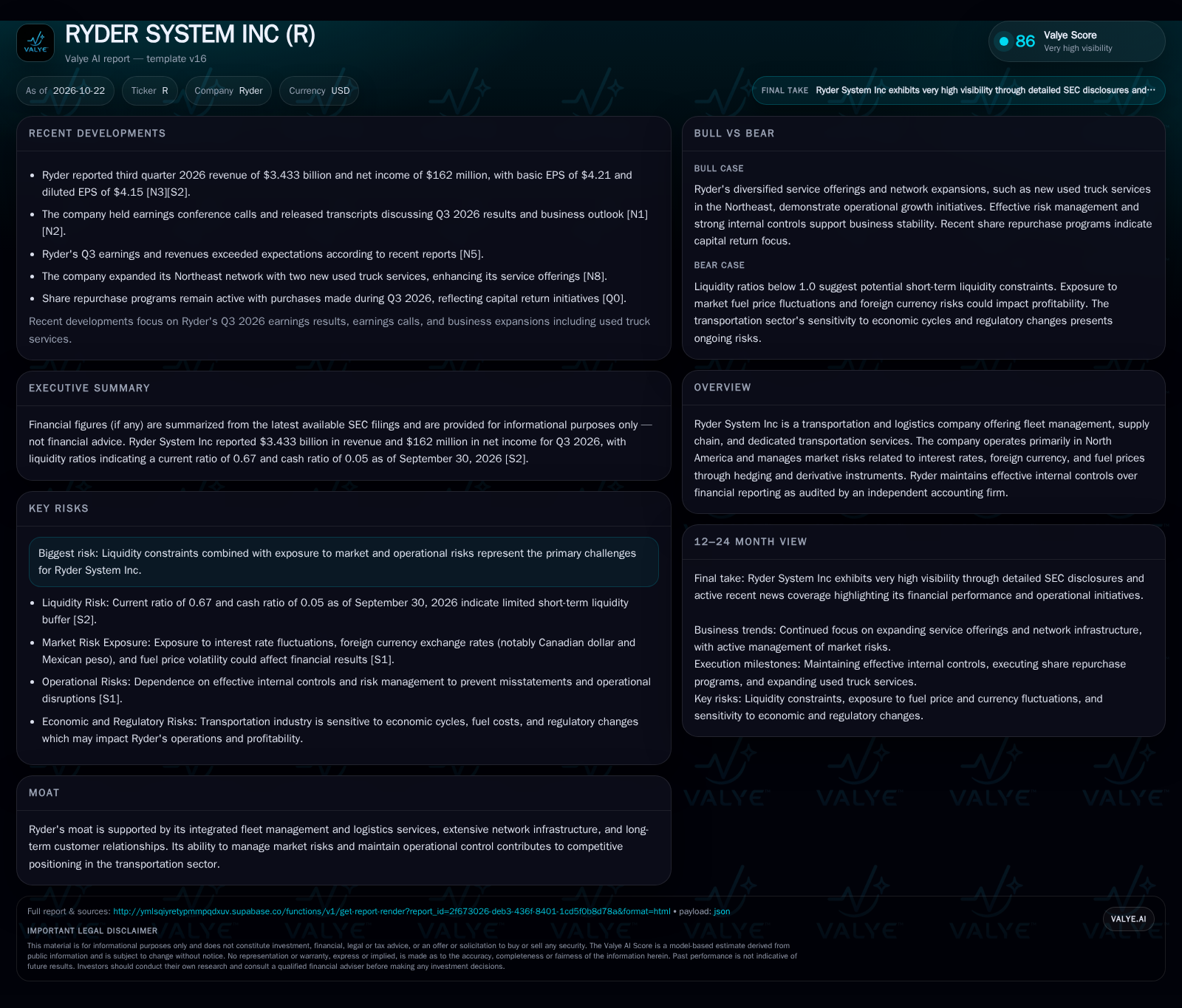
Ryder System delivered Q3 2026 revenue of $3.433 billion and net income of $162 million, exceeding expectations and continuing share repurchases. The company’s ability to sustain growth and capital returns will hinge on operational execution, risk management, and resilience to sector headwinds. [S2] [N3] [N5]
Ryder System Inc. finds itself at an inflection point in late 2026. The company’s robust Q3 performance—marked by $3.433 billion in revenue and $162 million in net income—signals continued operational strength and the ability to exceed market expectations. As Ryder leans into its integrated logistics model and risk management practices, its future trajectory will depend on its ability to navigate sector volatility, economic cycles, and capital allocation discipline. [S2] [N3] [N5]
Q3 Results, Capital Return, and Liquidity: Core Issues in Focus
Ryder System reported $3.433 billion in revenue and $162 million in net income for the third quarter of 2026, with basic earnings per share of $4.21 and diluted EPS of $4.15. These results exceeded analyst expectations, reinforcing operational momentum in a challenging sector. [S2] [N3] [N5]
The company reported a current ratio of 0.67 for the period. [S2]
Active share repurchase programs—evidenced by the Q3 2026 repurchase of 155,805 shares at $258.85 each—highlight management’s ongoing commitment to capital returns, even as liquidity remains tight.
Cash Flow Strength and Vulnerabilities Within Ryder’s Integrated Model
Ryder’s business model blends fleet management, supply chain solutions, and dedicated transportation services, generating revenue through a mix of long-term contracts, service fees, and asset-based logistics operations. The capital intensity of fleet ownership—requiring continuous investment in vehicles, maintenance, and technology—means that fixed costs are high, but scale can deliver significant operating leverage when fleet utilization and customer retention are strong.
Pricing power is typically constrained by competitive and cyclical pressures, especially in contract logistics and dedicated transportation. Adjustments to fuel surcharges, lease terms, and ancillary service fees allow some margin management, but the company’s exposure to input cost volatility (notably fuel and labor) remains. Asset mix (owned versus leased vehicles) and utilization rates are central to margin resilience.
Operating leverage can amplify both upside and downside: higher utilization and route density can drive incremental margins, but underutilization or sudden economic downturns can rapidly erode profitability given the fixed-cost base.
The integrated nature of Ryder's business model introduces both diversification benefits and complexity in capital allocation. For instance, balancing investment between fleet renewal and technology upgrades requires careful prioritization to avoid underinvestment in either area. Additionally, the mix of owned versus leased assets affects not only fixed costs but also balance sheet leverage and depreciation profiles, influencing reported earnings and cash flow dynamics. Ryder’s ability to optimize this asset mix in response to changing market conditions and customer demand patterns will be a key determinant of its operational efficiency and financial resilience.
Evaluating Ryder’s Integrated Service Platform: Competitive Edge or Crowded Field?
Ryder’s competitive position is anchored in its integrated platform—combining fleet management, warehousing, and transportation solutions—which can create stickier customer relationships and operational synergies. The breadth of offerings allows for cross-selling and deeper penetration within large enterprise accounts, supporting switching costs for complex, multi-modal logistics customers.
However, the sector remains highly competitive, with pressures from both asset-light logistics providers (that focus on technology, brokerage, and network optimization) and other asset-heavy operators with national scale. Technology-driven disruptors may erode traditional service advantages if Ryder cannot match digital service levels, real-time visibility, and cost efficiency.
Ryder’s risk management practices, including hedging for fuel and currency exposures, provide partial insulation from market volatility, but competitors employing similar strategies may blunt any unique advantage. Ultimately, sustained differentiation will depend on execution, customer retention, and the ability to extract value from the integrated model as market conditions evolve.
Triggers for Margin Growth and Accelerated Expansion
A favorable scenario for Ryder would involve a combination of robust economic activity, continued growth in e-commerce and supply chain outsourcing, and improvements in fleet utilization. If Ryder leverages its integrated platform to capture larger, longer-term contracts with high-value customers, it could see both top-line acceleration and improved margin mix.
Evidence of sustained utilization rates above historical averages, successful deployment of technology to reduce operating costs, and further expansion of value-added services (such as used truck sales or last-mile logistics) would support this case.
Confirmation would come from rising operating margins, improved current and cash ratios, and continued outperformance against sector peers on both revenue growth and customer retention. Conversely, a failure to demonstrate operating leverage or capital discipline would weaken the upside case.
In addition to leveraging its integrated platform, Ryder could enhance margin growth through targeted investments in data analytics and automation technologies that improve fleet scheduling, maintenance predictive capabilities, and route optimization. These advancements can reduce operational inefficiencies and lower variable costs, thereby amplifying the benefits of scale. Furthermore, expanding into adjacent service areas that complement core logistics offerings—such as reverse logistics or sustainability consulting—could open new revenue streams and differentiate Ryder from competitors focused solely on traditional asset management.
Execution Stability in a Cyclical Environment Shapes Outlook
The most plausible outcome is that Ryder continues to generate stable revenues and modest earnings growth, supported by its diversified service offerings and risk management strategies. Economic cyclicality and sector competition are likely to limit outsized gains, but the company’s integrated model and operational controls should enable it to weather moderate downturns.
Share repurchases and dividends may persist, but at a measured pace, contingent on cash generation and debt servicing needs.
This scenario would be confirmed by quarterly results that track in line with recent performance—steady revenues, maintained or slightly improving margins, and no material deterioration in liquidity metrics. Evidence of customer churn, margin compression, or rising costs without offsetting revenue growth would challenge the base case.
Potential Impact of Liquidity Challenges and Market Disruptions
A sustained period of underutilization, contract renegotiations at lower rates, or customer losses to more agile competitors could force margin compression and earnings declines. Regulatory changes that increase compliance costs or restrict operational flexibility would further strain profitability.
Evidence confirming this scenario would include a rapid deterioration in liquidity metrics, suspension of share repurchases or dividends, asset impairments, or guidance cuts tied to market or operational disruptions. Successful refinancing, new long-term contract wins, or cost containment would help falsify the downside case.
Factors That Will Separate Ryder’s Success from Operational Pressure
Fleet utilization rates and average revenue per vehicle, if disclosed, would signal the effectiveness of asset deployment and margin potential.
Operating cash flow trends relative to capital expenditures and shareholder returns will clarify whether internal funding is sufficient to support both growth and capital allocation objectives.
Contract renewal rates and customer retention metrics would help assess the stickiness of Ryder’s integrated service model and competitive differentiation.
Gross and operating margin trends, especially in the context of fuel and labor cost volatility, will indicate the company’s ability to manage input risk.
Any announced changes to hedging strategies or derivative positions may signal heightened sensitivity to market risk or evolving management priorities.
Material changes in regulatory environment or sector labor costs should be monitored for impact on fixed-cost structure and margin outlook.
Credit rating actions or changes in debt covenant compliance would provide early warning of financial stress or refinancing risk.
Disclaimer: This is research-only, informational analysis and not investment advice. It may include AI-generated interpretation and general industry context. Always verify important details using primary sources.

Comments