
Kaiser Aluminum: Pricing Power, Cost Volatility, and the Tug-of-War Shaping Margin Trajectory
Kaiser Aluminum’s disciplined metal price neutrality strategy buffers gross margin swings, but 2025’s shipment declines and alloyed metal cost surges reveal the business’s exposure to operational and input cost volatility. As capacity expansions come online, the central question is whether realized pricing can continue to offset volume and cost pressures in a structurally challenged metals market.
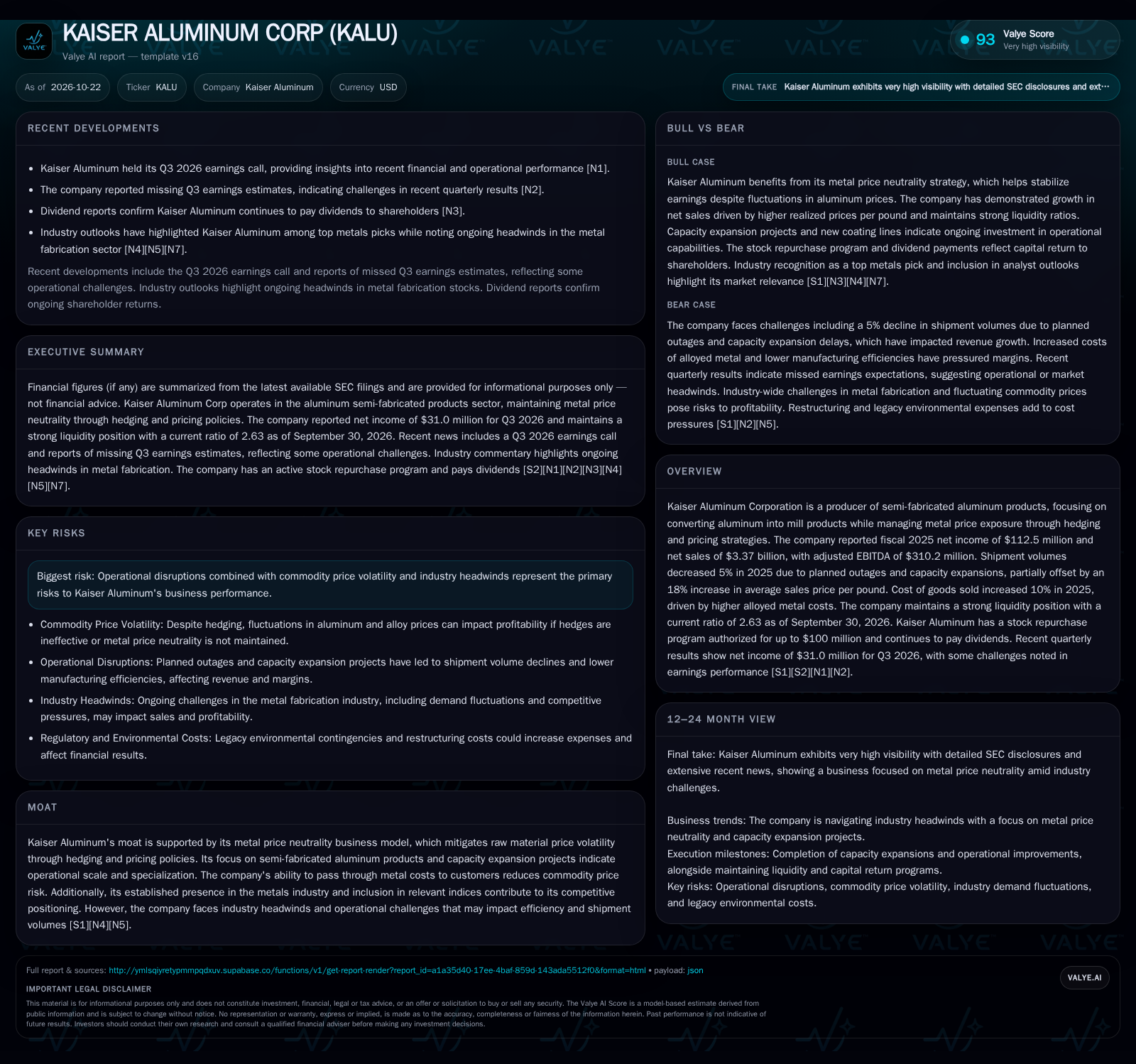
Kaiser Aluminum reported a 5% decline in shipment volume in 2025, offset by an 18% increase in average realized sales price per pound, as cost of goods sold rose 10% due to alloyed metal costs. Despite reported liquidity position and a capital return program, missed Q3 2026 earnings and ongoing industry headwinds underscore the fragility of margin stability. The key issue: can pricing and operational improvements outpace cost inflation and demand uncertainty as new capacity ramps? [S1] [S2] [N1] [N2]
Kaiser Aluminum’s business hinges on its ability to convert aluminum into higher-value, semi-fabricated products while neutralizing raw material price swings through hedging and pass-through pricing. The latest results highlight a nuanced dynamic: while shipment volumes declined in 2025 due to operational disruptions and planned upgrades, the company managed to lift average sales prices significantly, cushioning topline and margin impacts. However, surging input costs and missed earnings estimates in Q3 2026 spotlight the ongoing tension between cost inflation, volume risk, and the limits of pricing power. As Kaiser brings new capacity online, its ability to restore volume growth and defend margins against industry headwinds will be the central test.
Recent Results Underscore Margin Volatility and the Limits of Pricing Offset
Kaiser Aluminum reported a 5% decline in shipment volume for 2025, primarily attributed to planned outages and ongoing capacity expansion projects. This reduction in physical throughput could signal both temporary operational headwinds and potential longer-term challenges in demand or manufacturing efficiency [S1].
Despite lower volumes, the company achieved an 18% increase in average realized sales price per pound, suggesting either improved product mix, contractual pricing pass-throughs, or a favorable pricing environment for semi-fabricated aluminum [S1].
The cost of goods sold rose 10% in 2025, largely due to a 22% spike in the hedged cost of alloyed metal, only partially offset by lower manufacturing and freight costs [S1]. This dynamic pressures gross margins and highlights the importance of the company’s price neutrality strategy.
Q3 2026 net income was $31.0 million, but the company missed quarterly earnings estimates, indicating that margin pressures or softer demand continue to weigh on near-term performance [S2] [N1] [N2].
How Kaiser Aluminum Makes Money: Price Pass-Throughs, Operating Leverage, and Capital Cyclicality
Kaiser Aluminum’s core business model revolves around converting aluminum into semi-fabricated mill products—such as sheet, plate, and extrusions—primarily for aerospace, automotive, and industrial end markets. Critically, the company aims to maintain metal price neutrality: it passes through changes in aluminum and alloy costs to customers via contractual mechanisms, and employs hedging to limit direct exposure to commodity price swings [S1].
Revenue is thus a function of shipment volume, product mix (higher-value alloys or specialized applications command premium pricing), and the effectiveness of pass-through pricing. Fixed costs (labor, maintenance, depreciation) and capital needs are significant, especially during capacity expansions. Margins are exposed to operational disruptions (planned or unplanned outages), input cost volatility (particularly for alloys not fully hedged), and the effectiveness of cost recovery from customers.
Operating leverage is material: incremental volume growth can drive margin expansion if fixed costs are well-absorbed, but volume declines—such as those seen in 2025—can rapidly erode profitability, especially if cost inflation outpaces price increases.
Capital needs are cyclical, with periodic spikes during major expansion or modernization projects. The company’s ability to sustain dividends and buybacks depends on continued cash generation and disciplined capital allocation.
Where Kaiser Fits: Specialization, Price Neutrality, and Structural Industry Challenges
Kaiser Aluminum competes in the semi-fabricated aluminum sector, where barriers to entry stem from capital intensity, technical know-how, customer qualification requirements (especially in aerospace and automotive), and the ability to manage commodity volatility. Its metal price neutrality model—passing through input costs and hedging—offers a buffer against margin compression during periods of raw material swings, but does not fully insulate the company from volume or efficiency shocks.
Peers include vertically integrated aluminum producers, specialty metal fabricators, and global players with broader product portfolios. Many competitors face similar input cost and demand challenges, but those with greater scale, geographic diversity, or deeper customer integration may have more pricing power or operational flexibility.
The risk of substitution—such as by advanced composites or steel—remains a long-term headwind in certain applications, though aluminum’s lightweight and corrosion-resistant properties support its relevance in transportation and industrial end markets.
Kaiser’s focus on higher-value, specialized products and its established customer relationships provide some differentiation, but industry headwinds (overcapacity, cyclical demand, regulatory costs) are structural and affect all players.
If Volume Recovers and Capacity Expansions Deliver, Margin Upside Could Be Significant
The most favorable scenario for Kaiser Aluminum is that capacity expansion projects are completed on time and ramp smoothly, restoring shipment volumes to (or above) prior levels. If demand in core end markets (especially automotive and aerospace) rebounds, higher utilization would allow the company to leverage fixed costs, driving margin expansion.
Sustained or even modestly higher realized pricing—whether via product mix, customer contracts, or market dynamics—could further boost revenue and offset lingering cost inflation. If input costs stabilize or decline, the company’s price pass-through model could result in a period of margin expansion.
Evidence that would confirm this scenario includes a sequential rebound in shipment volumes, improvement in gross margin percentage, and positive commentary on capacity utilization and order backlogs. Upward revisions to earnings guidance or resumption of more aggressive buybacks/dividends would also support the upside case.
Volume Stabilizes, Price Pass-Throughs Hold, but Margin Expansion Is Capped by Cost Pressures
The most plausible path is that shipment volumes gradually recover as capacity expansions come online, but growth is tempered by ongoing industry headwinds and cyclical demand in key end markets. The company continues to use hedging and contractual pass-throughs to offset most input cost swings, but alloy and labor cost inflation persists.
Average realized prices remain elevated, but further gains are limited by competitive dynamics and customer resistance. Gross margins stabilize, but do not return to peak levels as cost inflation eats into pricing gains.
Evidence for this scenario would be shipment volumes returning to 2024 levels, steady gross margin percentages quarter-over-quarter, and relatively stable net income, but without significant positive earnings surprises. Management commentary would likely emphasize operational discipline, cost control, and selective capital returns rather than aggressive expansion.
Persistent Volume Weakness, Input Cost Surges, or Operational Setbacks Could Erode Profitability
A negative outcome would result if shipment volumes remain depressed due to weaker-than-expected demand, delays in ramping new capacity, or additional operational disruptions. If alloyed metal costs rise further and the company is unable to fully pass through these increases—or if hedging proves ineffective—gross margins could compress sharply.
Additional restructuring charges, legacy environmental expenses, or regulatory costs could further erode earnings, and missed earnings estimates could become more frequent, pressuring capital return programs and potentially forcing a reevaluation of dividend or buyback policies.
Confirmation of this scenario would include continued shipment volume declines, a drop in gross margin percentage, recurring earnings misses, and downward revisions to guidance. Increased restructuring or environmental charges and any reduction in dividend payments would also be red flags.
Milestones and Metrics That Will Define Kaiser Aluminum’s Margin and Volume Trajectory
Quarterly shipment volume trends—especially any sequential recovery or continued decline as capacity expansions are completed [S1] [S2].
Average realized sales price per pound, to gauge the sustainability of pricing power and product mix improvements (if disclosed) [S1].
Gross margin percentage and its movement relative to both input cost trends and realized pricing (if disclosed).
Completion timing and ramp effectiveness of capacity expansion projects, as indicated in management commentary or filings.
Updates on cost of goods sold components, particularly alloyed metal costs and the effectiveness of cost pass-throughs [S1].
Frequency and magnitude of restructuring charges or legacy environmental expenses in upcoming quarters [S1].
Dividend continuity and utilization of the remaining authorized buyback capacity—any shift could signal cash flow pressure or capital allocation changes [S1] [N3].
Disclaimer: This is research-only, informational analysis and not investment advice. It may include AI-generated interpretation and general industry context. Always verify important details using primary sources.

Comments