
Getty Realty’s Triple-Net Expansion: Portfolio Growth, Lease Durability, and the Capital Markets Tether
Getty Realty’s 2026 results highlight a net lease REIT actively scaling its portfolio and tenant base in automotive and convenience retail. With over $500 million deployed year-to-date and earnings guidance raised, the company’s reliance on long-term triple-net leases is both its core strength and a source of sector-specific exposure, as funding and tenant concentration risks remain watchpoints.
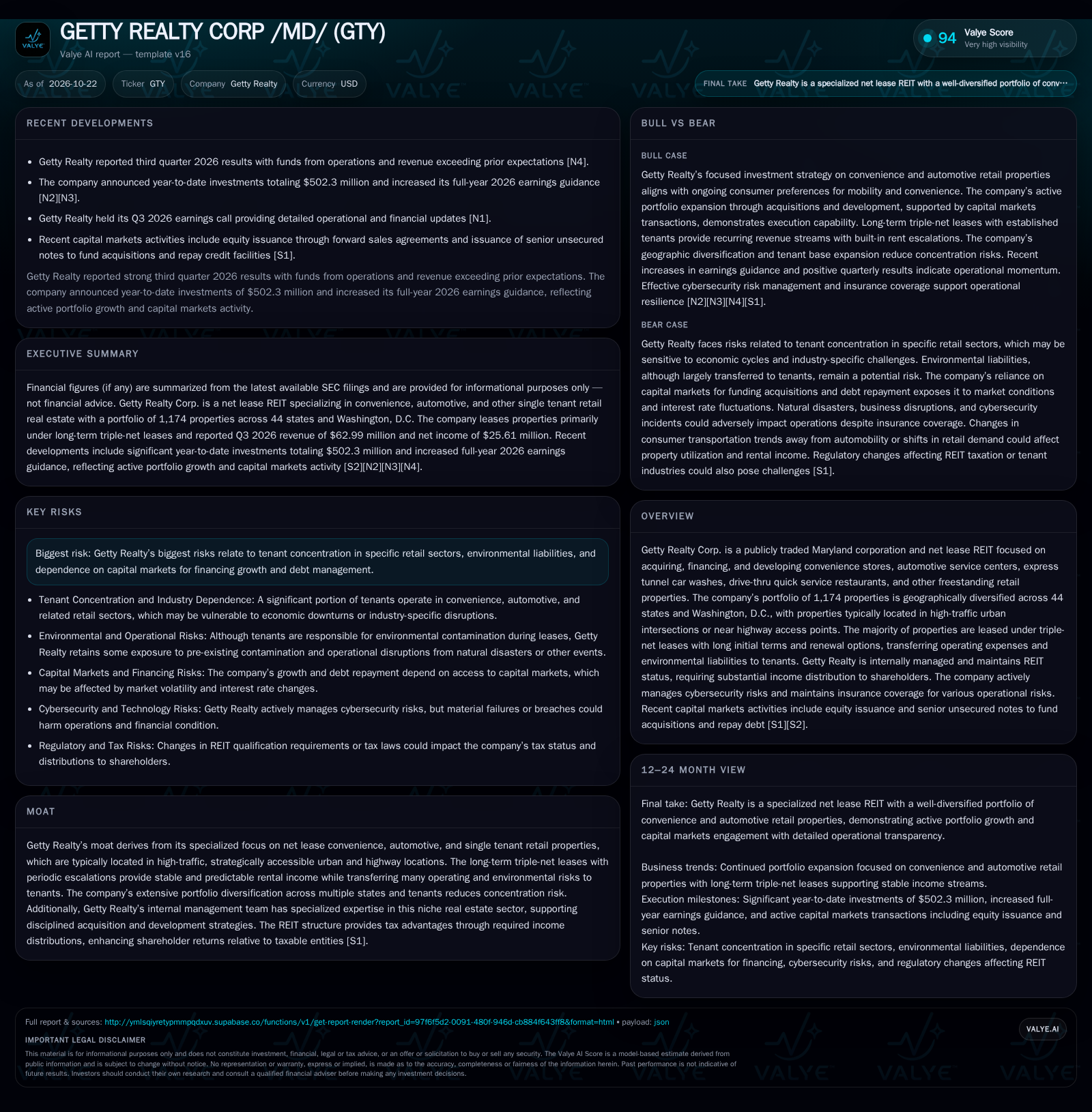
Getty Realty reported Q3 2026 revenue and net income above expectations, increased its full-year guidance, and invested over $500 million year-to-date into its portfolio. The company’s 1,174-property portfolio is highly diversified by geography and tenant, but remains concentrated in automotive and convenience retail sectors. Long-term triple-net leases underpin stable cash flow, but the business model requires ongoing access to capital markets for growth, and sectoral shifts in mobility or consumer habits could challenge the thesis. [S2] [N2] [N3] [N4]
Getty Realty’s 2026 performance illustrates the strengths and trade-offs of the net lease REIT model applied to the automotive and convenience retail landscape. By deploying over $500 million in fresh investments and raising guidance, Getty is leveraging its long-term triple-net lease structure to generate stable, predictable income streams. Yet, this stability is contingent on the durability of its tenant industries and continued access to capital markets for growth. As automobility and retail formats evolve, the sustainability of Getty Realty’s portfolio economics and its ability to manage concentration and funding risks will shape its next chapter. [S1] [S2] [N2] [N3] [N4]
2026 Momentum: Surpassing Expectations Amid Aggressive Portfolio Expansion
Getty Realty reported Q3 2026 revenue of $62.99 million and net income of $25.61 million, with results exceeding prior expectations for both funds from operations (FFO) and revenue. The company raised its full-year earnings guidance and disclosed year-to-date investments of $502.3 million, pointing to an accelerated pace of portfolio growth. The current portfolio stands at 1,174 properties diversified across 44 states and Washington, D.C., with 1,169 of these under triple-net lease structures. [S1] [S2] [N2] [N3] [N4]
These facts matter because they highlight both operational momentum and a willingness to deploy significant capital, reinforcing Getty’s thesis as a growth-oriented net lease REIT. However, the size of new investments and the upgrade to guidance also increase the stakes around funding reliability and tenant sector resilience.
How Getty Realty’s Net Lease Model Generates (and Constrains) Cash Flow
Getty Realty’s economics are built on the triple-net lease model: tenants pay rent and assume responsibility for taxes, insurance, maintenance, and environmental liabilities. This structure provides highly predictable, low-volatility cash flows, as operating expense exposure is minimized and lease terms are long (weighted average remaining term of 9.9 years). Rental rates typically include periodic escalations, which can help offset inflation over time. [S1]
The company’s capital requirements are substantial, given its growth-through-acquisition strategy. Portfolio expansion is funded via a mix of equity issuance (including forward sales agreements) and senior unsecured notes, with proceeds used for both acquisitions and debt repayment. This means external capital is essential for continued growth—Getty’s ability to scale is directly linked to capital market conditions and investor appetite. [S1] [S2]
Operating leverage in this model is modest: while incremental properties add to revenue with limited incremental overhead, the REIT structure mandates high payout ratios (at least 90% of taxable income), limiting retained earnings and requiring further capital raises for expansion. The model’s advantage is cash flow stability; its constraint is the dependence on external funding to fuel growth.
Specialization, Location, and Lease Structure: Defensible Niche or Sectoral Risk?
Getty Realty’s competitive position is anchored by specialization in convenience, automotive, and drive-thru retail properties—asset classes that have historically delivered resilient demand due to their alignment with U.S. consumer mobility patterns. Its typical sites are high-traffic, near highways or urban intersections, supporting tenant sales and asset utilization. [S1]
The triple-net lease structure, with long initial terms and renewal options, transfers most property-level risks to tenants and creates stickiness. Geographic and tenant diversity across 44 states and multiple brands helps mitigate concentration risk, though the company remains fundamentally exposed to trends in automobility, fuel retailing, and the evolution of convenience formats.
Peer REITs in the net lease space—such as those focused on retail, QSR, or specialty properties—compete for similar assets. However, Getty’s focus on automotive and convenience niches may provide some insulation from e-commerce disruption compared to broader retail REITs. The main counterforce is sectoral risk: if consumer transportation patterns shift away from car-centric models, or if regulatory or technological changes disrupt fuel and convenience retail, underlying asset demand could erode.
If Automobility and Convenience Retail Hold, Portfolio Compounding Accelerates
The favorable scenario for Getty Realty is one in which U.S. consumer preferences for automobility and convenience persist, supporting tenant profitability and low vacancy across its portfolio. Continued outperformance in FFO and revenue—enabled by accretive acquisitions and organic rent escalations—could allow Getty to scale its asset base while maintaining or even improving portfolio quality. [S1] [N4]
In this scenario, capital markets remain accessible and cost of capital favorable, allowing for continued equity and debt issuance to fund growth. Further, if Getty continues to diversify its tenant base (e.g., adding more QSRs, car washes, or new automotive service brands), concentration risk would diminish and lease renewal rates could remain high.
Evidence that would confirm this scenario includes sustained growth in FFO per share, ongoing acquisition announcements in resilient property categories, and limited tenant defaults or vacancies. Conversely, signs of tenant stress, rising vacancies, or an inability to raise capital on favorable terms would challenge this outcome.
Portfolio Growth Continues, but Capital Markets and Sector Risks Cap Upside
The most plausible path is steady portfolio expansion, with Getty Realty deploying capital into new acquisitions at a measured pace, supported by moderate rent escalations and high occupancy. The long-term lease structure ensures stable cash flows, but the company remains exposed to broader capital market conditions for funding growth, and to the health of the automotive/convenience sectors for tenant demand.
In this scenario, FFO and earnings grow in line with new investments and rent escalations, but rising interest rates or tighter capital markets could slow the pace of expansion. Sector-specific risks—such as shifts in mobility trends, changes in fuel consumption, or regulatory headwinds—may periodically impact tenant performance, but are offset by portfolio diversification and lease stickiness.
Confirmation would come from continued low vacancy rates, stable or growing FFO per share, and regular but not outsized acquisition activity. Falsification would involve a sustained inability to access external funding, a material increase in tenant defaults, or a marked slowdown in acquisition-driven growth.
Capital Market Dislocation or Sectoral Shock Triggers Growth and Income Headwinds
An adverse scenario could unfold if capital markets tighten—due to higher interest rates, credit contraction, or equity market volatility—making it difficult or expensive for Getty to raise funds for acquisitions or to refinance debt. This would constrain portfolio growth and could force the company to slow distributions or asset purchases.
Alternatively, a sector shock—such as a rapid decline in automobility, major regulatory changes affecting fuel/convenience retail, or technological disruption—could reduce tenant profitability, increase vacancies, and weaken rent coverage. Given the long average lease term, such shocks may take time to manifest in financials but could ultimately pressure cash flows and asset values.
Confirmation of this scenario would include a sharp drop in acquisition activity, rising vacancies or tenant bankruptcies, and a cut or suspension in dividend distributions. Early warning signs might be tightening spreads on unsecured notes, muted equity issuance, or negative earnings revisions tied to sector stress.
Milestones That Will Test Getty Realty’s Net Lease Growth Thesis
Sustained acquisition pace and the mix of new property types—are investments continuing at a similar scale, and is the portfolio diversifying into new tenant categories? [N2] [N3]
Occupancy rates and tenant default activity—are vacancy and bad debt levels remaining low, or are there signs of sector or tenant-specific stress? (If disclosed)
FFO per share and rent coverage metrics—does cash flow per share grow in line with acquisitions, and are tenants maintaining healthy rent coverage ratios? (If disclosed)
Cost and terms of new capital—are equity and debt issuances maintaining favorable pricing, or is the cost of capital rising materially? [S1] [S2]
Average lease term and rent escalation rates—are new leases maintaining long durations and built-in escalators, or is competitive pressure eroding these terms? (If disclosed)
Geographic and tenant concentration—does the top tenant or region account for a growing or shrinking share of rents, and is the company reducing exposure to any one risk cluster? (If disclosed)
Dividend payout ratio and coverage—does distribution remain well covered by recurring cash flow, or is there evidence of strain as investment pace accelerates? (If disclosed)
Capital recycling and asset sales—are older or underperforming properties being sold to fund new growth, or is the portfolio aging in place? (If disclosed)
Disclaimer: This is research-only, informational analysis and not investment advice. It may include AI-generated interpretation and general industry context. Always verify important details using primary sources.

Comments