
Alpine Income Property Trust: Long-Lease Stability Supports Refinancing and Credit Quality
Alpine Income Property Trust’s formula—net-leased commercial real estate with a high-occupancy, long-duration, investment-grade-anchored portfolio—offers visible cash flow, but the coming years will test its ability to maintain that stability as debt maturities and tenant risk profiles evolve.
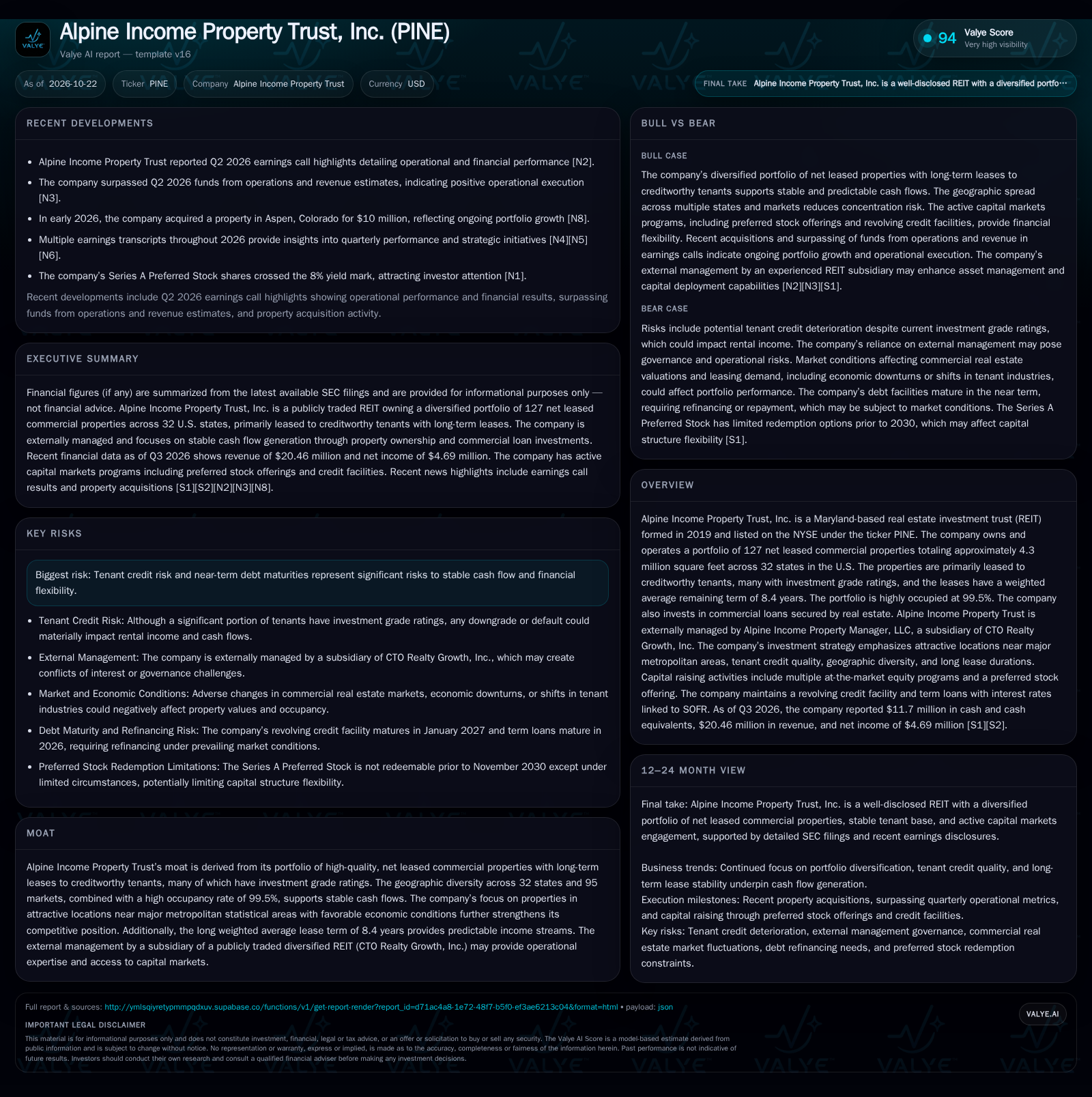
Alpine Income Property Trust (PINE) operates a 127-property, 99.5% occupied net lease portfolio with a weighted average lease term of 8.4 years, heavily exposed to investment grade tenants and major metropolitan areas. The company recently raised $50 million via preferred equity and maintains active credit facilities, but faces upcoming term loan and revolver maturities. Its success hinges on managing tenant credit risk, refinancing debt on favorable terms, and sustaining disciplined portfolio growth [S1] [S2].
Alpine Income Property Trust, Inc. (NYSE: PINE) has built a reputation for stability, with a net lease real estate portfolio spanning 127 properties across 32 states, 99.5% occupancy, and long-term leases to creditworthy tenants. This structure delivers predictable rental streams and reduces near-term volatility, a core attraction for REIT investors. However, as the company approaches significant debt maturities and faces a commercial real estate environment shaped by rising rates and evolving tenant risk, the durability of Alpine’s cash flows and its ability to extend or refinance capital on acceptable terms will define its next phase. The interplay between sustained portfolio quality, tenant resilience, and capital market access will determine whether Alpine can continue delivering on its promise of steady, visible income.
Current Portfolio Quality and Capital Structure Overview
As of September 30, 2026, Alpine Income Property Trust owns 127 net-leased commercial properties across 32 states, totaling approximately 4.3 million square feet, with a 99.5% occupancy rate. The portfolio is anchored by long-term leases—an 8.4-year weighted average remaining term—and derives 51% of annualized base rent from tenants with investment grade credit ratings. Over half of the properties are located in major metropolitan statistical areas. Financially, Alpine reported $20.46 million in Q3 revenue, net income of $4.69 million, and held $11.7 million in cash. On the capital side, the company recently raised $50 million via a public offering of 8.00% Series A Cumulative Redeemable Preferred Stock and maintains a $250 million senior unsecured revolving credit facility (maturing January 2027, with an accordion feature up to $750 million) and a $100 million term loan maturing in 2026 [S1] [S2].
These facts matter because Alpine’s cash flow visibility is underpinned by lease duration, tenant quality, and occupancy. However, the maturity schedule for its term loan and revolver introduces refinancing risk at a time when market conditions for commercial real estate debt remain uncertain, and ongoing capital access will be critical for growth and stability.
Net Lease Economics Underpinning Alpine’s Cash Flow
Alpine’s core business model relies on owning properties subject to net leases, where tenants are responsible for most property-level expenses (taxes, insurance, maintenance). This structure produces predictable, relatively high-margin rental income and minimizes variable cost exposure for the REIT. With a weighted average lease duration of 8.4 years and a 99.5% occupancy rate, Alpine benefits from contractual cash flows and reduced re-leasing risk.
The economics of net lease REITs hinge on spread management: acquiring or developing properties at cap rates above the company’s cost of capital, and financing them with a mix of equity, preferred stock, and debt. Alpine’s recent preferred equity issuance at 8% and term loan with SOFR-linked rates reflect the rising cost of capital environment. While the company’s fixed costs (interest, management fees) are material, the largely fixed-revenue stream creates operating leverage if rent escalators and new acquisitions outpace expense growth.
Capital requirements are substantial for portfolio growth, and the company’s ability to raise attractively priced capital—via ATM equity, preferred stock, or credit facilities—directly impacts its capacity to expand and recycle assets. If capital costs rise more quickly than cap rates on new acquisitions, external growth could be constrained or less accretive.
Evaluating Alpine’s Position Within the Net Lease REIT Market
Alpine competes with both publicly traded and private net lease REITs, as well as institutional owners of single-tenant retail, office, and industrial properties. Its competitive strengths include geographic diversity (32 states), a high share of investment grade tenants (51% of base rent), and a focus on properties in large MSAs (over 52%). This reduces market and tenant concentration risk relative to smaller or more regionally concentrated peers.
However, Alpine is externally managed by a subsidiary of CTO Realty Growth, Inc., which introduces potential conflicts of interest and may limit control over strategic decisions compared to internally managed REITs. Larger net lease REITs may also enjoy lower cost of capital, greater scale economies, and deeper tenant relationships, enabling them to bid more aggressively for prime assets or weather tenant bankruptcies with less impact.
Substitution risk remains: tenants could shift to direct ownership or alternative property providers if lease terms become less competitive, or if demand for certain property types (e.g., retail) weakens in a changing macro environment. Alpine’s focus on credit quality and lease term partially mitigates these risks, but does not eliminate cyclical exposure.
Value Opportunities in Accretive Acquisitions and Tenant Strength
A favorable trajectory for Alpine would be defined by continued portfolio expansion funded by accretive capital, sustained high occupancy, and minimal tenant credit issues. If the company can refinance its maturing term loan and revolver on favorable terms—without material dilution or rate shock—it could use its credit capacity and preferred equity proceeds to acquire additional net lease assets at attractive spreads.
Evidence supporting this scenario would include new property acquisitions at cap rates comfortably above Alpine’s blended cost of capital, further increases in investment grade tenant exposure, and stability or improvement in occupancy and rent collection. Upward revisions to FFO and cash flow guidance, as well as the extension or upsizing of credit facilities, would be confirming signals.
This scenario would be challenged if acquisition yields compress or if financing becomes prohibitively expensive. Additionally, a wave of tenant downgrades or defaults would undermine the portfolio’s perceived safety and cash flow predictability.
Growth and Stability Considerations with Upcoming Debt Maturities
The most plausible path for Alpine is continued stable cash flow from its existing portfolio, with moderate external growth paced by available capital and refinancing outcomes. The long lease terms and high occupancy should support visible rental income, but incremental portfolio expansion may slow if capital market conditions remain tight or if the company prioritizes deleveraging over rapid growth.
Confirmation would come from steady occupancy, stable FFO per share, and successful refinancing of the term loan and revolver at manageable rates. Modest acquisition activity—funded by a mix of retained cash flow, credit facility draws, and measured equity or preferred issuance—would indicate disciplined growth without undue balance sheet risk.
This scenario could be falsified by a spike in tenant delinquencies, significant asset sales to fund debt repayment, or dilutive equity raises driven by refinancing stress.
Potential Impact of Tenant Challenges and Capital Market Conditions
A negative scenario would unfold if tenant credit quality materially deteriorates—through downgrades, bankruptcies, or industry disruptions—leading to rent defaults or elevated vacancy. This would reduce rental income, increase re-leasing costs, and potentially trigger asset write-downs, undermining Alpine’s cash flow stability.
Simultaneously, if debt markets remain restrictive or interest rates rise further, Alpine may struggle to refinance its $100 million term loan (2026) and $250 million revolver (2027) at acceptable terms. Forced asset sales, dilutive equity issuance, or increased borrowing costs could erode earnings and constrain future growth.
Evidence of this scenario would include falling occupancy, rising bad debt expense, reductions in FFO guidance, or unsuccessful attempts to refinance maturing debt. Any sign of tenant distress concentrated in specific property types or regions would further pressure the investment case.
Events Influencing Alpine’s Resilience and Future Growth
Refinancing terms and timing for the $100 million term loan maturing in 2026 and $250 million revolver maturing in early 2027.
Occupancy rate trends, particularly any movement away from the current 99.5% level.
Changes in the proportion of annualized base rent derived from investment grade tenants, as tenant credit profiles evolve.
Acquisition volume, cap rates on new purchases, and whether these transactions are accretive relative to Alpine’s cost of capital.
Preferred stock and common equity issuance activity, including pricing and impact on dilution if disclosed.
Rental collection rates and any increases in bad debt expense or tenant defaults, especially among non-investment grade tenants.
Updates to guidance or FFO per share, reflecting management’s outlook on portfolio stability and growth.
Any changes to the external management agreement or cost structure, which could impact governance and long-term alignment.
Disclaimer: This is research-only, informational analysis and not investment advice. It may include AI-generated interpretation and general industry context. Always verify important details using primary sources.

Comments