
Lindsay Corporation: Irrigation Recovery, Infrastructure Leverage, and the Economics of Durable Ag-Tech
The strategic focus on infrastructure and operational discipline could support resilience, yet future growth will depend on Lindsay’s ability to accelerate irrigation recovery and navigate a competitive, weather-sensitive market.
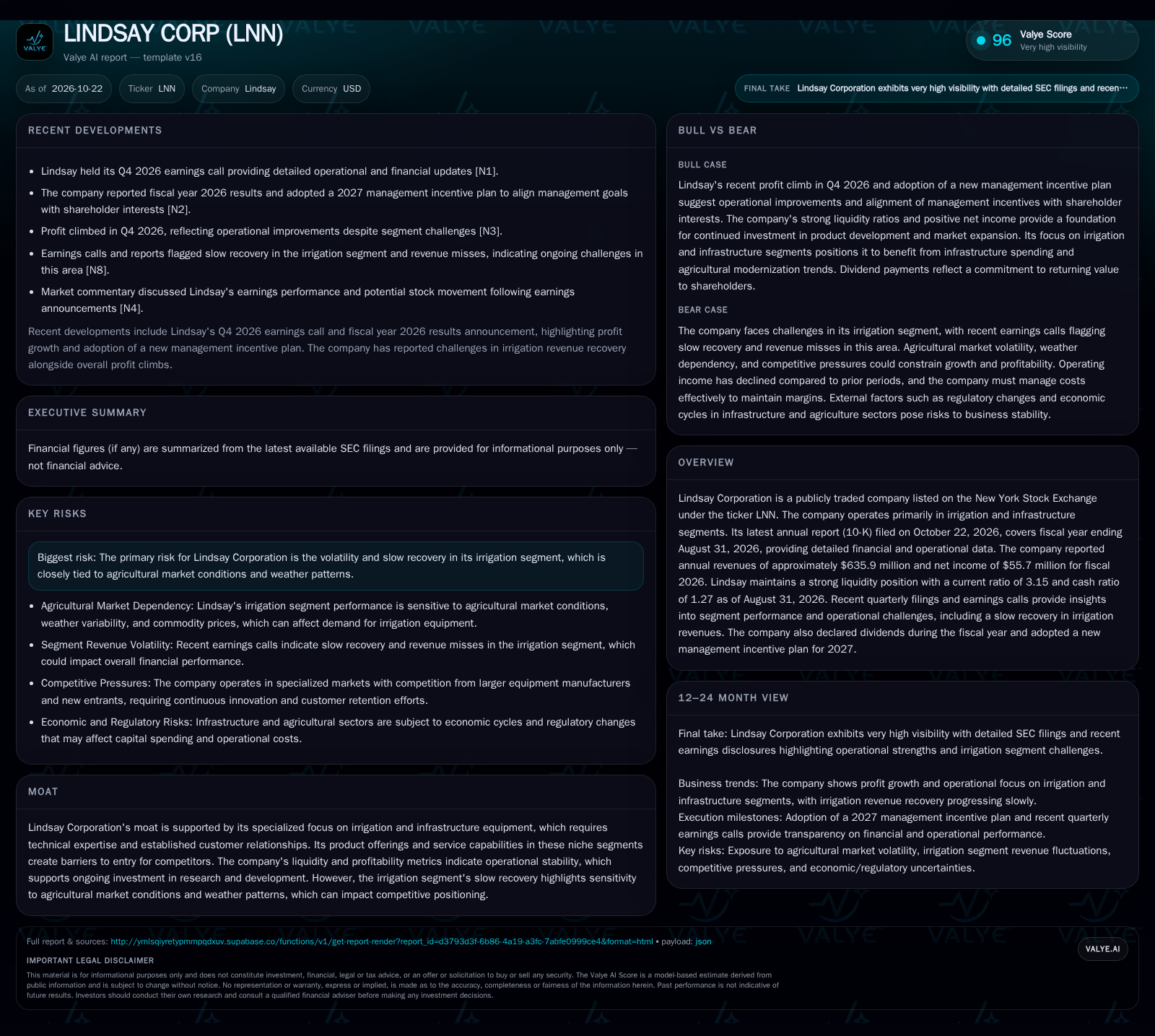
Lindsay Corporation reported $635.9 million in revenue and $55.7 million in net income for fiscal 2026, with profit gains in Q4 despite ongoing irrigation segment headwinds. Infrastructure segment performance and management incentive alignment will be pivotal for Lindsay’s next phase.
Lindsay Corporation’s latest results highlight a company at a strategic crossroads. Profitability has improved—particularly in the most recent quarter—yet persistent weakness in the core irrigation business underscores the company’s vulnerability to agricultural cycles. With a reported balance sheet position and a renewed management incentive plan, Lindsay is positioned to invest in both its irrigation and infrastructure segments. The key question is whether operational improvements and infrastructure growth can offset the enduring challenges of a weather-dependent, competitive ag-tech market.
Profit Growth and Irrigation Headwinds Define Lindsay’s Latest Results
For fiscal year 2026, Lindsay Corporation reported revenue of $635.9 million and net income of $55.7 million, with diluted earnings per share of $5.33 [S1]. This marks a period of profit growth, particularly in Q4, despite ongoing headwinds in the irrigation segment, where recovery has been slow and revenue missed internal expectations [N3] [N8]. The company reported $189.8 million in cash and a current ratio of 3.15 as of August 2026 [S1]. Lindsay also declared $1.11 per share in dividends for the nine months ended May 2026 [S2]. The adoption of a 2027 management incentive plan reflects an effort to align leadership objectives with shareholder value [N2]. These data points frame a business with clear operational strengths but exposed to segment-specific volatility.
How Lindsay’s Irrigation and Infrastructure Segments Generate Returns
Lindsay’s core economics derive from the manufacture and sale of irrigation systems and infrastructure products. In irrigation, revenue is largely driven by capital equipment sales—primarily center pivot and lateral move systems—supplemented by aftermarket parts and, increasingly, technology-enabled solutions. The infrastructure segment generates returns from road safety products, specialty barriers, and traffic management systems.
The company’s revenue mix can swing meaningfully based on agricultural capital spending, which is itself sensitive to commodity prices, weather, and farm profitability. Irrigation equipment typically commands high average selling prices but can be cyclical and heavily influenced by macro factors. Aftermarket and service revenues, while smaller, offer recurring potential and better margin stability. The infrastructure segment, in contrast, tends to provide steadier volume but may be more exposed to government budget cycles and project timing.
Lindsay’s operational leverage is most apparent in its ability to scale production and distribute fixed costs over higher volumes—especially when irrigation demand rebounds. However, the capital requirements for manufacturing, inventory, and working capital are significant, and the business must carefully balance investment in R&D and technology against margin preservation. The company reported cash and liquidity metrics for the period; these figures do not by themselves establish operating runway, investment capacity, financial flexibility, or financing capacity.
Specialization, Customer Relationships, and Barriers in Ag-Tech and Infrastructure
Lindsay’s primary competitive advantages lie in its technical expertise, established dealer and distributor networks, and long-standing customer relationships in both irrigation and infrastructure. The company competes with other specialized irrigation providers and diversified industrial manufacturers, many of which possess scale advantages or broader product portfolios.
Barriers to entry in irrigation include the complexity of system design, integration of digital and automation technologies, and the need for localized service. However, these barriers are not absolute: large agricultural equipment manufacturers and emerging ag-tech startups are investing in precision irrigation and alternative water management solutions, potentially eroding Lindsay’s moat over time.
In infrastructure, Lindsay’s niche focus on road safety and traffic management provides some insulation from generic competition, but project-based revenues are inherently lumpy and subject to public funding cycles. The company’s ability to innovate—particularly in remote monitoring, automation, and data integration—will be critical to sustaining differentiation as both segments evolve.
Accelerated Irrigation Recovery and Infrastructure Expansion Could Drive Durable Growth
A favorable scenario for Lindsay would see a robust rebound in irrigation demand, driven by higher agricultural commodity prices, improved farm profitability, and increased adoption of precision agriculture technologies. In this environment, Lindsay could leverage its dealer network and product portfolio to capture incremental share and expand aftermarket revenues. Simultaneously, continued investment in infrastructure—spurred by public funding or stimulus—could lift the segment’s contribution and smooth overall revenue volatility.
Confirmation of this scenario would require evidence of sustained double-digit growth in irrigation equipment orders, rising aftermarket and technology-enabled revenue, and improved segment margins. Infrastructure backlog expansion and new project wins would further support the thesis. Management’s continued alignment through incentive plans, coupled with incremental R&D spend and successful product launches, would also validate the company’s ability to execute.
Mixed Recovery: Irrigation Gradually Improves While Infrastructure Provides Stability
The most plausible near-term outcome is a gradual improvement in irrigation revenues as agricultural conditions stabilize, but with continued volatility due to commodity price swings and weather events. Infrastructure is likely to remain a steadier contributor, offsetting some of the cyclicality in irrigation. Lindsay’s operational discipline and cost management help sustain profitability, but material margin expansion is constrained by competitive pricing pressure and input cost variability.
Evidence of steady infrastructure revenue, incremental irrigation recovery, and contained SG&A and R&D spending would support the base case. Conversely, further revenue misses or persistent irrigation weakness would challenge this thesis.
Prolonged Irrigation Weakness and Competitive Disruption Threaten Returns
If agricultural markets remain weak or deteriorate—due to persistent low commodity prices, adverse weather, or reduced farm investment—Lindsay’s irrigation segment could face prolonged revenue declines. Competitive pressures from both established players and technology entrants could erode pricing power and accelerate share loss. Infrastructure, while more stable, may not be able to offset the scale of irrigation shortfalls, especially if public spending tightens.
This downside would be indicated by consecutive quarters of irrigation revenue contraction, margin compression, and potential reductions or suspensions of dividends. Rising inventory or receivables, coupled with increased promotional activity or discounting, would further signal distress. Lack of new product traction or management turnover could exacerbate concerns about long-term competitiveness.
What Will Determine Lindsay’s Next Phase: Irrigation Orders, Segment Margins, and Execution
Quarterly irrigation equipment order trends and book-to-bill ratios—if disclosed—would provide direct evidence of demand recovery or further weakness.
Aftermarket and technology-enabled irrigation revenue growth rates would help gauge progress in building recurring, higher-margin streams.
Infrastructure segment backlog and new project wins, particularly in road safety and traffic management, would test the resilience of the non-agricultural business.
Quarterly gross and operating margin trends, by segment, would clarify the sustainability of recent profit improvements.
R&D and SG&A expense trajectories—relative to revenue—would indicate management’s discipline and ability to invest for future growth.
Dividend declarations and payout ratios, especially in the context of fluctuating earnings, would signal the company’s view on capital allocation and underlying cash flow stability.
Management commentary on competitive dynamics, technological innovation, and regulatory developments in both segments would offer early warnings of structural shifts.
Employee retention, particularly in engineering and field service roles (if disclosed), could provide insight into Lindsay’s ability to maintain its technical edge.
Disclaimer: This is research-only, informational analysis and not investment advice. It may include AI-generated interpretation and general industry context. Always verify important details using primary sources.

Comments