
Medpace Holdings: Scaling Full-Service CRO Execution Amid Liquidity Constraints and Industry Consolidation
Medpace’s robust backlog growth and operational expansion signal sustained demand for high-complexity clinical trial outsourcing, even as liquidity metrics and competitive intensity test the durability of its full-service model.
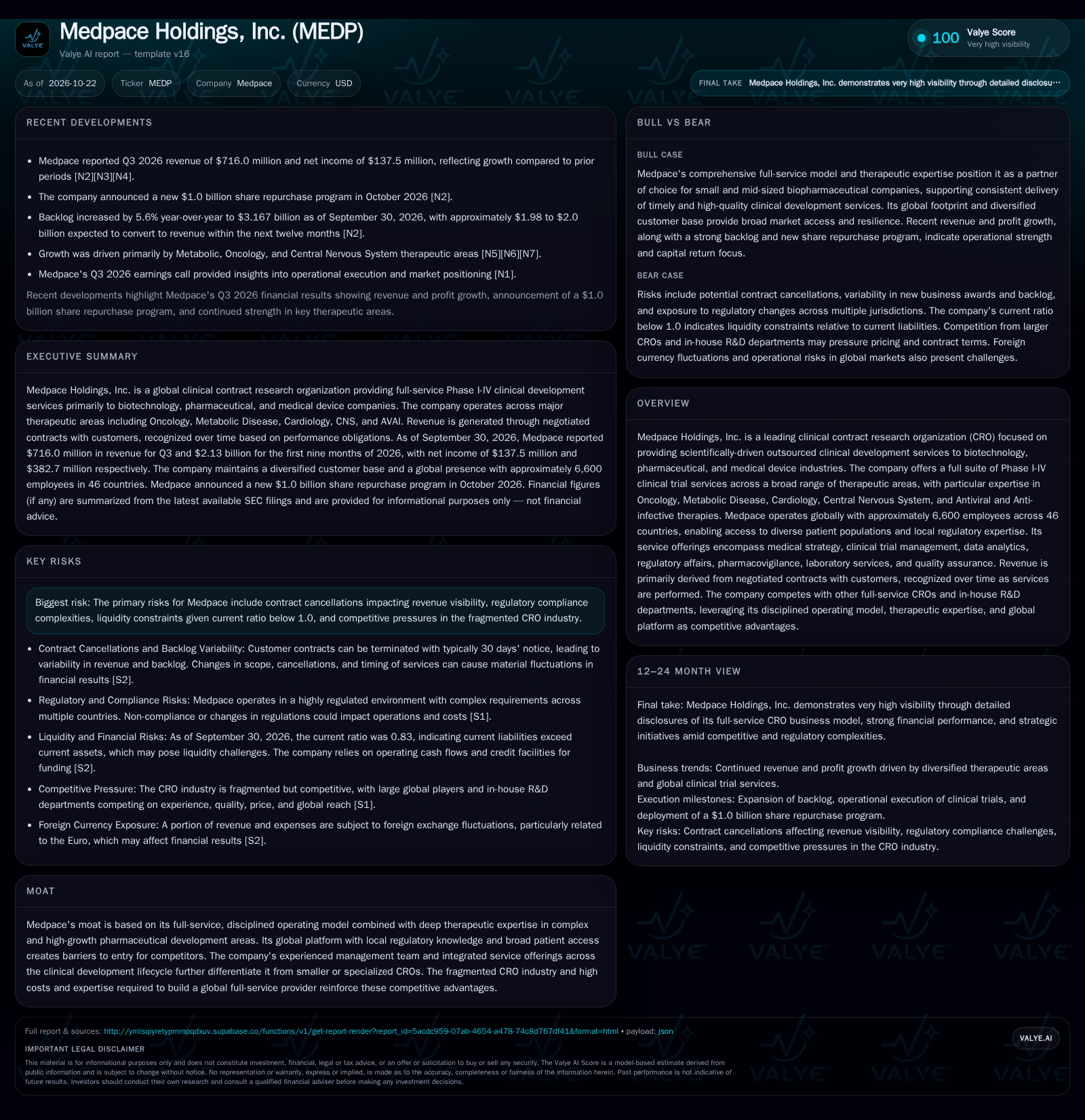
Medpace continues to grow its clinical research business, reporting record backlog and double-digit revenue gains, while facing industry-wide competitive and liquidity pressures. Key watchpoints include backlog conversion, margin discipline, and the pace of new business awards amid evolving biopharma R&D spending.
Medpace Holdings, Inc. stands at a pivotal juncture in the global contract research organization (CRO) market, balancing strong operational momentum with emerging financial and industry headwinds. The company’s record backlog, double-digit revenue growth, and expansion in high-value therapeutic areas reflect continued demand for its scientifically-driven, full-service clinical development model.
Backlog Expansion and Liquidity Constraints Define the Current Landscape
Medpace reported a backlog of $3.167 billion as of September 30, 2026, up 5.6% year-over-year, with $1.98–$2.0 billion expected to convert to revenue within the next twelve months—a strong indicator of near-term revenue visibility and customer demand [S2]. Revenue for the first nine months of 2026 reached $2.13 billion, representing a 17% increase over the comparable 2025 period, primarily driven by growth in Metabolic, Oncology, and CNS therapeutic areas [S2] [N5] [N6] [N7]. Net income for Q3 2026 was $137.5 million, with basic EPS of $4.92 [S2].
[S2] In October 2026, the company authorized a $1.0 billion share repurchase program, testing the balance between returning capital to shareholders and maintaining operational flexibility given the below-1.0 current ratio [N2].
Revenue Recognition, Cost Structure, and the Profitability Profile of a Full-Service CRO
Medpace’s revenue is primarily generated from fixed-fee or unit-of-service contracts with biotechnology, pharmaceutical, and medical device clients. These contracts typically span a few months to several years, with revenue recognized over time based on the cost-to-cost input method, aligning recognized revenue with the actual progress and resource consumption of each project [S2]. This model provides some revenue predictability—especially when supported by a sizable backlog—though it also exposes the company to potential volatility from project delays, scope changes, or contract cancellations.
The company’s cost structure is dominated by direct costs associated with personnel and reimbursed out-of-pocket expenses, which increase as service volume rises. SG&A expenses are largely driven by personnel costs and, to a lesser extent, stock-based compensation. As Medpace scales, operating leverage may be realized if incremental revenue growth outpaces the growth of fixed costs; however, the ability to expand margins depends on maintaining price discipline and cost control in a competitive environment.
Capital needs are moderate compared to asset-heavy industries, as CROs primarily require investment in talent, IT, and global infrastructure rather than physical assets. However, working capital requirements can be significant given the timing of receivables and payables, especially when current liabilities exceed current assets. The newly authorized $1 billion share repurchase program, when combined with a sub-1.0 current ratio, raises questions about the sustainability of capital returns versus the need to preserve flexibility for organic growth or opportunistic acquisitions.
Barriers to Scale and the Evolving Competitive Map in Global CRO Services
Medpace competes primarily with other full-service CROs, such as IQVIA, ICON, PPD (Thermo Fisher), Fortrea, and a range of specialty or regional CROs. The industry is fragmented, but significant barriers exist for building a global, full-service platform—including the need for therapeutic expertise, regulatory know-how, geographic reach, and integrated technology [S1]. Medpace’s disciplined operating model and focus on complex, high-growth therapeutic areas (notably Oncology, Metabolic Disease, and CNS) provide a defensible niche and potential switching frictions for customers seeking end-to-end solutions.
However, larger CROs benefit from scale advantages in technology investment, site access, and global client relationships, which could pressure Medpace’s pricing power and margin profile. Additionally, some large biopharma clients may internalize R&D or leverage their purchasing scale for more favorable contract terms. The threat from specialized or regional CROs is more pronounced in less complex trials or geographies where local expertise trumps global reach. Technology-driven disruption—such as decentralized trial models or advanced analytics—could further shift the competitive landscape, favoring CROs with greater resources to invest in digital capabilities.
Sustained Demand for Complex Trials Drives Margin Expansion and Capital Returns
In an upside scenario, Medpace leverages its therapeutic expertise and integrated service offering to win an outsized share of new business awards, particularly in Oncology, Metabolic Disease, and CNS—segments expected to see robust R&D investment from both emerging biotechs and established pharma. Strong backlog conversion, disciplined project execution, and successful cost management could enable operating margin expansion, even as personnel and reimbursed costs rise with activity levels.
If the company is able to convert its $3.167 billion backlog efficiently, maintain win rates in high-value therapeutic areas, and deploy its $1 billion buyback without constraining operating flexibility, EPS growth could outpace revenue growth. Evidence supporting this scenario would include: (1) above-guidance revenue and margin performance in subsequent quarters, (2) continued growth in backlog and new business awards, (3) stable or improving working capital metrics despite capital returns, and (4) market share gains in complex, multi-country trials.
Balanced Growth Amid Competitive Pressures and Financial Discipline
The most plausible scenario sees Medpace maintaining mid- to high-single-digit revenue growth, driven by a steady flow of new contracts in its core therapeutic areas and reliable backlog conversion. Operating margins remain stable as the company manages personnel and reimbursed costs, offsetting any pricing pressure from larger CROs or tightening biopharma R&D budgets.
Liquidity remains tight but manageable, with operating cash flows and credit facilities covering working capital needs. The share repurchase program is executed incrementally, preserving potential financial flexibility while providing some capital return to shareholders. Evidence for this scenario includes: (1) backlog conversion rates in line with historical averages, (2) stable or slightly improving SG&A as a percentage of revenue, (3) absence of material contract cancellations or project delays, and (4) maintenance of current liquidity metrics without a notable deterioration.
Contract Cancellations, Margin Compression, and Liquidity Erosion
A downside scenario materializes if biopharma funding pressures, regulatory disruptions, or operational missteps lead to an uptick in contract cancellations or delays, eroding backlog and revenue visibility. Increased competition from larger CROs or aggressive pricing by regional players could compress margins, especially if Medpace is forced to absorb higher personnel costs or offer discounts to defend market share.
Liquidity risk could become acute if the company’s sub-1.0 current ratio is exacerbated by delayed receivables, higher payables, or aggressive capital returns—potentially forcing a drawdown on credit facilities or constraining investment in growth initiatives. Evidence for this scenario would include: (1) a sequential decline in backlog or new business awards, (2) material contract cancellations or scope reductions, (3) rising SG&A or direct costs outpacing revenue growth, (4) further deterioration in current or cash ratios, and (5) a slowdown or suspension of the share buyback program.
What Will Reveal Medpace’s CRO Model Resilience and Growth Prospects?
Quarterly backlog growth and the pace of new business awards—if disclosed—will be critical in gauging forward revenue visibility and competitive win rates.
Backlog conversion rates and the proportion of backlog recognized as revenue within the expected twelve-month window will test operational execution.
Trends in SG&A and direct costs as a percentage of revenue will help assess margin discipline and operating leverage.
Incidence and magnitude of contract cancellations, delays, or scope reductions—if disclosed—will indicate customer stability and project quality.
Growth in core therapeutic areas (Oncology, Metabolic Disease, CNS) versus other segments will clarify whether Medpace is sustaining its competitive niche.
Adoption of new technology platforms or digital trial capabilities (if disclosed) would signal responsiveness to industry trends and potential margin expansion.
Any changes in the mix of customer types (small/mid-size biotech vs. large pharma) would help indicate demand resilience and pricing dynamics.
Disclaimer: This is research-only, informational analysis and not investment advice. It may include AI-generated interpretation and general industry context. Always verify important details using primary sources.

Comments