
Wyndham Hotels & Resorts: Risk Management Depth, Capital Discipline, and the Economics of a Franchise-Dominated Hospitality Model
Wyndham’s robust cybersecurity governance and capital return policies anchor its current position, but the company’s future trajectory will be shaped by the scale of its franchise fee growth, resilience to macro shocks, and ability to leverage its brand portfolio amid intensifying hospitality competition.
Wyndham Hotels & Resorts enters late 2026 with solid operational transparency, rigorous cybersecurity oversight, and a balanced short-term financial position. The company’s $1.8 billion share repurchase authorization and positive Q3 2026 net income reflect disciplined capital allocation. Looking ahead, the core question is whether Wyndham can drive sustained franchise fee growth and maintain profitability as economic and competitive crosswinds reshape the hospitality sector. Monitoring the mix of managed versus franchised properties, cost inflation, and macro-driven occupancy swings will be key.
Wyndham Hotels & Resorts stands out in the hospitality sector for its commitment to operational transparency, deep cybersecurity governance, and disciplined capital allocation. The critical issues for investors are less about near-term solvency and more about Wyndham’s ability to drive sustainable franchise fee growth, defend its brand moat, and weather macroeconomic and competitive headwinds that could reshape industry economics over the next several years.
Recent Financials and Governance: What Sets Wyndham Apart Today
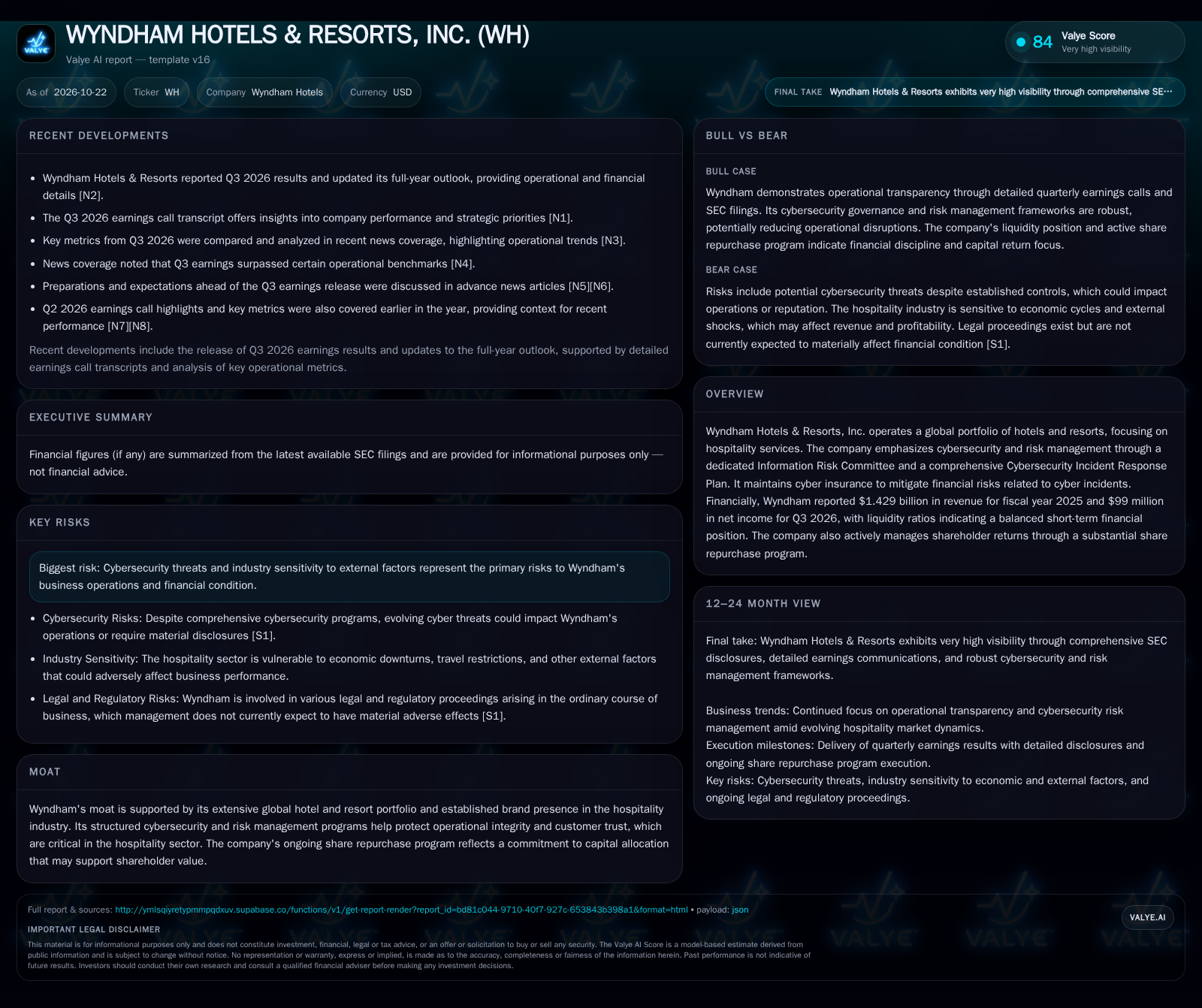
Wyndham Hotels & Resorts reported approximately $1.429 billion in revenue for the fiscal year ended December 31, 2025, and posted $99 million in net income for Q3 2026 [S1] [S2]. As of September 30, 2026, the company’s current assets stood at $504 million against current liabilities of $498 million, with cash and cash equivalents of $71 million, resulting in a current ratio of 1.01 and a cash ratio of 0.14 [S2]. These figures indicate a balanced short-term liquidity position—not aggressive, but not distressed.
The company’s cybersecurity and risk management apparatus is unusually robust, featuring an Information Risk Committee chaired by the CISO and SVP Legal, with board-level oversight. Wyndham maintains a Cybersecurity Incident Response Plan with annual testing and external support, and holds cyber insurance for both cyber events and business interruption [S1].
A $1.8 billion share repurchase program, with $479 million in remaining authorization, underscores the company’s commitment to shareholder returns [S2]. This combination of operational rigor and capital discipline defines Wyndham’s current strategic posture.
The Franchise-Driven Economics Shaping Wyndham’s Earnings Power
Wyndham’s business model is centered on franchising and, to a lesser extent, management of hotels and resorts. Franchise fees—typically calculated as a percentage of gross room revenue—constitute the core revenue stream, offering high margin potential and operating leverage since the company does not bear the direct costs of property ownership or daily operations.
This asset-light structure enables Wyndham to generate stable, recurring fee income while minimizing capital intensity. The model is sensitive to systemwide occupancy rates, average daily rates (ADR), and the pace of new hotel openings or conversions into the Wyndham system. When room demand is robust, incremental revenue flows disproportionately to the bottom line given the largely fixed overhead structure.
However, the company’s earnings are exposed to macro-driven volume swings, cost inflation passed through to franchisees, and the competitive dynamics of attracting and retaining hotel owners. Sustained franchise fee growth hinges on Wyndham’s ability to maintain or grow its system size, support property-level profitability, and defend pricing power amid rising labor and operating costs across the hospitality sector.
Brand Scale, Cybersecurity Trust, and the Shifting Landscape of Midscale Hospitality
Wyndham’s competitive advantage historically stems from its large, globally recognized portfolio of hotel brands spanning economy and midscale segments. This breadth provides the scale to negotiate with distribution partners, attract franchisees, and could create network effects—such as loyalty programs—across its system.
The hospitality industry is, however, intensely competitive. Wyndham competes with other major franchisors and operators, as well as with alternative lodging platforms. Barriers to entry at the brand level remain meaningful, but switching costs for franchisees may not be high unless Wyndham’s value proposition (distribution, technology, loyalty, and support) is demonstrably superior.
Wyndham’s visible investment in cybersecurity and risk management could become a unique selling point if cyber threats increasingly affect guest data or business continuity. However, the company must continually refresh its brand portfolio and technology stack to remain relevant, particularly as digital platforms and guest expectations evolve.
Unlocking Franchise Fee Growth Through Brand Expansion and Operational Leverage
The most favorable scenario for Wyndham is one in which travel demand remains resilient, and the company successfully expands its franchise base—either through organic growth, conversions, or selective international expansion. In this scenario, incremental systemwide revenue flows through to earnings at high margins due to the fixed-cost nature of the franchise model.
Evidence supporting this outcome would include a rising number of franchised properties, higher same-hotel revenue growth, stable or increasing franchisee retention rates, and positive commentary on pipeline conversion rates in earnings calls. Sustained growth in loyalty program membership and technology-enabled guest engagement would reinforce Wyndham’s value proposition for both guests and owners.
A further catalyst could be the successful monetization of new digital tools or ancillary services offered to franchisees, creating additional fee streams and stickier relationships.
Navigating Macro Cycles With Steady Fee Flows and Disciplined Capital Returns
The most plausible trajectory for Wyndham is continued moderate franchise fee growth, tempered by periodic macroeconomic headwinds and cost pressures. The company’s asset-light model should provide resilience compared to asset-heavy peers, but earnings will still fluctuate with changes in travel demand, ADR, and system size.
Share repurchases are likely to continue as a capital allocation priority, barring a material deterioration in financial performance or liquidity. Stable cybersecurity governance should reduce the risk of operational disruptions, but will not fully insulate the company from reputational or compliance shocks.
Confirmation of this scenario would come from stable to slightly growing system size, consistent quarterly franchise fee growth, and ongoing share repurchases within the existing authorization. If disclosed, metrics such as franchisee churn, pipeline conversion, and loyalty program engagement would help validate the stability of Wyndham’s platform.
Macro Shocks, Cyber Incidents, or Franchise Attrition Could Pressure Wyndham’s Model
Downside risk centers on a confluence of macroeconomic contraction (e.g., recession, travel demand shock), a significant cybersecurity breach, or a sustained increase in franchisee attrition. Because Wyndham’s revenue depends on systemwide room nights and franchisee stability, a sharp downturn in travel or loss of major franchisees could lead to negative operating leverage.
A severe cyber incident—despite current controls—could necessitate costly remediation, disrupt operations, and damage brand trust. Rising labor and property costs could also erode property-level profitability, making Wyndham’s franchise offer less attractive relative to alternatives.
Indicators that this scenario is playing out would include declining system size, negative same-hotel revenue growth, public disclosure of major cyber incidents, or a pause/reduction in share repurchases due to liquidity constraints or adverse events.
Milestones and Metrics That Will Shape Wyndham’s Long-Term Value Thesis
Quarterly changes in the number of franchised and managed properties, indicating system growth or contraction.
Same-hotel revenue growth rates, if disclosed, as a measure of underlying demand and pricing power.
Franchisee retention and churn rates, which would signal the health and competitiveness of Wyndham’s offering.
Updates on the size and conversion rate of the development pipeline, reflecting future fee growth potential.
Any public disclosure of significant cybersecurity incidents or remediation costs.
Trends in loyalty program membership and guest engagement metrics, as proxies for brand stickiness and guest acquisition.
Volume and pace of share repurchases relative to the authorized amount and free cash flow generation.
Property-level profitability trends or franchisee financial health, if discussed in earnings calls or disclosures.
Disclaimer: This is research-only, informational analysis and not investment advice. It may include AI-generated interpretation and general industry context. Always verify important details using primary sources.

Comments