
Norfolk Southern and the Union Pacific Merger: Shaping the Economics and Risks of an Integrated U.S. Rail Network
Norfolk Southern’s pending merger with Union Pacific stands to transform the U.S. freight rail landscape, promising operational and network synergies but facing regulatory, cost, and integration hurdles. Recent financials reflect improved efficiency, but fuel and competitive pressures remain central to the thesis.
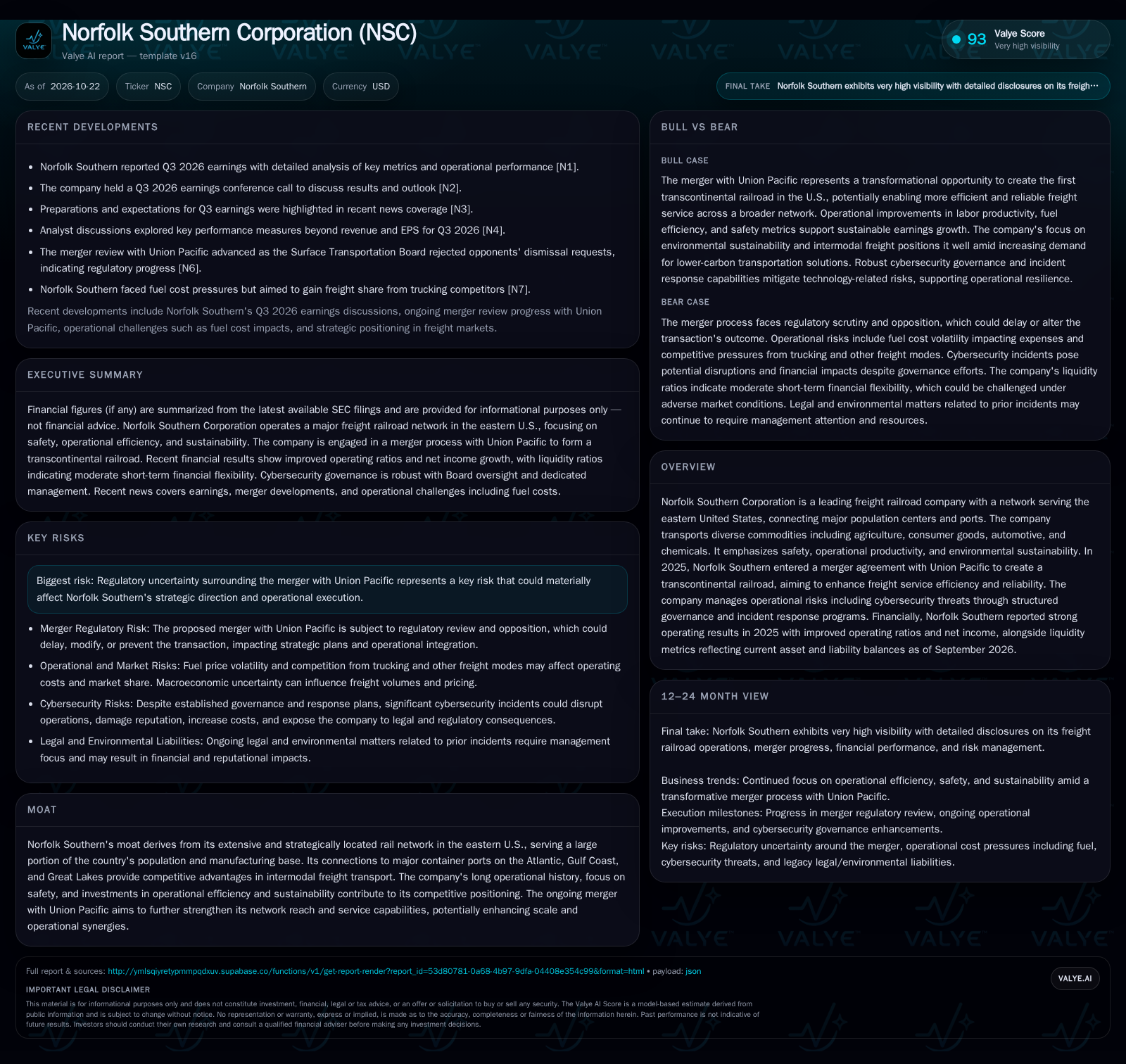
Norfolk Southern reported improved operating efficiency and strong earnings in 2025, while actively advancing a transformative merger with Union Pacific. The deal, if completed, could enhance network reach and operational scale but is subject to regulatory approval and integration risk. Cost pressures—especially from fuel—and competition from trucking remain material. Cybersecurity and legacy environmental liabilities round out the key risk factors. The investment thesis hinges on merger execution, cost management, and the ability to capture modal share from trucking.[S1] [S2] [N6] [N7]
Norfolk Southern stands at an inflection point: its pending merger with Union Pacific could create the first truly transcontinental freight railroad in the U.S., promising new scale and intermodal reach. Recent financials reflect operational improvements and a focus on cost control, yet the company faces acute fuel cost pressures and ongoing competition from the trucking sector. With regulatory review of the merger underway, the next phase for Norfolk Southern will hinge on its ability to execute integration, sustain efficiency gains, and capture share in a shifting logistics landscape—all while navigating legacy risks and evolving cybersecurity threats.
Merger Momentum, Financial Efficiency, and Persistent Cost Pressures
Norfolk Southern’s most material current development is its ongoing merger process with Union Pacific, which aims to create the first transcontinental rail operator in the United States. The combined network would connect the eastern and western halves of the country, offering shippers coast-to-coast service and potentially unlocking new operational efficiencies and pricing power. As of late 2026, the merger review process has advanced, with the Surface Transportation Board rejecting attempts to dismiss the proposal, suggesting regulatory evaluation is active but not yet resolved.[N6]
On the operational front, Norfolk Southern reported $12.18 billion in railway operating revenues and $2.87 billion in net income for 2025, with an improved operating ratio of 64.2%. This reflects both revenue growth and progress in cost containment—particularly in labor productivity and fuel efficiency. However, recent quarters have seen significant fuel cost headwinds, with fuel expenses rising from $700 million in the first nine months of 2025 to $1.08 billion in the same period of 2026, underscoring the volatility of operating inputs and persistent margin risk.[S1] [S2]
The company’s liquidity position as of September 2026 shows $1.6 billion in cash and equivalents, a current ratio of 0.9, and a cash ratio of 0.47. [S2]
Rail Economics: Volume, Pricing, and the Leverage of Network Integration
Norfolk Southern’s business model is anchored in transporting bulk and containerized freight across a dense eastern U.S. network, with revenue streams diversified across agriculture, consumer goods, automotive, and chemicals. The company’s ability to generate operating leverage stems from the high fixed-cost nature of rail infrastructure: once the network is in place, incremental volume can be moved at relatively low marginal cost, allowing for substantial profitability gains when demand is robust.
Pricing power in rail typically depends on network reach, service reliability, and the availability (or lack) of direct substitutes for long-haul freight. The pending merger with Union Pacific could materially alter the economics by creating end-to-end service offerings, reducing interchange complexity, and potentially enabling premium pricing for coast-to-coast shipments that bypass congested hubs or handoffs.
However, fuel remains a large and volatile input cost, as evidenced by the recent spike in fuel expenses. While railroads can often pass some fuel costs through to customers via surcharges, competitive dynamics with trucking and other railroads limit the full recovery of these increases. The capital intensity of the business remains high, with ongoing property additions and maintenance requirements; thus, sustained free cash flow and access to capital markets are critical, especially during periods of elevated operating expense or major integration events.
Network Density, Modal Substitution, and the Strategic Stakes of Integration
Norfolk Southern’s competitive position is rooted in its dense eastern network, longstanding relationships with major ports, and its ability to offer intermodal service at scale. The moat derives from physical infrastructure barriers, regulatory hurdles to new rail construction, and the entrenched nature of shipper relationships. However, competition from trucking—especially for time-sensitive or last-mile freight—remains intense, with trucking offering greater route flexibility and, at times, aggressive pricing.
The proposed merger with Union Pacific could enhance Norfolk Southern’s moat by extending its reach into the western U.S., creating a seamless transcontinental option for shippers and potentially raising switching costs for major customers. However, integration risks loom large: the complexity of aligning operations, technology systems, labor agreements, and customer service standards across two legacy networks could create friction, service disruptions, or cost overruns if not managed carefully.
Substitution risk is most acute in markets where rail competes directly with trucking for intermodal containers and bulk commodities. Advances in autonomous or electric trucking could, over time, erode rail’s cost and environmental advantages, particularly for medium-haul routes. For now, Norfolk Southern’s competitive strengths are durable, but ongoing investment in service reliability, technology, and customer integration will be required to maintain its edge.
Merger Synergies and Modal Share Gains: The Bullish Chain of Events
In a favorable scenario, the merger with Union Pacific is approved without major regulatory concessions or divestitures, and integration is executed smoothly. The combined entity leverages its expanded network to offer seamless transcontinental service, capturing share from both rival railroads and long-haul trucking by delivering faster, more reliable, and cost-effective freight options.
Operational synergies—such as optimized routing, shared technology platforms, consolidated purchasing, and streamlined labor—could drive material improvements in the operating ratio and free cash flow. If the company is able to pass through fuel costs efficiently or benefit from lower energy prices, margin expansion could be significant.
Confirmation of this scenario would come from regulatory approval milestones, evidence of volume growth in intermodal and long-haul segments, improvement in the operating ratio post-integration, and visible market share gains from trucking. Early customer wins for coast-to-coast contracts and positive feedback from shippers would further validate the upside thesis.
Operational Discipline and Integration Challenges Define the Next Phase
The most plausible trajectory is that the merger process continues through regulatory review, with approval likely but subject to conditions such as asset divestitures or service commitments. Integration proceeds with some inevitable friction—technology harmonization, labor negotiations, and network rationalization introduce temporary cost pressures and service variability.
Norfolk Southern maintains its focus on safety, productivity, and fuel efficiency, but faces ongoing volatility in input costs and competitive pricing from trucking. The company delivers moderate revenue growth as U.S. industrial activity and consumer spending fluctuate, and is able to defend margins through operational improvements.
Evidence supporting this scenario would include steady operating ratios (in the mid-60s), stable or modestly growing intermodal volumes, timely progress on merger integration milestones, and the absence of major service disruptions or regulatory penalties. Margins may remain under pressure if fuel costs stay elevated or if integration proves more complex than anticipated.
Regulatory Roadblocks, Integration Missteps, and Margin Compression
In the adverse scenario, the merger faces significant regulatory pushback, resulting in delays, onerous conditions, or even rejection. Alternatively, post-approval integration is marred by operational disruptions—technology failures, labor disputes, or customer defections—leading to service reliability issues and reputational damage.
Fuel cost inflation or an economic downturn could further erode margins, particularly if Norfolk Southern is unable to pass through costs or defend pricing against aggressive trucking competition. Legacy legal or environmental liabilities may resurface, requiring unexpected cash outlays and management focus.
Signs that this scenario is unfolding would include missed regulatory deadlines, sharp increases in operating ratio, negative customer feedback or lost contracts, and evidence of service failures during network integration. Material declines in liquidity or working capital would also signal stress.
Milestones That Will Shape Norfolk Southern’s Post-Merger Value Proposition
Progress of the Union Pacific merger through key Surface Transportation Board (STB) regulatory milestones, including disclosures of required divestitures or service commitments.
Reported operating ratio trends, particularly post-merger—sustained improvement or deterioration would provide a clear test of operational synergy realization.
Intermodal volume growth, especially in transcontinental and port-to-inland corridors, as evidence of modal share gains from trucking (if disclosed).
Fuel expense as a proportion of total operating costs and the effectiveness of fuel surcharge mechanisms during periods of price volatility.
Customer contract wins or renewals in the wake of the merger, signaling market acceptance of the integrated network (if disclosed).
Incidence and severity of operational disruptions or service delays during the integration process, including labor actions or technology migration setbacks.
Material legal or environmental settlements, as these could impact both cash flow and management bandwidth.
Cybersecurity incident disclosures and Board-level oversight updates, as evidence of continued resilience in the face of persistent digital threats.
Disclaimer: This is research-only, informational analysis and not investment advice. It may include AI-generated interpretation and general industry context. Always verify important details using primary sources.

Comments