
Nasdaq’s Technology Platform: Recurring Revenue Expansion, Competitive Resilience, and the Next Phase of Market Infrastructure Innovation
Nasdaq’s Q3 2026 results highlight record performance in index and fintech segments, a strategic push into always-on market infrastructure, and a growing focus on tokenized assets. The company’s recurring revenue base and leadership in listings underpin resilience, but macroeconomic and regulatory volatility remain persistent challenges.
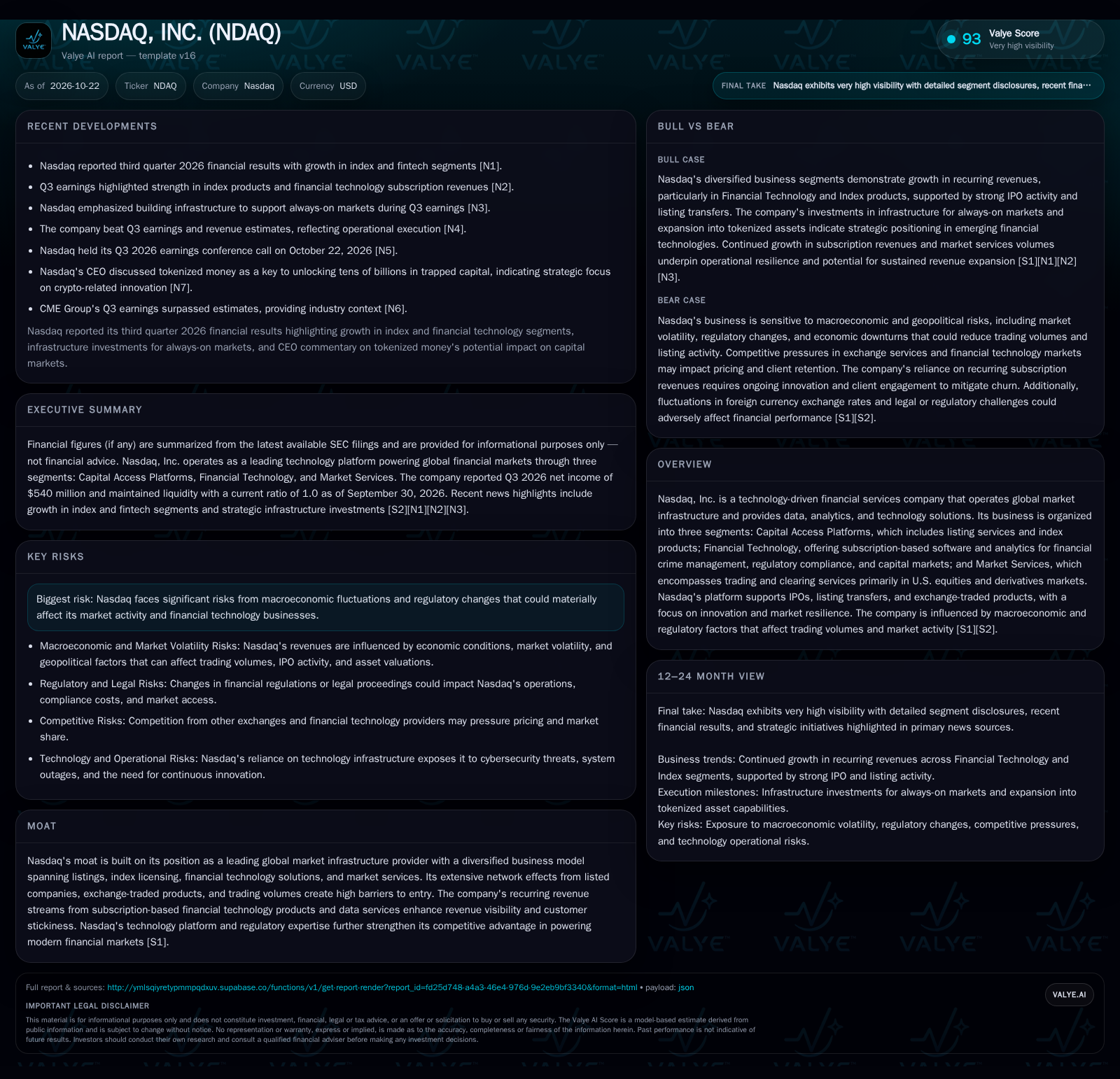
Nasdaq’s latest quarter underscores the strength of its diversified, technology-driven business model, with record net inflows in index products, 14% recurring revenue growth in financial technology, and continued dominance in U.S. IPO listings and transfers. Strategic investments in market infrastructure and tokenized asset capabilities aim to deepen network effects and revenue visibility, though exposure to macroeconomic cycles, regulatory shifts, and intense competition in exchange and fintech services remain key watchpoints. [S1] [S2] [N1] [N2] [N3] [N7]
Nasdaq, Inc. continues to evolve beyond its origins as a stock exchange operator, now functioning as a diversified technology platform at the center of global capital markets. Recent results showcase record-setting activity in listings, index products, and fintech solutions, while strategic commentary and infrastructure investments signal an ambition to enable always-on, tokenized financial ecosystems. The durability of Nasdaq’s recurring revenue streams and its network effects provide resilience, but the company’s fortunes remain tightly linked to macroeconomic cycles, regulatory environments, and the perpetual race to innovate in financial technology.
Recent Results Reflect Record Index Inflows and Fintech Momentum
Nasdaq’s Q3 2026 snapshot reveals several material developments. The company reported net income of $540 million for the quarter, with basic EPS of $0.97 and diluted EPS of $0.96. As of September 30, 2026, Nasdaq’s cash and equivalents stood at $365 million, with current assets of $4.532 billion and current liabilities of $4.517 billion, resulting in a current ratio of 1.0 and a cash ratio of 0.14. [S2]
On the operating front, Nasdaq achieved record net inflows of $99 billion in its Index segment for 2025, ending the year with $882 billion in ETP assets under management. The Financial Technology segment delivered 14% growth in annual recurring revenue and total revenue, attributed to new client wins and deeper penetration among existing accounts. [S1]
Nasdaq maintained its position as the leading U.S. IPO exchange for the seventh consecutive year, with over $24 billion in proceeds from U.S. operating company IPOs in 2025 and $1.2 trillion in listing transfers, including the largest on record. [S1]
Recent CEO commentary and earnings calls emphasize strategic investments in always-on market infrastructure and a push into tokenized money solutions, positioning the company for future shifts in capital markets technology. [N3] [N7]
How Nasdaq’s Diversified Segments Translate Into Recurring Revenue and Platform Economics
Nasdaq’s revenue mix is increasingly weighted toward recurring, subscription-based streams, particularly within its Financial Technology and Index segments. The Capital Access Platforms segment, which includes listings and index products, benefits from both transactional (listing fees, transfer fees) and recurring (index licensing, data services) revenue, providing a buffer against cyclical market downturns. The Index business, with nearly $900 billion in ETP AUM, generates steady licensing and asset-based fees that scale with inflows and market appreciation.
Financial Technology delivers software, analytics, and regulatory/compliance solutions primarily through multi-year subscription contracts. These products—ranging from financial crime management to workflow automation—can exhibit high gross margins and low incremental costs, enabling operating leverage as the client base expands. Revenue growth in this segment is driven by new client acquisition, cross-sell/upsell activity, and increasing regulatory complexity across global markets.
Market Services (equity derivatives, cash equities, clearing) remains more exposed to market volumes and volatility, but benefits from scale, automation, and the high fixed-cost nature of exchange infrastructure. Pricing power in this segment is limited by competition and regulatory oversight, but volume spikes during periods of volatility can deliver outsized incremental profit.
Nasdaq’s capital requirements are moderate relative to traditional asset-intensive businesses, but ongoing investment in technology infrastructure, cybersecurity, and regulatory compliance is essential to maintain platform reliability and win new business. The company reported cash and liquidity metrics for the period; these figures do not by themselves establish operating runway, investment capacity, financial flexibility, or financing capacity. [S2]
Network Effects, Platform Stickiness, and the Dynamics of Modern Exchange Competition
Nasdaq’s competitive moat is anchored in its dual role as a global market infrastructure provider and a technology platform. The breadth of its listings, the scale of its index franchise, and its integration into trading, data, and compliance workflows create significant switching frictions for institutional clients. As more companies list and more assets track Nasdaq indices, the platform’s relevance and stickiness increase, reinforcing network effects.
Competition remains fierce, however. U.S. and global exchanges compete aggressively for listings, trading volumes, and index licensing. Alternative trading systems, decentralized finance (DeFi) protocols, and fintech upstarts pose a structural threat, especially as technology reduces barriers to entry for new market venues. In Financial Technology, Nasdaq faces established software vendors and nimble regtech startups, requiring constant innovation to maintain pricing power and client retention.
Regulatory expertise, operational reliability, and deep client relationships are key differentiators. The company’s push into tokenized assets and always-on infrastructure could further entrench its position if these initiatives become industry standards, but could also expose Nasdaq to new forms of competition and regulatory scrutiny.
Tokenization and Always-On Markets Could Catalyze a New Phase of Growth
A favorable scenario for Nasdaq centers on its ability to leverage investments in tokenized assets and always-on infrastructure to unlock new capital flows and revenue streams. If the adoption of tokenized money accelerates, as suggested by recent CEO commentary, Nasdaq could become a foundational platform for digital asset issuance, trading, and settlement, capturing fees from new asset classes and expanding its role in global capital formation. [N7]
Sustained momentum in recurring fintech and index revenues, combined with further growth in IPO and listing activity, would compound operating leverage and improve margin visibility. Confirmation of this scenario would include: continued double-digit recurring revenue growth in Financial Technology, accelerating net inflows into index products, successful launch or scale-up of tokenized asset solutions, and evidence of new client wins tied to these innovations.
Falsification would come from regulatory pushback on tokenized markets, failure to win new digital asset mandates, or a slowdown in recurring revenue growth despite infrastructure investments.
Resilient Recurring Revenues Offset Market Cyclicality, But Macro and Regulatory Headwinds Persist
The most plausible outlook is for Nasdaq’s core recurring revenue streams in Financial Technology and Index products to continue offsetting the inherent cyclicality in Market Services. IPO activity and trading volumes may ebb and flow with macroeconomic conditions, but the company’s subscription and licensing revenues provide a stable earnings base.
Moderate growth is likely as new regulatory requirements and the proliferation of passive investment vehicles drive ongoing demand for Nasdaq’s technology and index solutions. The company’s investments in infrastructure and tokenized assets may yield incremental growth, but industry-wide adoption could be slow and subject to regulatory hurdles.
Evidence confirming this scenario would be ongoing mid-single-digit growth in recurring revenues, steady net inflows into index products, and a balanced mix of transactional and subscription income. Falsification would come from a material decline in recurring revenue, a sustained downturn in IPO/listing activity, or rising client churn in Financial Technology.
Market Volatility, Regulatory Shocks, or Tech Disruption Could Erode Revenue and Moat
A negative scenario would be triggered by a combination of macroeconomic recession, regulatory upheaval, or disruptive technological change. A sharp decline in trading volumes, IPOs, or listing transfers—driven by a market downturn or loss of investor confidence—would directly pressure Market Services and Capital Access revenues.
If regulatory bodies impose new restrictions on digital assets, trading practices, or exchange fees, Nasdaq could face higher compliance costs and lower pricing power. Meanwhile, a breakthrough by a disruptive fintech or DeFi platform could siphon off trading and data volumes, challenging the company’s network effects and customer stickiness.
This scenario would be confirmed by falling net inflows in index products, negative recurring revenue trends in Financial Technology, customer defections or pricing concessions to retain business, or any material legal or regulatory action curbing core business lines.
Milestones That Will Validate or Challenge Nasdaq’s Recurring Revenue Thesis
Sustained double-digit recurring revenue growth in Financial Technology—if disclosed—would support the upside view that subscription and SaaS economics are scaling.
Quarterly net inflows and total AUM in the Index segment: continued records would signal network effects and competitive strength.
Annual proceeds from IPOs and listing transfers: a sharp drop could indicate waning platform relevance or macro headwinds.
Adoption rates and commercial traction for tokenized asset solutions: customer wins, volume metrics, or integration announcements would be informative—if disclosed.
Revenue mix evolution: a rising proportion of recurring vs. transactional revenues would suggest improving earnings predictability.
Regulatory developments affecting digital assets, exchange operations, or data monetization: new rules or enforcement actions could alter profit pools.
Client retention, renewal rates, and cross-sell/upsell metrics in Financial Technology—if disclosed—would help test the durability of customer relationships.
Major technology outages, security incidents, or operational disruptions: any such event could undermine client trust and competitive positioning.
Disclaimer: This is research-only, informational analysis and not investment advice. It may include AI-generated interpretation and general industry context. Always verify important details using primary sources.

Comments