
Snap-on’s Strategic Expansion: Innovation, Operational Discipline, and Market Dynamics
Snap-on Inc’s recent acquisitions and ongoing operational initiatives highlight a push to diversify revenue streams and enhance productivity, but modest organic growth and inflationary pressures signal a need for continued execution discipline and strategic focus.
Snap-on Inc is leveraging acquisitions like Diesel Laptops and Hi-Force to broaden its diagnostics and industrial tool offerings, while its Rapid Continuous Improvement program continues to drive operational efficiency. The company’s success in integrating new businesses, delivering innovation such as the Apollo diagnostic tool, and capturing emerging demand in markets like data centers will be critical to reversing recent organic declines and sustaining its competitive edge. [S2] [N3] [N6] [N8]
Snap-on Inc’s latest quarterly results underscore the company’s dual strategy of operational efficiency and targeted acquisition-driven expansion. While the firm maintained impressive gross margins and boasts a reported liquidity position, organic sales slipped and operating expenses climbed in Q3 2026. The integration of new diagnostic and industrial tooling assets, along with investments in innovation and brand, will be pivotal as Snap-on seeks to counteract macroeconomic headwinds and capitalize on emerging market opportunities. The next phase hinges on Snap-on’s ability to translate its diversified portfolio and operational initiatives into sustainable topline growth and margin stability.
Recent Results Demonstrate Margin Strength Despite Organic Growth Deceleration
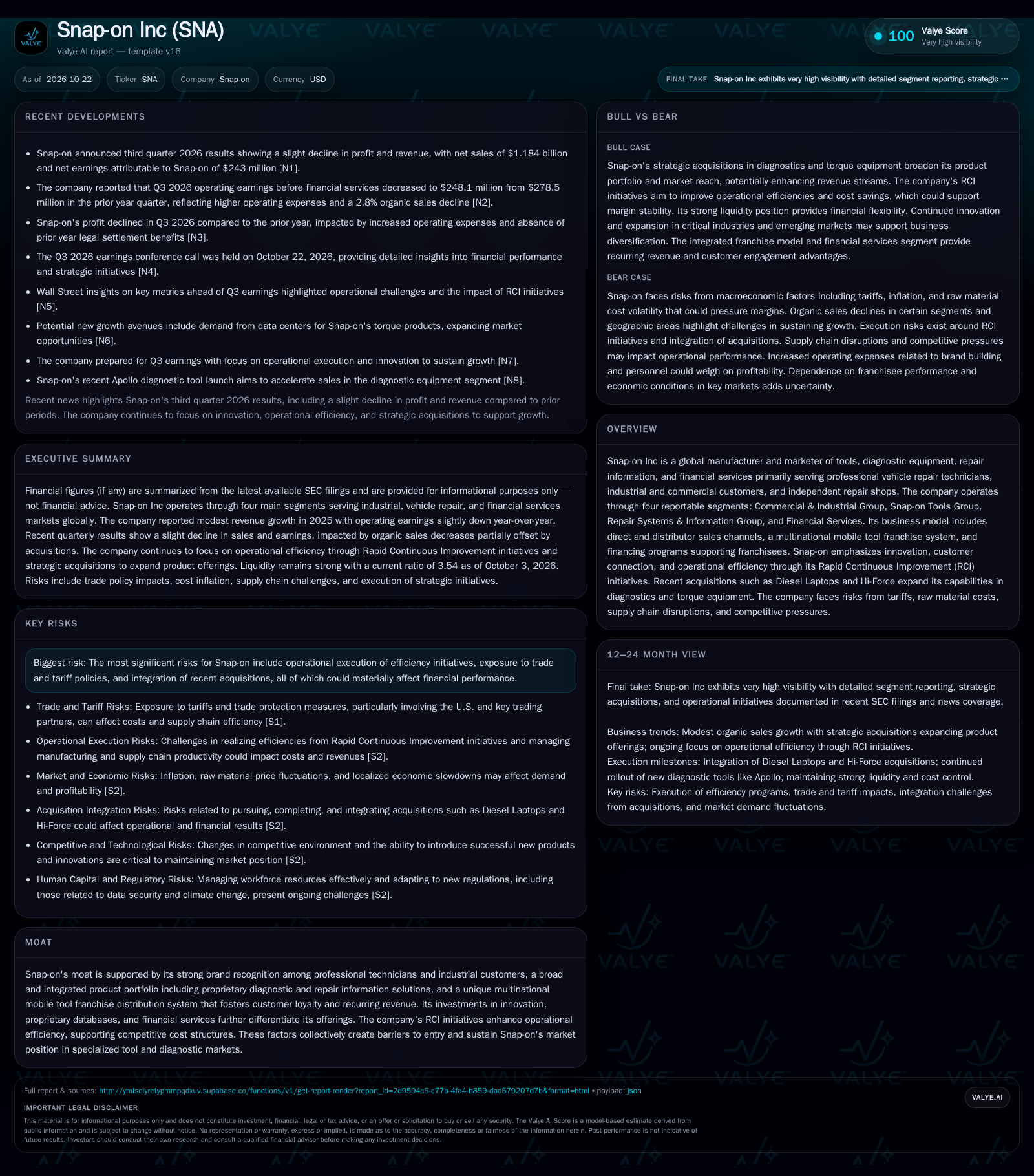
In Q3 2026, Snap-on reported net sales of $1.184 billion—a 0.6% decrease from the prior year. Organic sales declined by 2.8%, with the contraction partially offset by contributions from recent acquisitions (Diesel Laptops and Hi-Force) and foreign currency effects. Despite top-line pressures, gross margin improved slightly to 51.0%, benefitting from cost efficiency programs. Operating expenses increased, driven by higher brand and personnel investments and the absence of a prior year legal settlement benefit. As of October 3, 2026, Snap-on reported $1.67 billion in cash and a current ratio of 3.54. These dynamics reflect both the challenges of maintaining organic growth in a competitive, inflationary environment and the ongoing commitment to productivity and innovation. [S2] [N3]
Snap-on’s Multi-Segment Model Enhances Value Creation and Shapes Margin Profile
Snap-on’s revenue model is anchored in four segments: industrial/commercial tools, mobile franchise van sales, repair systems and diagnostics, and financial services. The direct and distributor sales channels, especially the mobile franchise system, create high customer intimacy but require ongoing investment in franchisee support and product innovation. Diagnostic and information solutions, such as the Apollo tool, offer higher margin potential due to proprietary software and recurring update/service opportunities, though the extent of recurring revenue is not disclosed.
Operating leverage is a key feature: the company’s Rapid Continuous Improvement (RCI) initiatives target fixed cost reduction and supply chain efficiencies, enabling gross margin improvement even when sales are flat or declining. However, variable costs—especially raw materials and labor—remain exposed to inflation and supply chain volatility, limiting margin upside in inflationary periods.
The Financial Services arm provides in-house financing to franchisees and customers, smoothing revenue recognition and supporting sales, but introduces some credit risk and ties up capital. Recent acquisitions in diagnostics and industrial torque equipment could shift the sales mix toward higher-value, specialized offerings, but integration costs and return-on-invested-capital will be critical to long-term value.
Brand, Channel, and Data Fortify Snap-on’s Competitive Moat While Posing Risks
Snap-on’s moat rests on brand loyalty among professional technicians, a differentiated multinational mobile franchise network, and a broad portfolio that includes proprietary diagnostic equipment and data-driven repair solutions. The company’s direct sales model fosters repeat business and high customer switching frictions, particularly in the tool and diagnostics ecosystem.
However, competitive threats persist from large diversified tool manufacturers, digital disruptors in diagnostics, and OEMs offering integrated repair solutions. As vehicle technology evolves (e.g., electrification, ADAS), the technical complexity and update cycle for diagnostics intensifies, raising the bar for innovation and data quality.
Recent moves into data center torque applications and expanded industrial tool lines suggest Snap-on is actively seeking new verticals less vulnerable to automotive cyclicality. The risk is that competitors with greater scale or digital expertise could erode Snap-on’s pricing power or accelerate customer switching if Snap-on’s pace of innovation lags.
Growth Opportunities in Integration, Innovation, and Vertical Market Entry
In a favorable scenario, Snap-on successfully integrates Diesel Laptops and Hi-Force, leveraging cross-selling and expanded industrial reach to offset slowdowns in core automotive markets. The Apollo diagnostic tool gains traction, establishing Snap-on as a go-to provider for next-generation vehicle diagnostics, while proprietary data and subscription-based services increase recurring revenue.
Emerging demand from data centers for torque products could become a meaningful revenue stream, diversifying the customer base and reducing exposure to auto repair cycles. Operating leverage from RCI initiatives would allow margin expansion even with moderate topline growth.
Confirmation would come from a sustained return to organic sales growth, increasing contribution from non-automotive segments, and higher revenue per customer in diagnostics and data services. A rising share of recurring or software-driven revenue, if disclosed, would further validate the scenario. [N6] [N8]
Macro Headwinds and Product Expansion Set the Stage for Business Stabilization
The most plausible outcome is that Snap-on manages modest organic sales growth, with acquisitions providing incremental boosts. Cost inflation remains a headwind, but ongoing RCI initiatives and selective price increases help preserve gross margins near current levels. The franchise van and repair segments continue to generate steady cash flow, while new products like Apollo add incremental, but not transformative, growth.
Integration of recent acquisitions proceeds without major disruption, but synergies are gradual rather than dramatic. The company’s reported liquidity and disciplined capital allocation limit downside risk, but sustained margin or revenue acceleration is deferred until macro conditions improve or a new product/vertical achieves scale.
Evidence would include stable to slightly improving organic sales, gross margin maintenance above 50%, and steady contribution from financial services. Any sign of franchisee distress, integration setbacks, or margin slippage would challenge this outcome.
Integration Challenges and Market Shifts Could Stall Growth and Compress Margins
A negative scenario would unfold if Snap-on struggles to integrate its acquisitions, resulting in operational inefficiencies, unexpected costs, or cultural misalignment. If inflation accelerates or supply chain disruptions intensify, gross margins could compress despite RCI efforts. Sluggish demand in core automotive markets, compounded by competitive encroachment or technological obsolescence in diagnostics, could drive further organic sales declines.
Rising operating expenses—whether from wage inflation, increased customer acquisition costs, or ongoing investment in brand and digital capabilities—could outpace revenue growth, eroding profitability. Franchisee health could deteriorate if economic conditions worsen, potentially impacting tool sales and financial services performance.
This scenario would be confirmed by continued organic revenue contraction, a decline in gross margin below recent levels, visible integration missteps, or rising credit losses in the Financial Services segment.
Factors Influencing Snap-on’s Future in Tools, Diagnostics, and Industrial Markets
Organic sales growth by segment—especially in diagnostics and industrial tools—would help test whether recent investments are yielding new revenue streams, if disclosed.
Gross margin trends quarter-over-quarter, as a direct measure of Snap-on’s ability to offset inflation and realize RCI benefits.
Operating expense as a percentage of sales, indicating whether brand and personnel investments are translating into operating leverage or pressuring margins.
Progress on integration milestones for Diesel Laptops and Hi-Force, including revenue synergies, retention of key personnel, and cross-selling activity, if disclosed.
Recurring revenue or software/service attachment rates in the diagnostics segment—a useful metric would be the proportion of sales tied to data subscriptions or ongoing service contracts.
Franchisee performance and van network health, including franchisee retention, sales productivity, and financing defaults, if available.
Evidence of new vertical traction—such as data center torque sales volume or revenue contribution—validating Snap-on’s ability to diversify beyond automotive.
Working capital trends and credit losses in the Financial Services segment, especially if macro conditions deteriorate.
Disclaimer: This is research-only, informational analysis and not investment advice. It may include AI-generated interpretation and general industry context. Always verify important details using primary sources.

Comments