
Tesla in 2026: Innovation Ambitions, Financial Realities, and the Next Competitive Horizon
Tesla enters late 2026 with robust revenue, a substantial cash balance, and a high-profile innovation agenda spanning electric vehicles, autonomy, and energy. Yet, the company's operational execution, mounting competitive threats, and leadership concentration define both its upside and vulnerability in a rapidly evolving global auto and technology landscape.
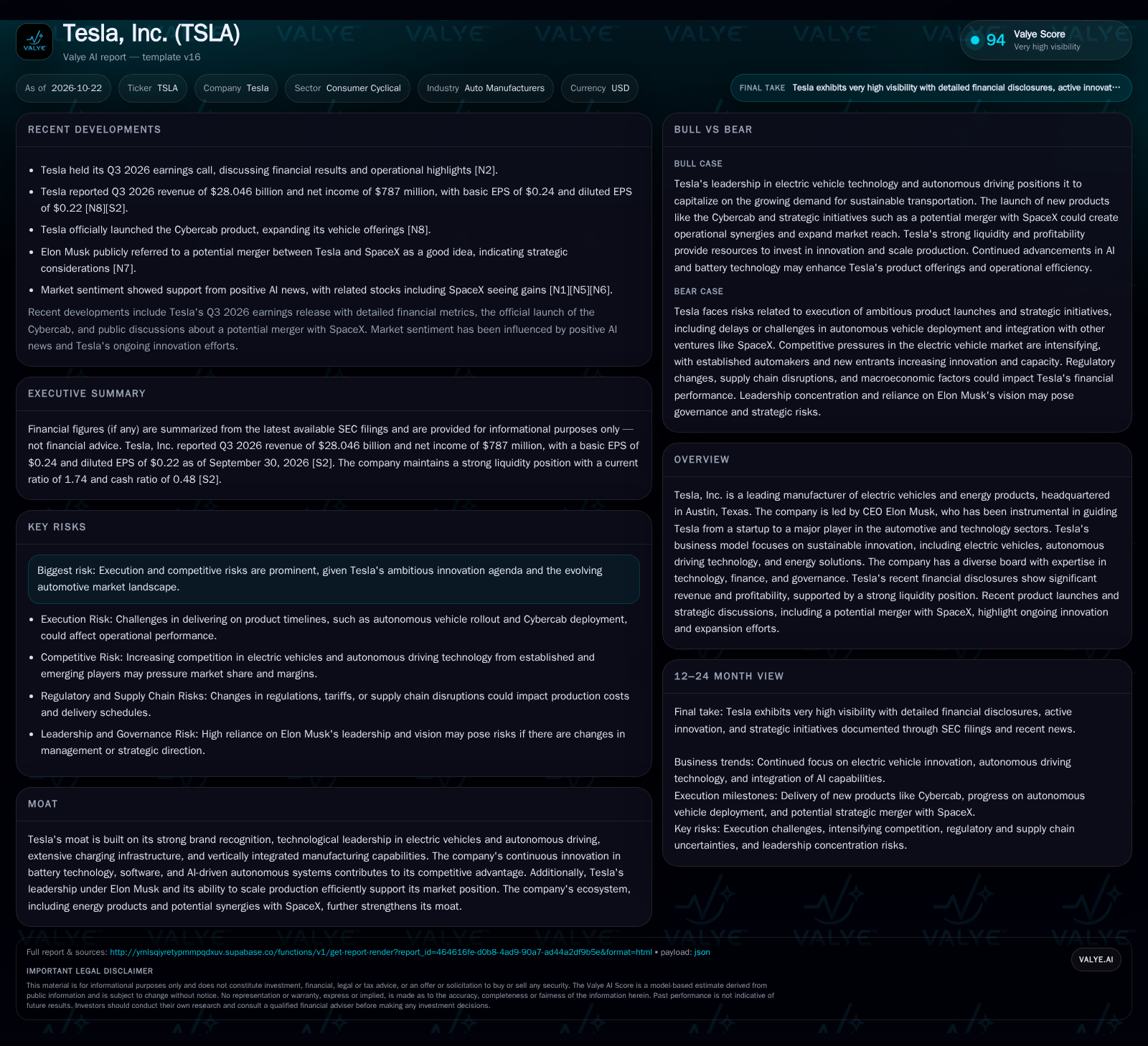
Tesla reported $28.0B in Q3 2026 revenue and $787M in net income, maintaining a sizable $17.9B cash position. The company faces ambitious product timelines, possible strategic moves such as a SpaceX merger, and intensifying competition in EVs and autonomy. Execution discipline, regulatory developments, and pacing on AI/autonomous rollouts will be central to future value creation and risk management. [S2] [N2] [N7]
Tesla’s 2026 profile combines formidable financial scale with an outsized technological ambition: $28 billion in quarterly revenue, nearly $18 billion in cash, and a CEO with a penchant for pushing boundaries. The company’s core electric vehicle and energy businesses are accompanied by a high-stakes bet on autonomous driving and AI, with product launches and even a potential merger with SpaceX shaping the conversation. Yet, as competition stiffens and regulatory and operational risks mount, Tesla’s ability to execute, adapt, and lead will determine whether its innovation engine translates into durable economic advantage.
Tesla’s Q3 2026 Snapshot: Scale, Cash, and Strategic Questions
Tesla reported Q3 2026 revenue of $28.046 billion and net income of $787 million, reflecting continued scale and profitability in its core operations. As of September 30, 2026, the company held $17.853 billion in cash and equivalents, with a current ratio of 1.74 and a cash ratio of 0.48. The company reported cash and liquidity metrics for the period; these figures do not by themselves establish operating runway, investment capacity, financial flexibility, or financing capacity. [S2]
The company’s leadership remains centered on Elon Musk, who retains approximately 20% ownership and continues to shape Tesla’s innovation agenda. Public discussion about a possible merger with SpaceX, endorsed as a 'good idea' by Musk himself, raises the prospect of deeper integration between automotive, energy, and space technology. [N7]
Tesla’s current positioning is defined by its commitment to sustainable innovation—spanning electric vehicles, autonomous driving, and energy products—while facing executional and competitive headwinds that could impact its ability to deliver on ambitious promises. [S1] [N2]
Underlying Economics: Volume Scale, Investment Intensity, and Operating Leverage
Tesla’s business model is built on high-volume manufacturing of electric vehicles, supported by proprietary technology in batteries, software, and autonomy. The company’s vertically integrated approach—owning manufacturing, much of its supply chain, and its charging network—aims to capture margin and control quality, but also exposes the business to sizable fixed costs and capital intensity.
The company’s $28 billion quarterly revenue base suggests substantial operating leverage, with incremental gross margin highly sensitive to utilization rates, product mix (e.g., Model 3/Y vs. higher-end models or energy products), and pricing discipline. However, continued investment in R&D, AI, and new production lines (including for autonomous and next-generation vehicles) requires ongoing capital allocation, and the path to scalable, profitable autonomy remains uncertain.
If new product launches—such as the Cybercab or advanced FSD—achieve commercial success and operational efficiency, margin expansion could follow. Conversely, cost overruns, recalls, or delayed ramp-ups could erode profitability.
Defending the Moat: Technological Edge vs. Global Automotive Giants
Tesla’s competitive advantage historically rests on early-mover status in EVs, proprietary battery and software technology, and a globally recognized brand. Its direct-to-consumer sales model, expansive charging infrastructure, and aggressive autonomous driving R&D support its differentiation.
However, the competitive landscape is shifting rapidly. Incumbent automakers are ramping up EV production with increasingly compelling models, leveraging global scale and distribution. New entrants, especially in China and Europe, are innovating on both cost and features. In autonomy, tech firms and traditional OEMs are investing heavily, narrowing Tesla’s perceived lead.
The question is whether Tesla’s pace of innovation, vertical integration, and ecosystem synergies (potentially including SpaceX) can maintain or widen its moat—particularly as regulatory scrutiny, price competition, and technology convergence accelerate.
When Execution Meets Vision: How Tesla Could Outrun Its Rivals
The most favorable scenario for Tesla involves successful, timely launches of next-generation vehicles and autonomous capabilities, resulting in market share gains and margin expansion. If the company’s AI and battery technology deliver clear, defensible advantages—such as superior range, safety, or fully autonomous operation—Tesla could cement a prominent position as both a mobility and technology platform.
A merger or deeper integration with SpaceX could unlock operational synergies in advanced manufacturing, AI, or energy storage, and further reinforce the brand’s innovation halo. Continued strong cash flow and disciplined capital allocation would support rapid scaling and adaptation to new regulatory or market environments.
Evidence confirming this scenario would include: accelerating adoption of new Tesla models or autonomous features, clear regulatory approvals for FSD, sustained or rising gross margins despite competitive pressure, and early signs of successful SpaceX collaboration. Conversely, repeated delays, lackluster adoption, or margin compression would challenge the bullish case.
Balancing Growth and Risk: Tesla’s Most Likely Trajectory
The most plausible path forward sees Tesla maintaining its leadership position in global EVs while experiencing gradual erosion of its technology gap as competitors catch up. Revenue growth continues, but at a moderated pace, with margins pressured by increased competition, cost inflation, and the ongoing need for heavy R&D and capex.
Autonomous driving features progress incrementally, with regulatory hurdles and technological complexity preventing full-scale rollout in the near term. Tesla’s energy and storage segments expand, but remain secondary to the auto business in terms of profit contribution.
Confirmation would come from steady (but not accelerating) vehicle deliveries, stable but not expanding automotive margins, and gradual adoption of new technology features. A plausible falsification would be a sudden surge in competitive pricing pressure, major execution shortfalls, or regulatory setbacks in key markets.
When Ambition Outpaces Delivery: Where Tesla’s Risk Lurks
The main risk for Tesla is that ambitious product and autonomy timelines slip, leading to missed volume targets, cost overruns, or high-profile recalls. If competitors rapidly close the technology gap or undercut Tesla on price and features, the company could see market share and margin erosion.
Execution failures—whether in scaling new models, achieving reliable FSD, or integrating new ventures—could undermine investor confidence and strain cash resources, especially if paired with regulatory or legal setbacks. Leadership concentration around Elon Musk may amplify strategic volatility or execution risk.
Confirmation of this scenario would include repeated delays in product launches, adverse legal or regulatory rulings, a sharp decline in gross margin, or an observable shift in consumer preference toward rivals’ EVs or autonomous offerings.
Concrete Markers for Testing Tesla’s Innovation and Execution Thesis
Pace of new vehicle deliveries and backlog conversion, especially for next-generation models and autonomous-capable vehicles.
Gross margin trend by segment (automotive, energy, and services), particularly in the face of new competition and pricing dynamics.
Regulatory milestones or approvals for full self-driving (FSD) features in major global markets.
R&D and capital expenditure levels relative to revenue growth—an indicator of sustainable innovation and operational discipline.
Frequency, scale, and impact of recalls, warranty costs, or product-related litigation, if disclosed.
Evidence of operational or technology synergies with SpaceX or other Musk-led ventures, should a merger or integration proceed.
Churn or retention rates for software/autonomous feature subscriptions, if disclosed.
Customer adoption rates and satisfaction metrics for Tesla’s energy and storage products, as a signal of ecosystem depth and cross-selling potential.
Disclaimer: This is research-only, informational analysis and not investment advice. It may include AI-generated interpretation and general industry context. Always verify important details using primary sources.

Comments