
IBM’s Hybrid Cloud and AI Strategy: Scale, Execution, and the Next Competitive Battleground
IBM’s latest results underscore its commitment to hybrid cloud and AI, but financial leverage, competitive intensity, and execution risks put the spotlight on whether its innovation and partnerships can drive sustainable growth.
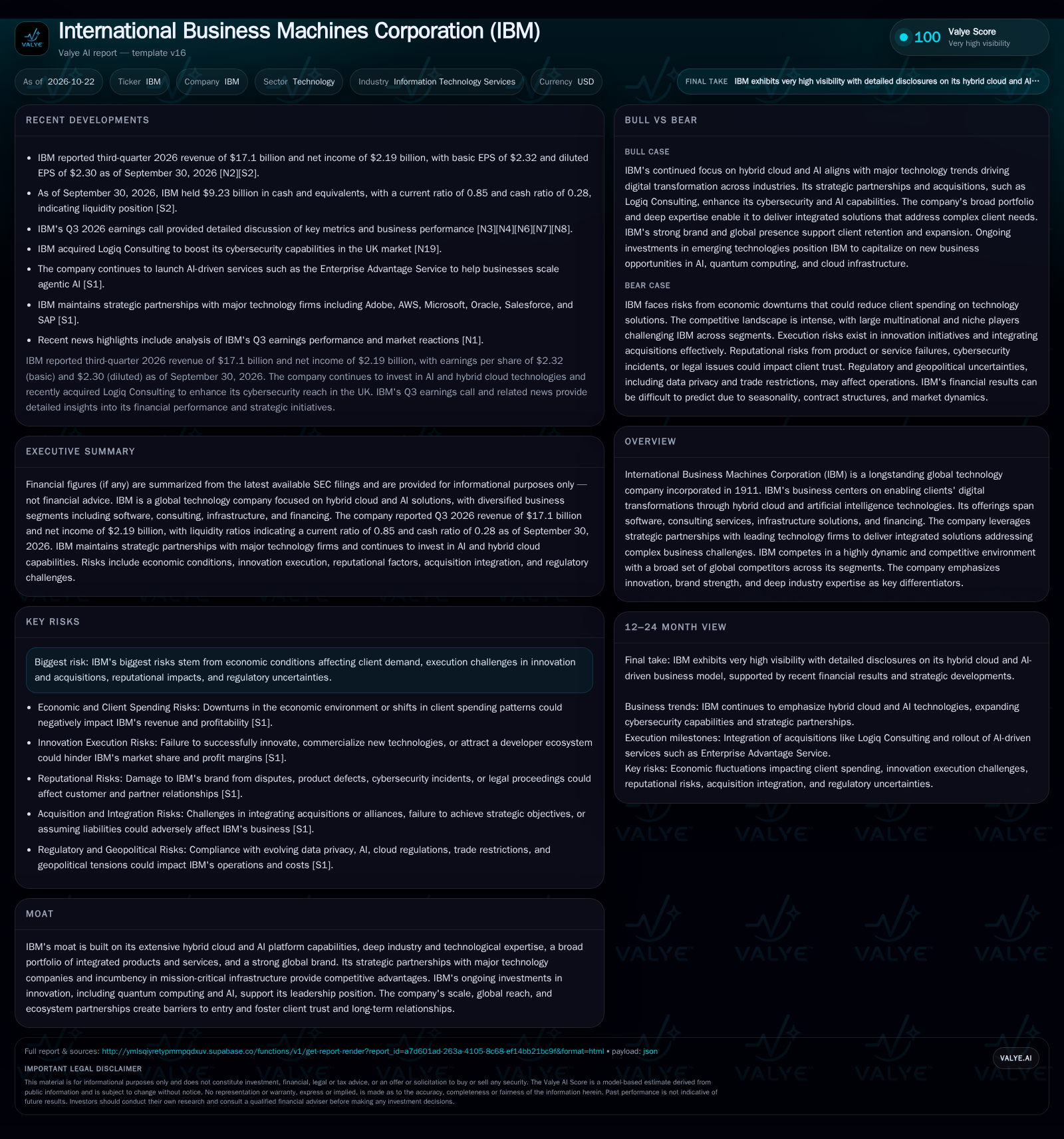
IBM reported Q3 2026 revenue of $17.1 billion and net income of $2.19 billion, with a current ratio of 0.85 as of September 30, 2026. The company is investing in AI and hybrid cloud, launching new services and expanding strategic partnerships. The key question is whether IBM can translate its innovation and ecosystem leverage into durable revenue and margin expansion in a crowded market. [S2] [N2]
IBM’s third-quarter 2026 results highlight both the strengths and tensions at the heart of its transformation. With $17.1 billion in revenue and $2.19 billion in net income, IBM demonstrates the scale and relevance of its hybrid cloud and AI-driven strategy. The next phase will test whether IBM’s technology investments and ecosystem leverage are enough to overcome structural and market headwinds. [S2] [N2]
Recent Financial Performance and Strategic Momentum
IBM reported Q3 2026 revenue of $17.1 billion and net income of $2.19 billion, with diluted earnings per share of $2.30. These figures reaffirm IBM’s position as a major player in enterprise technology, underpinned by a broad portfolio spanning software, consulting, infrastructure, and financing. This balance-sheet structure is not unusual for a mature enterprise IT provider but could become a constraint if business conditions deteriorate or large investments are required. IBM’s continued investment in AI and hybrid cloud, including the launch of the Enterprise Advantage Service, reflects its commitment to staying at the leading edge of technology transformation. [S2] [N2] [S1]
For instance, the interplay between debt maturities, cash flow generation from recurring revenue streams, and capital expenditures on infrastructure upgrades can significantly influence IBM's strategic agility. Additionally, the pace and scale of R&D spending in AI and hybrid cloud relative to competitors would indicate whether IBM is positioning itself to close innovation gaps or risk falling behind. Understanding these financial dynamics is critical to evaluating whether IBM's current momentum is built on a durable foundation or is vulnerable to external shocks or internal resource constraints.
Hybrid Cloud and AI Economics: Scale, Mix, and Margin Leverage
IBM’s revenue streams are diversified across software, consulting, infrastructure, and financing, but the company’s growth narrative now centers on hybrid cloud and AI. These segments tend to feature a mix of recurring revenue (software subscriptions, cloud services), project-based consulting, and hardware/infrastructure sales. Software and cloud subscriptions, if IBM can grow them, offer higher gross margins and more predictable cash flow compared to legacy infrastructure or low-margin consulting projects. However, capital requirements remain significant: ongoing R&D in AI and quantum computing, integration of acquisitions, and the need to maintain global infrastructure. Operating leverage is possible if IBM can shift its revenue mix toward higher-margin, lower-variable-cost platforms, but this requires both successful innovation and the ability to cross-sell integrated solutions to large enterprise clients. The risk is that competitive pricing pressure and integration complexity could erode margin gains from new services.
The economics of hybrid cloud and AI services also depend heavily on IBM's ability to optimize customer lifetime value through integrated offerings. If IBM can successfully bundle software, consulting, and infrastructure into cohesive solutions that reduce client complexity and cost, it may increase switching costs and deepen client relationships. However, this requires seamless interoperability and a unified customer experience across disparate platforms and services, which can be challenging given IBM’s broad portfolio and partner dependencies. Furthermore, the capital intensity of maintaining and expanding global data centers to support hybrid cloud must be balanced against the margin profile of subscription revenues. The timing and scale of these investments, coupled with the pace of client adoption, will materially affect IBM’s operating leverage and profitability trajectory.
Differentiation in a Crowded and Evolving Market
IBM competes with technology giants and specialized players across all segments—software (e.g., Microsoft, Oracle), cloud (e.g., AWS, Google Cloud), consulting (e.g., Accenture, Deloitte), and infrastructure (e.g., Dell Technologies, HPE). Its potential advantages lie in its broad portfolio, integrated solutions, deep industry expertise, and long-standing client relationships, especially in regulated or mission-critical sectors. Strategic partnerships with Adobe, AWS, Microsoft, Oracle, Salesforce, and SAP expand IBM’s ecosystem reach but can also create dependencies on external platforms and evolving standards. The competitive threat is twofold: hyperscale cloud providers can outspend IBM on infrastructure and AI, while specialized SaaS and consulting firms can outmaneuver on agility and customer intimacy. The question is whether IBM’s portfolio breadth, innovation pipeline, and global reach are enough to maintain share and pricing power in a market where switching costs are declining and technology cycles are accelerating. [S1]
IBM's differentiation strategy hinges not only on breadth but on the depth of integration across its hybrid cloud and AI offerings. The company's ability to embed AI capabilities into industry-specific workflows and compliance frameworks could create defensible niches, especially in sectors with stringent regulatory requirements. However, this advantage is conditional on IBM’s agility in updating solutions in response to rapidly evolving client needs and regulatory landscapes. Moreover, strategic partnerships, while expanding ecosystem reach, may constrain IBM’s product roadmap or expose it to platform risk if partners prioritize their own cloud or AI services. Thus, IBM must continuously calibrate these relationships to preserve its competitive positioning while leveraging partner strengths.
Integrated AI Services Drive Margin Expansion and Share Gains
In a favorable scenario, IBM’s investments in AI and hybrid cloud translate into a growing share of high-margin, recurring-revenue contracts. The successful rollout of new offerings like the Enterprise Advantage Service attracts large enterprise clients seeking integrated, scalable, and secure AI solutions. Strategic partnerships deepen, enabling IBM to deliver end-to-end value across software, infrastructure, and consulting, while cross-selling AI and cybersecurity capabilities acquired through recent deals. Operating leverage emerges as software and cloud mix increases, driving both gross and operating margin expansion. Confirmation would come from sustained growth in software/cloud revenues, rising margins, and evidence of large, multi-year client wins or renewals specifically attributable to new AI-driven offerings. Falsification would be indicated by stagnation or decline in these segments, margin compression, or the loss of major clients to cloud-native or SaaS competitors.
Incremental Growth Amid Margin Pressure and Execution Complexity
The most plausible trajectory is that IBM continues to grow software and cloud revenues modestly through incremental innovation, cross-selling, and deepening partnerships, but faces ongoing margin pressure from competition and the need to fund R&D and integration costs. Consulting and infrastructure remain important but do not outpace the broader market. While new AI-driven services gain traction, adoption is gradual as large enterprise clients move cautiously, and some deals are offset by pricing concessions or churn in legacy businesses. This scenario would be confirmed by steady but unspectacular revenue and margin trends, stable client retention, and the absence of major step-changes in either competitive wins or losses. Falsification would occur if revenue growth stalls across key segments, integration costs escalate, or IBM is forced to curtail investments due to balance-sheet constraints.
Execution Missteps and Intensifying Competition Erode Franchise Value
In a negative outcome, IBM’s innovation and integration efforts fall short—either due to technical setbacks, slow client adoption, or failure to differentiate versus cloud-native and SaaS rivals. Economic headwinds or regulatory changes further dampen client spending on large transformation projects, leading to revenue stagnation or decline. Margin erosion accelerates as pricing pressure intensifies and IBM is forced to invest more heavily to retain clients or chase growth. Evidence supporting this scenario would include missed revenue or margin targets, loss of major client contracts, rising restructuring or integration costs, and negative commentary from clients or partners about IBM’s relevance or execution. Falsification would require clear evidence of successful innovation commercialization, competitive win-backs, or rapid scaling of new, high-margin services.
Milestones That Will Shape IBM’s Next Chapter
Sustained revenue growth in software and hybrid cloud segments, especially attributable to AI-driven offerings, would support the thesis that IBM is capturing next-generation tech demand.
Gross and operating margin trends—improvement would indicate successful mix shift and operating leverage, while compression could signal competitive or integration headwinds.
Large, multi-year client contract wins or renewals, particularly those citing AI or hybrid cloud as differentiators, would be strong validation of IBM’s strategic direction.
Evidence of successful integration and commercialization of recent acquisitions (such as Logiq Consulting) would suggest IBM can translate M&A into operational value.
Disclosures on client retention/churn rates—if disclosed—would help assess the stickiness of IBM’s new and legacy offerings in a fast-changing technology landscape.
Client or partner commentary in earnings calls or industry forums regarding IBM’s execution, integration, and differentiation would offer qualitative insight into competitive positioning.
Disclaimer: This is research-only, informational analysis and not investment advice. It may include AI-generated interpretation and general industry context. Always verify important details using primary sources.

Comments