
Meta Platforms: Advertising Strength and AI Growth Amid Regulatory Pressures
Meta’s robust Q3 2026 financial performance underscores the strength of its advertising-driven core, while Reality Labs’ persistent losses and a record $25 billion regulatory fine highlight the execution and compliance hurdles facing its push into AI and immersive computing.
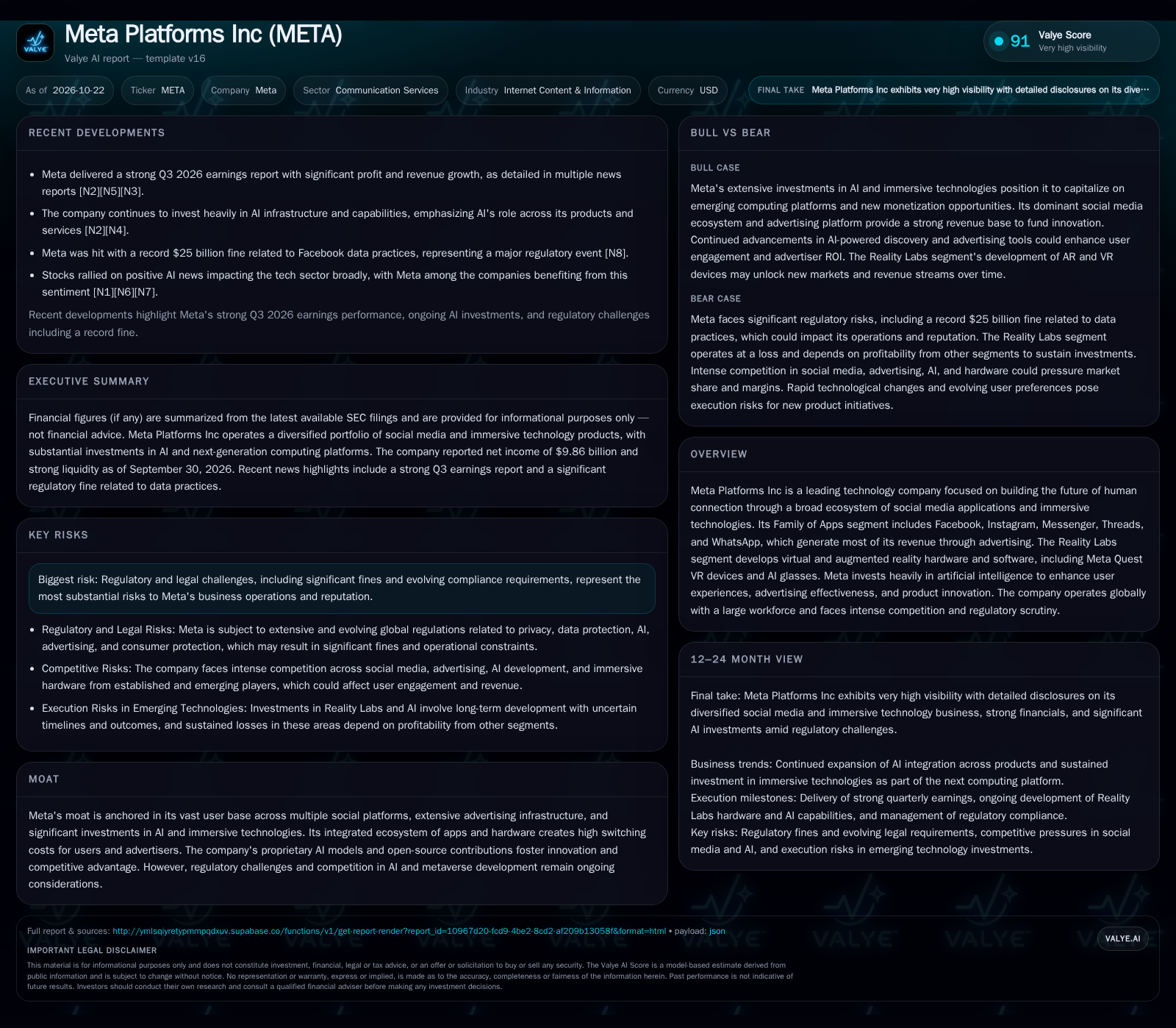
Meta delivered strong Q3 2026 earnings, reinforced by its dominant Family of Apps advertising platform. The company is investing aggressively in AI and immersive hardware, but Reality Labs continues to operate at a loss. A record $25 billion fine for Facebook data practices underscores mounting regulatory risk. Meta’s reported liquidity position, yet the path to monetizing next-gen platforms and navigating competitive and regulatory threats is complex. [N2] [N5] [N8]
Meta Platforms enters late 2026 as a paradox of scale and ambition: a social media and advertising juggernaut with extraordinary profitability and liquidity, investing aggressively in artificial intelligence and immersive hardware. The company’s Q3 2026 financial results showcase the enduring power of its Family of Apps, even as Reality Labs’ losses and a massive $25 billion regulatory fine signal the high stakes of its moonshot bets.
Q3 2026 Overview: Profit Trends, AI Investments, and Regulatory Fines Shaping Meta’s Position
Meta reported net income of $9.86 billion and basic EPS of $3.86 in Q3 2026, highlighting the resilience of its advertising-centric Family of Apps as a cash generator [S2]. The company reported cash and liquidity metrics for the period; these figures do not by themselves establish operating runway, investment capacity, financial flexibility, or financing capacity. [S2]
The Reality Labs segment, responsible for VR/AR hardware and AI glasses, continues to operate at a loss, comprising 18% of company costs and expenses, while the core Family of Apps accounts for 82% [S2].
Meta was hit with a record $25 billion fine tied to Facebook data practices, signaling ongoing and material regulatory and legal risks [N8].
The company is doubling down on AI infrastructure and capabilities, with management emphasizing AI’s central role in product experience and monetization across its platforms [N2] [N5].
Monetization Strategies: Advertising, Hardware Ventures, and Platform Expansion Economics
Meta’s core economic engine remains digital advertising, driven by enormous daily user engagement across Facebook, Instagram, WhatsApp, Messenger, and Threads. The company’s self-serve ad platform and global sales force enable granular targeting, high ROI for advertisers, and significant operating leverage as incremental ad revenue scales with relatively modest increases in infrastructure and personnel costs.
Reality Labs, encompassing Meta Quest VR, Ray-Ban Meta AI glasses, and AR initiatives, represents a capital-intensive, loss-generating segment. Hardware sales may command premium pricing but face high R&D and go-to-market costs, and the segment’s losses are underwritten by the cash flow from advertising. The long-term economics of Reality Labs depend on whether immersive devices and software can achieve mass adoption and recurring revenue—through device sales, app marketplaces, or subscription models. At present, Reality Labs’ negative operating margin is a drag, but could flip if a breakthrough platform emerges.
AI investment is both an expense and a potential margin lever: it powers content discovery, ad targeting, and new product features, but requires massive ongoing infrastructure spend. If Meta’s AI advances deliver higher engagement or ad efficacy, they could drive incremental revenue at high contribution margins. However, generative AI and superintelligence research are long-tail bets with uncertain monetization timelines.
Maintaining the Social Graph: Competitive Strengths and Emerging Ecosystem Challenges
Meta’s competitive moat is built on three pillars: the sheer scale of its active user base, deep integration across its app ecosystem, and proprietary AI/advertising infrastructure. High switching costs for users and advertisers, plus network effects from interconnected apps, reinforce its dominance in social media and digital marketing.
However, competitive threats are intensifying across all fronts. In social media, upstart platforms and established tech giants continue to vie for user attention, especially among younger demographics. In digital advertising, alternative networks and privacy-driven changes (e.g., third-party cookie deprecation, device restrictions) may erode targeting precision and ROI.
In AI and immersive hardware, Meta faces formidable competition from both traditional tech peers and specialized entrants developing frontier AI models, AR/VR devices, and metaverse platforms. The company’s large R&D budget is an advantage, but fast-moving rivals could outpace Meta in product innovation or capture early-mover advantage in new computing paradigms.
Revenue Growth Potential from AI and Immersive Platform Innovations
In a favorable scenario, Meta’s heavy investment in AI yields transformative improvements in user engagement, ad targeting, and content discovery, driving both higher time spent and advertiser willingness to pay. If Reality Labs’ VR/AR devices achieve mainstream adoption—either through compelling use cases, lower price points, or ecosystem lock-in—hardware and software revenue could become a material contributor, reducing dependence on the core ad business.
A successful rollout of generative AI tools for creators and businesses could unlock new monetization models (e.g., AI-powered commerce, virtual goods, or subscription-based premium features). This would be confirmed by a sustained acceleration in non-advertising revenue, improved Reality Labs margins, and rising user engagement or retention in new product categories.
Further, if Meta can leverage its scale and compliance investments to navigate regulatory challenges more efficiently than peers, it could cement its leadership in both established and emerging markets.
Profit Stability Supported by Scale Despite Innovation and Regulatory Fluctuations
The most plausible near-term scenario is that Meta’s Family of Apps continues to deliver robust advertising revenue and profitability, underwritten by global scale and deep advertiser relationships. Incremental improvements in AI-powered discovery and ad targeting may support modest revenue growth and margin expansion, but Reality Labs is likely to remain loss-making as market adoption of VR/AR hardware progresses gradually.
Regulatory scrutiny, including ongoing privacy and data protection enforcement, will likely persist, resulting in periodic fines or compliance expenses but not existential disruption.
Confirmation would come from continued high ad revenue growth, stable or improving Family of Apps margins, and manageable regulatory costs relative to operating income. Falsification would involve a sharp, sustained drop in ad engagement, runaway regulatory costs, or failure of Reality Labs to gain any commercial traction.
Economic Risks from Regulatory Headwinds and Declining Platform Engagement
In an adverse scenario, escalating regulatory action—such as further record fines, mandated platform changes, or restrictions on data use—could erode Meta’s core advertising economics and user trust. If user engagement on Facebook, Instagram, or WhatsApp declines due to competitive pressure, privacy concerns, or shifting preferences (especially among younger users), ad revenue could stagnate or contract.
Should Reality Labs’ losses widen without evidence of hardware adoption or ecosystem growth, the drag on consolidated margins could accelerate, especially if cash flow from the core business comes under pressure. Moreover, if AI investments fail to translate into differentiated product features or monetizable tools, Meta could fall behind in the next wave of computing innovation.
Downside confirmation would include a meaningful decline in DAU/MAU, flat or declining ad revenue, mounting regulatory costs outpacing operating income, and continued Reality Labs losses with no sign of commercial breakthroughs.
Key Developments Influencing Meta’s AI Progress, Platform Growth, and Regulatory Adaptation
Sustained growth in Family of Apps daily and monthly active users (DAU/MAU), especially among youth demographics, would validate continued platform relevance—if disclosed.
Trends in ad revenue growth, cost per impression, and ad load across Facebook, Instagram, and WhatsApp remain critical to the core business.
Reality Labs’ revenue growth, unit sales of Meta Quest and AI glasses, and progress toward breakeven or narrowing losses would help test the viability of immersive hardware.
R&D and capital expenditure trends, particularly related to AI infrastructure, signal management’s conviction and the potential for future product breakthroughs.
Magnitude, frequency, and scope of regulatory fines, settlements, or mandated platform changes will shape Meta’s operational and reputational risk profile.
Emergence of new monetization streams from AI-powered products, creator tools, or virtual goods would indicate success in diversifying revenue.
If disclosed, metrics on user engagement with new AI features, AR/VR content consumption, or time spent in Meta’s immersive environments would provide early traction signals.
Trends in operating margins and segment-level profitability, particularly the trajectory of Reality Labs’ losses relative to total company earnings, will clarify investment sustainability.
Disclaimer: This is research-only, informational analysis and not investment advice. It may include AI-generated interpretation and general industry context. Always verify important details using primary sources.

Comments