
United Airlines: Managing Fuel Price Swings, Liquidity Strains, and Route Asset Strength
United Airlines Holdings faces a complex environment of fuel cost exposure, below-one liquidity ratios, and valuable international route assets. Its profitability and capital strategy hinge on fuel price management, potential financial flexibility, and international market positioning.
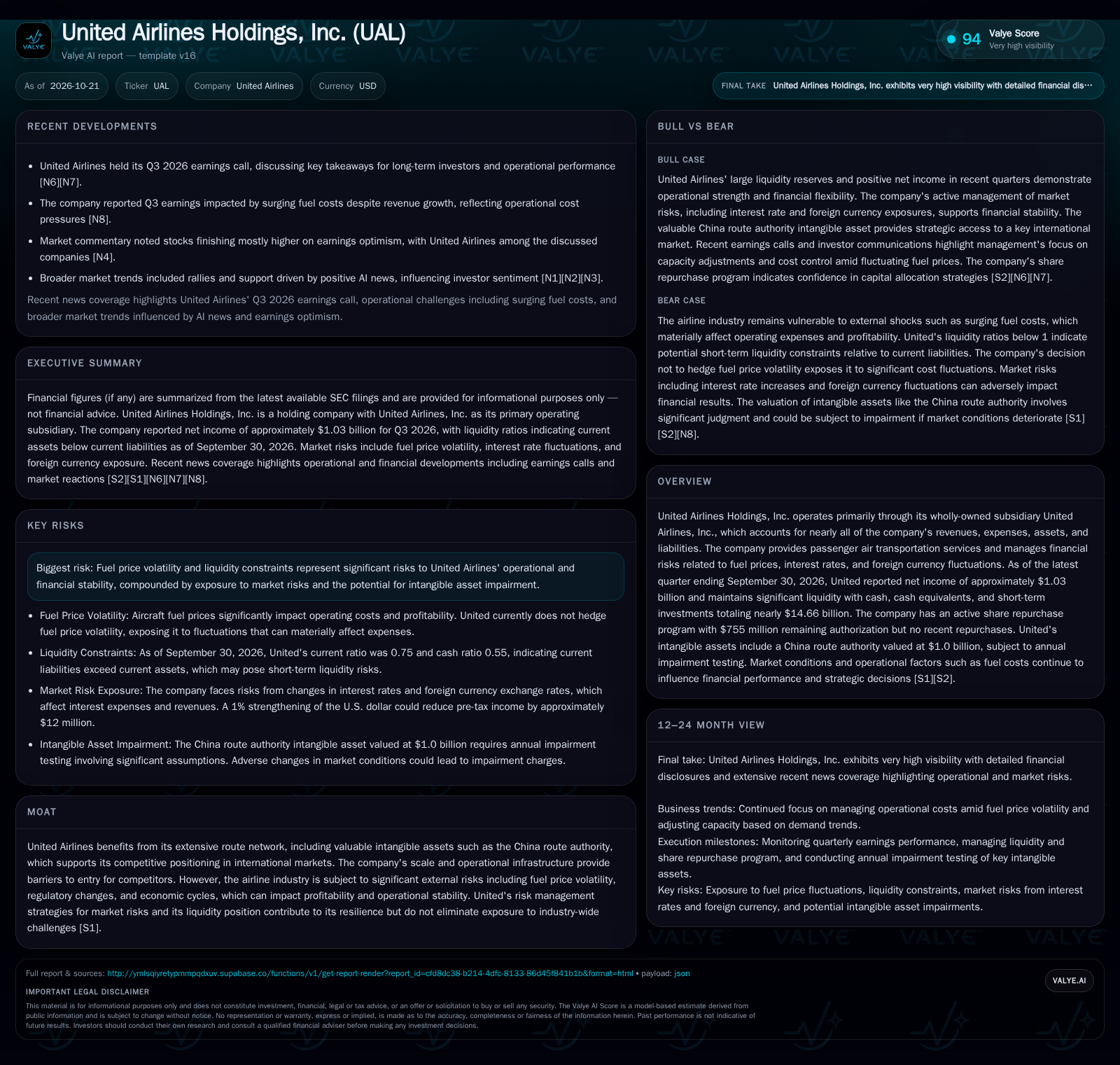
The company holds nearly $14.66 billion in liquid assets, yet faces material exposure to fuel price swings, interest rate fluctuations, and foreign exchange volatility. A $1 change in fuel per barrel would move annual fuel costs by $116 million, and United does not currently hedge fuel. The $1.0 billion China route authority provides strategic international access but is subject to impairment risk. The share repurchase program remains authorized but was inactive in the last quarter. [S1] [S2]
United Airlines Holdings, Inc. stands at a crossroads defined by robust recent profitability, substantial liquid assets, and a strategic international footprint, yet faces significant short-term liquidity tension and pronounced exposure to external market forces. With net income topping $1 billion for Q3 2026 and a valuable China route authority on its balance sheet, United’s financial narrative is complicated by a current ratio below one and an unhedged position on volatile fuel costs. For investors and analysts, the core questions revolve around how United will manage cost shocks, preserve balance sheet flexibility, and leverage its international routes for sustainable value.
Profitability Trends, Liquidity Challenges, and Key Strategic Assets
In the third quarter of 2026, United Airlines Holdings reported net income of approximately $1.03 billion, translating to basic and diluted EPS of $3.17 and $3.14 respectively. The company’s liquidity position comprises $6.65 billion in cash and equivalents and $8.01 billion in short-term investments, summing to nearly $14.66 billion in liquid assets. United’s China route authority, valued at $1.0 billion, remains a key intangible asset, providing access to lucrative international markets but requiring ongoing impairment testing. The company remains exposed to major market risks, particularly fuel price volatility, without active fuel hedging, and retains a $755 million share repurchase authorization with no recent buyback activity. [S1] [S2]
Analyzing Cost Drivers, Revenue Streams, and Factors Increasing Volatility
United’s core business model is built on high fixed costs—aircraft, labor, and airport operations—overlaid with variable costs dominated by fuel. Revenue is driven by passenger ticket sales, ancillary fees, and cargo, with yield management strategies seeking to optimize load factor and pricing. Profitability is highly sensitive to input costs, especially fuel, where a $1/barrel move impacts annual fuel expense by $116 million. The lack of fuel hedging means United’s cost base is directly exposed to market swings, potentially amplifying earnings volatility.
Operating leverage can be significant: incremental revenue gains, when load factors are high, can fall disproportionately to the bottom line once fixed costs are covered. However, this also means that downturns or cost shocks (such as a fuel price spike) can rapidly erode margins. Capital requirements remain heavy, both for fleet upkeep and regulatory compliance.
Interest rate and foreign exchange exposures add further complexity. United manages debt with a mix of fixed and variable rates, with $8.6 billion in variable-rate debt as of December 2025, meaning rate increases would elevate interest expense. International routes expose United to FX swings, which can erode USD-reported profits even when local markets are healthy.
Fuel price volatility not only affects United’s cost base directly but also influences strategic decision-making around capacity deployment and pricing strategies. In periods of rising fuel costs, United may face difficult trade-offs between maintaining competitive fares and protecting margins, potentially leading to selective route adjustments or capacity reductions on less profitable segments. Conversely, stable or declining fuel prices could enable more aggressive capacity expansion or promotional pricing to capture market share. The absence of fuel hedging amplifies the importance of flexible operational planning and dynamic revenue management to mitigate cost shocks and preserve profitability.
The Impact of Route Control, Network Size, and Competitive Dynamics
United’s competitive moat is built on its extensive route network, particularly its authority to operate China routes—a highly regulated and capacity-constrained international corridor. This asset, valued at $1.0 billion, provides United with privileged access to a major growth market, a position that is not easily replicated by new entrants due to regulatory and bilateral constraints.
Domestically and internationally, United faces intense competition from other network carriers, low-cost airlines, and, on some routes, international flag carriers. Barriers to entry include capital intensity, regulatory approvals, and airport slot scarcity, but price competition remains fierce and customer switching costs are low. Superior network breadth, schedule frequency, and international connectivity can support pricing power in premium segments, but commodity pricing remains prevalent in economy classes.
Substitution threats, such as high-speed rail on some short-haul routes and videoconferencing for business travel, are persistent but have not fundamentally altered long-haul or intercontinental air travel demand. United’s ability to leverage its network and premium international routes will be central to sustaining competitive advantage.
United’s network advantage is partly contingent on regulatory environments that govern international route access. These frameworks can shift due to geopolitical developments or bilateral negotiations, potentially altering the competitive landscape. The restricted nature of certain routes, like those to China, creates a scarcity value that supports pricing power and market share. However, this also introduces concentration risk, as overreliance on a limited number of high-value corridors could expose United to disproportionate impacts from regulatory or demand disruptions in those markets. Diversification of international routes and continuous engagement with regulators are therefore critical to sustaining long-term competitive positioning.
Earnings Growth Potential from Cost Efficiency and Revived International Travel
If United maintains profitability by keeping non-fuel costs in check and successfully passes fuel price increases through to fares, margin expansion is plausible. A recovery or acceleration in international travel demand—particularly on China routes—could provide high-margin growth, leveraging United’s privileged route authority. If fuel prices remain stable or decline, United’s unhedged position could become a tailwind rather than a risk.
Confirmation of this scenario would include sustained or rising EPS, stable or improving liquidity ratios, and evidence of robust international load factors and yields. Additional buyback activity could signal management confidence and an absence of acute capital constraints. A lack of impairment charges on the China route intangible would further support the thesis that international demand is resilient.
Maintaining Operational Stability Despite Input Price Fluctuations and Liquidity Limits
The most plausible path is one of continued profitability but elevated volatility. United is likely to manage through ongoing cost pressures, with fuel and interest expense swings offset by incremental fare adjustments and disciplined capacity management. Liquidity remains tight, but not critical, provided there are no large negative shocks or abrupt demand declines.
Ongoing communications about cost management, fleet optimization, and international route performance would further support the base case.
Risks from Rising Expenses, Cash Flow Pressures, and Potential Asset Write-Downs
Adverse outcomes could be triggered by a rapid rise in fuel prices, global demand shocks, or an unfavorable move in interest or currency rates. With no fuel hedging, a major fuel price spike could overwhelm fare increases, compressing margins and eroding profitability.
A further risk is impairment of the $1.0 billion China route authority if international demand falters or regulatory conditions change. Such a write-down would directly impact reported equity and could signal diminished strategic value. Confirmation of this scenario would include consecutive quarters of net losses, further deterioration in liquidity ratios, negative cash flow from operations, and impairment charges on intangible assets.
In a scenario where fuel prices surge sharply and persistently, United’s lack of fuel hedging could lead to compounded margin pressures, especially if fare increases lag due to competitive constraints or demand elasticity. Additionally, tightening liquidity ratios under such stress could limit the company’s ability to invest in fleet modernization or service enhancements, potentially eroding customer experience and market share. Impairment of intangible assets like the China route authority would not only affect balance sheet strength but could also signal a reassessment of growth prospects in key international markets, prompting more conservative capital allocation and operational strategies.
Indicators Reflecting United’s Operational and Financial Durability
Quarterly net income and EPS trends, to gauge whether profitability is resilient or eroding as costs and demand fluctuate. [S2]
Current ratio and cash ratio movements, to monitor whether liquidity stress is intensifying or easing. [S2]
Fuel expense per available seat mile (if disclosed), as a direct measure of United’s cost exposure and efficiency.
Load factor and yield metrics on key international routes, especially China, to test the value and utilization of strategic intangible assets.
Magnitude and frequency of impairment charges, particularly relating to the China route authority.
Any initiation or acceleration of share repurchases, which could signal confidence and capital flexibility. [S2]
Updates to fuel hedging policy, as a change would alter the risk profile for input cost volatility. [S1]
Debt structure evolution, particularly the mix of fixed vs. variable rate debt, to assess interest rate sensitivity and refinancing risk.
Disclaimer: This is research-only, informational analysis and not investment advice. It may include AI-generated interpretation and general industry context. Always verify important details using primary sources.

Comments