
Essential Properties Realty Trust: Net-Lease Strategy and Middle-Market Tenant Resilience Under Scrutiny
With a granular, highly diversified portfolio of long-term net-leased properties serving middle-market tenants, Essential Properties Realty Trust delivers contractual income stability—yet faces the structural test of tenant credit risk and capital access as it scales in a competitive niche.
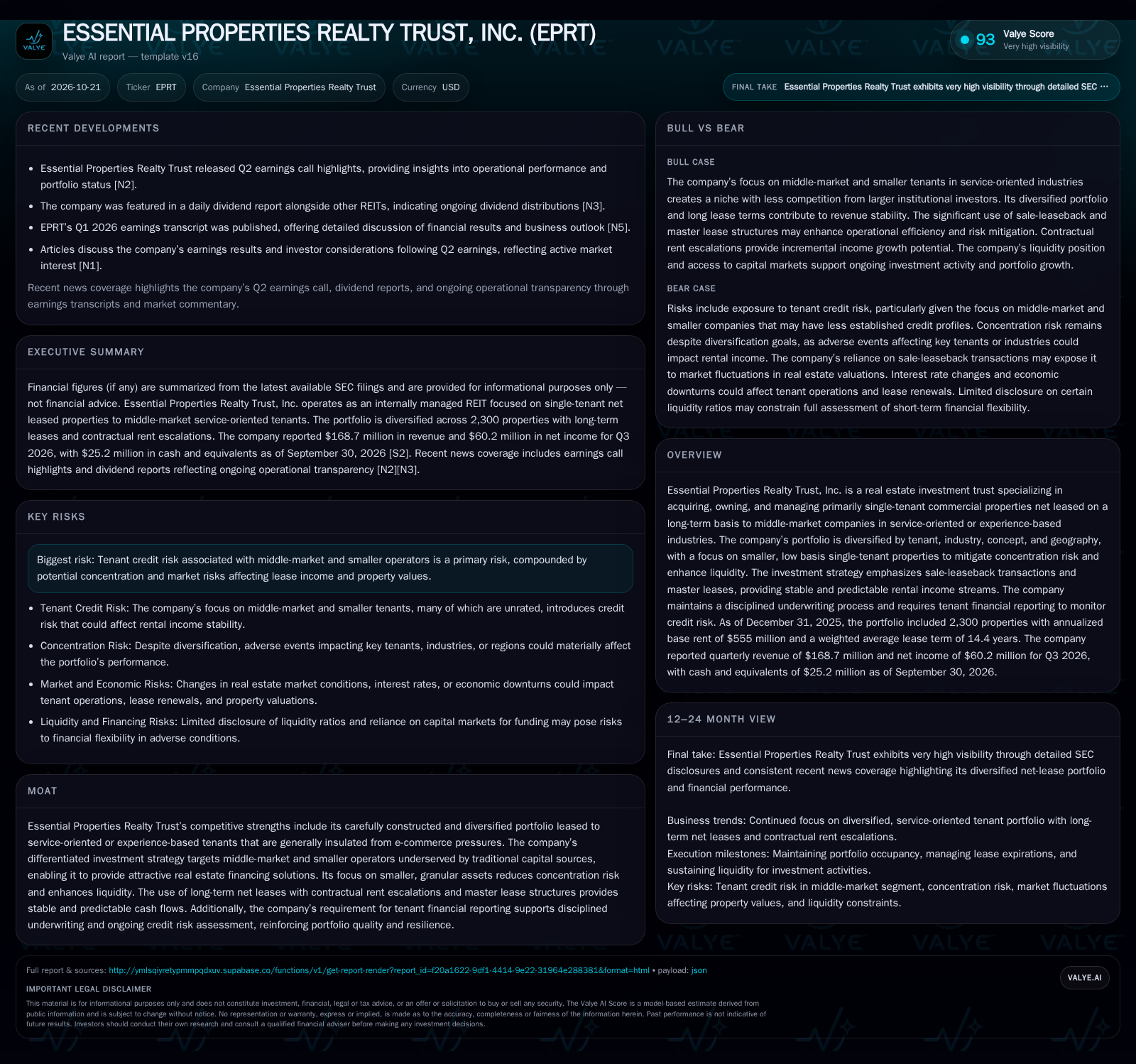
Essential Properties Realty Trust (EPRT) operates a $7.2 billion portfolio of 2,300 single-tenant, net-leased properties focused on service-oriented middle-market tenants. Its long lease terms, high tenant diversification, and use of sale-leaseback and master lease structures underpin income stability and risk mitigation. While contractual rent escalations provide incremental growth and the company maintains access to capital markets, exposure to unrated tenant credit risk and reliance on capital market funding remain central challenges for long-term resilience and growth. [S1] [S2]
Essential Properties Realty Trust (EPRT) has carved out a defensible position in the net lease real estate sector by targeting granular, service-oriented properties leased to middle-market tenants. Its $7.2 billion portfolio is diversified by tenant, industry, and geography, and is structured around long-term leases, frequent use of sale-leasebacks, and master lease agreements. [S1] [S2]
Current Operating Base: Portfolio Scale, Lease Terms, and Diversification
As of December 31, 2025, Essential Properties Realty Trust managed a portfolio of 2,300 properties generating $555 million in annualized base rent, diversified across 659 tenant concepts and 48 states. No single tenant contributed more than 3.4% of base rent, and the company’s explicit goal is to keep tenant and property concentration below 5% and 1% of rent, respectively. The weighted average remaining lease term stood at 14.4 years, with only 5.2% of rent coming from leases expiring before 2031. Sale-leaseback structures represented 95% of investments by rent, while master leases covered 66.8% of annualized base rent. Contractual rent escalations applied to nearly all leases at an average rate of 1.8% per year. Recent financials show Q3 2026 revenue of $168.7 million, net income of $60.2 million, and cash and equivalents of $25.2 million. These facts anchor EPRT’s current position as a diversified, long-duration, income-oriented REIT focused on middle-market service industries [S1] [S2].
EPRT’s Cash Flow Model: Net Lease Economics and Growth Opportunities
Essential Properties Realty Trust’s business model is anchored by long-term, triple-net leases to middle-market tenants in service-centric sectors—such as car washes, medical services, early childhood education, and quick-service restaurants. The triple-net structure shifts most property-level expenses (taxes, insurance, maintenance) to tenants, allowing EPRT to capture a high proportion of rental revenue as operating profit. The company's average property investment is relatively low ($3.1 million per site), supporting liquidity and resale flexibility while mitigating single-asset risk.
Contractual rent escalations averaging 1.8% annually provide incremental organic income growth, though this remains only partial inflation protection. The heavy use of sale-leaseback transactions (95% of investments by rent) allows EPRT to serve a niche of smaller, often unrated tenants who lack access to traditional bank financing—enabling the company to negotiate attractive yields and long lease terms in exchange for capital. Master leases (covering two-thirds of rent) further reduce administrative burden and renewal risk, as groups of properties are bundled under single agreements.
The company reported cash and liquidity metrics for the period; these figures do not by themselves establish operating runway, investment capacity, financial flexibility, or financing capacity. As of year-end 2025, the company had $7.2 billion in gross real estate investment and $2.5 billion in total debt, with $1.4 billion in reported liquidity (including undrawn credit facilities and forward equity proceeds) [S1]. This capital structure supports continued portfolio growth, though it introduces exposure to interest rate movements and capital market conditions. The model is asset-heavy and leverages operating stability for predictable but modestly growing cash flows, typical of net lease REITs.
Positioning Within the Net Lease Market: Niche Strengths and Competitive Dynamics
EPRT’s focus on middle-market, service-oriented tenants differentiates it from larger net lease REITs that target investment-grade or national tenants. By concentrating on granular, lower-basis properties, EPRT faces less direct competition from institutional buyers and benefits from reduced exposure to e-commerce disruption, as its tenants provide in-person services or experiences. The sale-leaseback approach also allows EPRT to source deals from operators seeking growth capital rather than just those seeking to monetize mature assets.
However, this strategy comes with trade-offs. EPRT’s tenants are often unrated and more vulnerable to economic downturns or sector-specific headwinds, increasing underlying credit risk. While property and tenant diversification, long lease terms, and rent coverage ratios (3.6x as of 2025) help mitigate risk, the portfolio’s resilience will be tested during periods of stress. The competitive environment is also evolving, as other REITs and alternative asset managers increasingly pursue sale-leaseback opportunities in niche sectors. EPRT must balance its underwriting discipline and risk management against the need to deploy capital and maintain growth in a maturing segment.
Potential for Outperformance Through Diversification and Lease Design
If EPRT’s granular diversification strategy continues to insulate the portfolio from tenant defaults and industry-specific volatility, the company could sustain above-peer income stability and incremental growth through rent escalations. Outperformance may be driven by the combination of long lease tenures, high rent coverage ratios, and disciplined underwriting that keeps tenant credit events rare—even in a slowing economy. Robust master lease coverage reduces renewal risk and administrative churn, while the company’s ability to source attractive sale-leaseback deals from underserved operators could support continued accretive growth.
Evidence that would confirm this scenario includes persistently high portfolio occupancy, stable or rising rent coverage ratios, low tenant default rates, and continued growth in annualized base rent. Increasing dividend distributions and positive earnings revisions may further validate the thesis.
Growth Outlook with Tenant Turnover and Capital Market Stability
The most plausible outlook is one of steady, moderate growth in rental income, with incremental gains from contractual escalations and new investments tempered by periodic tenant churn and occasional credit events. EPRT’s portfolio diversification and long lease durations provide a buffer against isolated tenant failures or sector slowdowns, but some modest increase in default rates or rent concessions may occur during economic downturns.
Access to capital markets remains available but at higher cost during tightening cycles, leading to selective investment activity and greater emphasis on internal capital recycling. Confirmation would come from stable occupancy rates in the high 90s, modest increases in annualized rent, and refinancing or new capital raises at manageable spreads. Evidence of increased tenant financial reporting and active asset management would further support the base case.
Risks from Tenant Credit Weakness and Capital Market Stress
A plausible adverse scenario would see rising tenant defaults or rent concessions among EPRT’s middle-market, unrated tenant base—potentially triggered by sector-specific shocks or a broad economic downturn. As tenants struggle, rent coverage ratios deteriorate and portfolio occupancy falls, forcing EPRT to spend more on lease workouts, property re-leasing, or even asset sales at unfavorable valuations. If these events coincide with tightening credit markets or a material rise in interest rates, the company could face higher funding costs, limited access to new capital, and pressure on both investment activity and dividend coverage.
Confirmation would come from declining occupancy, falling rent coverage ratios, a spike in tenant delinquencies, and negative trends in net operating income. Evidence of distressed asset sales, dividend cuts, or the inability to refinance maturing debt on favorable terms would further validate a downside thesis.
EPRT’s Milestones Reflecting Tenant Mix and Portfolio Durability
Portfolio occupancy rates: Persistent high-90s occupancy would support income stability, while a drop would signal tenant distress or re-leasing challenges.
Weighted average rent coverage ratio: A stable or rising ratio indicates tenant health; a decline could portend future credit events.
Annualized base rent growth: Continued increases—driven by escalations and new investments—would confirm portfolio expansion and pricing power.
Tenant default and lease termination rates: If disclosed, these would directly measure the effectiveness of underwriting and diversification.
Cost and availability of new debt/equity capital: Spreads on new financings or successful capital raises would reflect market confidence and support for future growth.
Exposure by sector and geography: Shifts in portfolio mix—if disclosed—may reveal evolving risk concentrations or new opportunities.
Lease renewal and re-leasing spreads: Metrics on rent changes for renewed or re-leased properties would test the company’s ability to maintain or grow income in the face of tenant churn.
Disclaimer: This is research-only, informational analysis and not investment advice. It may include AI-generated interpretation and general industry context. Always verify important details using primary sources.

Comments