
Triumph Financial’s Trucking Platform: Specialization, Integration, and Sector Concentration Risks
Triumph Financial’s integrated focus on the U.S. trucking ecosystem—spanning banking, factoring, payments, and data intelligence—has delivered diversified income streams and platform growth, but exposes the company to cyclical and competitive pressures unique to the sector. The test is whether its technology-enabled, network-driven model can sustain growth and defend margins as the trucking landscape and financial technology evolve.
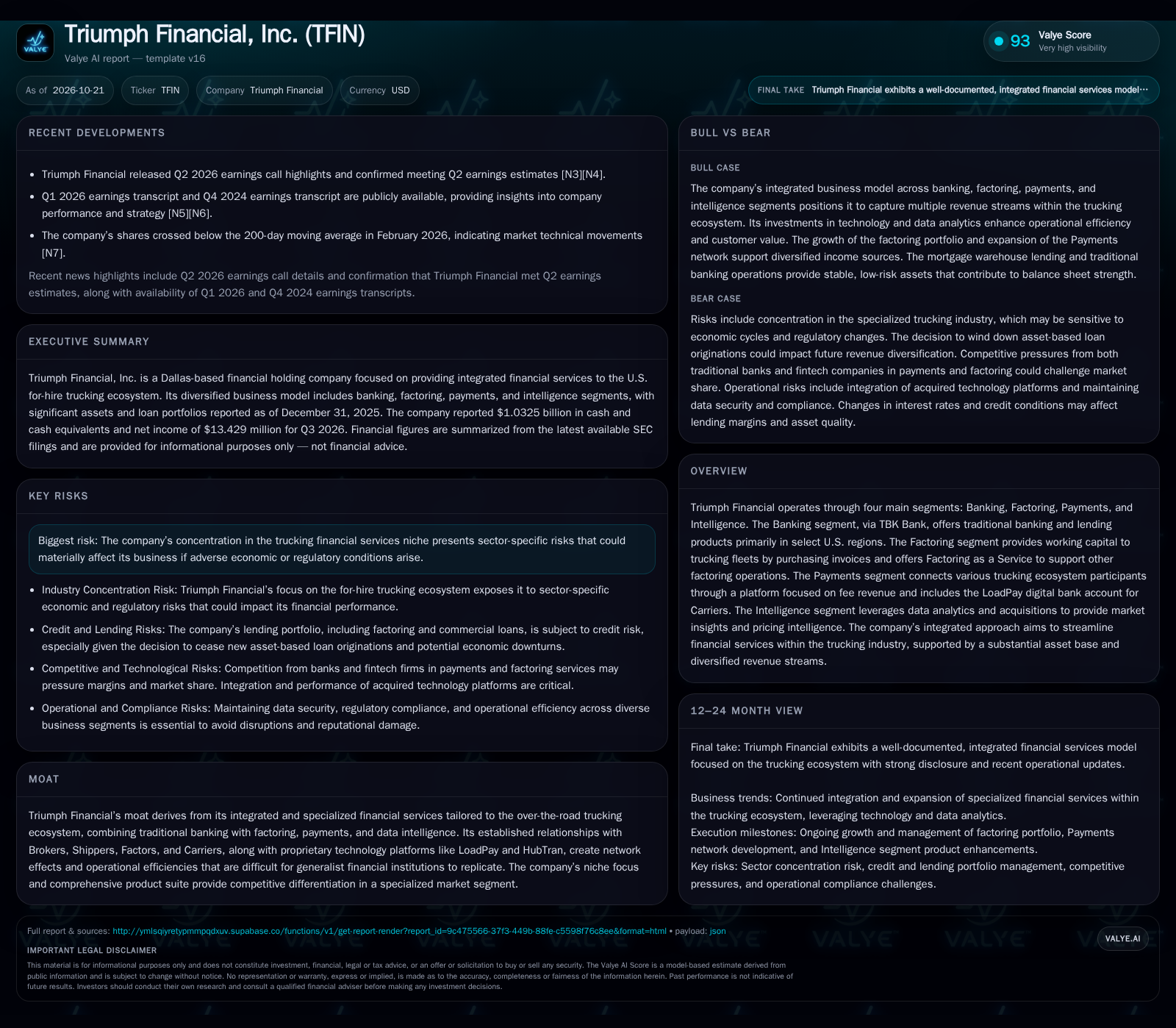
Triumph Financial is a Dallas-based financial holding company specializing in banking, factoring, payments, and intelligence services for the U.S. for-hire trucking sector. As of late 2025, it managed $6.4 billion in assets and generated over half its revenue from banking, with its factoring and payments segments focused on digital network effects and platform integration. The business model’s specialization fosters competitive differentiation but also heightens exposure to trucking-industry cycles and regulatory risks. Recent growth in factoring and platform-driven payments is promising, yet the long-term thesis hinges on Triumph’s ability to leverage technology and data while managing credit, compliance, and sector concentration risks. [S1] [S2]
Triumph Financial, Inc. stands out for its tightly integrated suite of financial services targeting the U.S. for-hire trucking sector. With over $6 billion in assets and a business model spanning banking, factoring, payments, and intelligence, Triumph’s platform seeks to harness network effects and data-driven insights to create a differentiated value proposition for brokers, shippers, carriers, and factors. However, this specialization—while a source of moat—also amplifies exposure to trucking-industry cycles, regulatory shifts, and the evolving competitive landscape. The company’s next phase will test whether its technology investments and segment synergies can sustain growth and margin resilience as the broader logistics and financial technology markets shift.
Current Financial Performance and Strategic Developments at Triumph
As of December 31, 2025, Triumph Financial reported $6.381 billion in consolidated assets and $4.950 billion in deposits, with total loans held for investment at $4.991 billion. Its 2025 revenue mix was 57% Banking, 31% Factoring, 11% Payments, and 1% Intelligence, reflecting a diversified but trucking-centric portfolio. The factoring portfolio grew to $1.149 billion, and the company launched Factoring as a Service (FaaS) in 2024 to extend its reach. Notably, Triumph decided to cease new asset-based loan originations in 2026, signaling a shift in risk appetite and portfolio strategy. By Q3 2026, Triumph held $1.0325 billion in cash and equivalents and posted $13.429 million in net income for the quarter. No new material risk factors have been disclosed since the 2025 10-K, and the company met Q2 2026 earnings estimates. [S1] [S2] [N3] [N4]
Revenue and Margin Benefits from Triumph’s Integrated Approach
Triumph’s economics hinge on its ability to extract value from the interconnected needs of the trucking sector. The Banking segment delivers traditional interest income from a geographically concentrated loan book—primarily in Colorado, Iowa, Illinois, and Texas—with commercial and mortgage warehouse lending offering relatively stable, low-risk returns. Factoring, which involves purchasing invoices from trucking fleets at a discount, generates income through spreads and fees—its recent portfolio growth suggests demand for working capital solutions in the sector, but exposes Triumph to counterparty and sector credit risks. The launch of Factoring as a Service (FaaS) adds a capital-light, fee-based layer to the model, potentially boosting margins if the service scales.
Payments, particularly after the HubTran acquisition, is shifting from capital-intensive float and interest income to a platform-based, fee-driven model. This reduces Triumph’s balance-sheet risk and may improve operating leverage, provided network effects drive sufficient volume. The Intelligence segment, though currently a small revenue contributor, aims to monetize proprietary data and analytics, which could yield high incremental margins if the offering becomes essential for pricing and operational optimization across the ecosystem.
The company’s decision to halt new asset-based loan originations could reduce risk-weighted asset growth but may also limit future lending revenue diversification. Overall, Triumph’s model blends traditional spread-based earnings with emerging platform and data monetization strategies, offering multiple levers for margin expansion but also exposing the business to the cyclicality and fragmentation of the trucking sector.
The Durability of Specialization as a Competitive Edge
Triumph’s competitive strength lies in its deep specialization within the for-hire trucking ecosystem—a market often underserved by large, generalist banks. Its integrated suite, linking banking, factoring, payments, and intelligence, creates operational synergies and cross-selling opportunities, and the platform’s network effects become more pronounced as more brokers, shippers, and carriers participate. Proprietary products like LoadPay and the recently acquired HubTran and data analytics platforms (Isometric Technologies, Greenscreens AI) help build switching frictions, as customers integrate Triumph’s services into their workflows.
However, this specialization is a double-edged sword. The trucking sector’s fragmentation, cyclicality, and susceptibility to regulatory shifts mean Triumph’s fortunes are tied to industry health. Competitively, the company faces pressure from both regional and national banks expanding into transportation lending and a growing cohort of fintechs offering point solutions in factoring and payments. If fintech entrants can replicate Triumph’s platform effects or undercut on price, Triumph’s moat could narrow. The question is whether Triumph’s proprietary data and integration depth will continue to offset these competitive threats as digital adoption accelerates across logistics finance.
Indicators of Potential for Sustained Platform Expansion
The most favorable scenario for Triumph is one in which its integrated platform achieves network scale—becoming the default financial and data backbone for the U.S. for-hire trucking ecosystem. In this case, Factoring as a Service (FaaS) and Payments network effects accelerate, driving high-margin, recurring fee income and reducing Triumph’s reliance on balance-sheet lending. The Intelligence segment, leveraging rich transaction data and AI-driven analytics, becomes indispensable for pricing and operational decision-making, further embedding Triumph in customer workflows.
Evidence that would confirm this scenario includes accelerating revenue growth from Payments and Intelligence segments, increasing customer retention, and a rising share of fee-based, capital-light income. Clear signs of network effects would be the onboarding of new brokers, shippers, and carriers at an increasing rate, as well as expanding API integrations with third-party platforms. If Triumph’s data products become the industry standard for routing, pricing, or credit assessment, the company could command premium pricing and enjoy durable switching costs.
Trucking Industry Cycles Shape the Central Growth Outlook
The most plausible outcome is that Triumph continues to grow at a measured pace, maintaining its trucking-sector specialization while incrementally expanding its platform and data offerings. Factoring and payments remain the primary growth drivers, but revenue mix shifts only gradually as the Intelligence segment matures. Traditional banking provides a stable base, while FaaS and digital payments reduce overall capital intensity, supporting moderate operating leverage.
Confirming evidence would include steady growth in the factoring portfolio (adjusted for sector cycles), stable or improving net interest margins, and modest but consistent increases in Payments and Intelligence contributions. Falsifying evidence would be stagnating Payments volumes, high churn in platform customers, or a failure to demonstrate pricing power in data products. Sector shocks—such as a sustained trucking downturn or major regulatory changes—would also test the resilience of Triumph’s business mix.
Risks Arising from Overreliance on Sector Specialization
In a negative scenario, Triumph’s trucking-sector concentration amplifies downside risk during industry downturns or regulatory disruptions. A sharp contraction in freight volumes, rising delinquencies among carriers, or adverse regulatory changes could drive higher credit losses in both factoring and traditional lending. If new fintech entrants or large banks aggressively target Triumph’s niche with superior technology or lower fees, customer attrition could accelerate and erode platform network effects.
This scenario would be confirmed by a shrinking factoring portfolio, rising credit losses, declining Payments revenue, and evidence of customer migration to competitors. A slowdown in Intelligence adoption or a need to materially increase customer acquisition costs would also signal weakening competitive position. The decision to halt new asset-based lending could further limit Triumph’s ability to diversify earnings in a stressed environment.
Key Events That Could Confirm or Undermine Triumph’s Platform Strategy
Growth rates and absolute revenue from the Payments and Intelligence segments—particularly any inflection in fee-based, capital-light income.
Factoring portfolio performance, including growth, delinquency rates, and concentration by carrier or sector.
Adoption and retention metrics for Factoring as a Service (FaaS), if disclosed, to assess whether the platform model is gaining traction.
Customer churn or retention rates across the integrated platform—especially among brokers, shippers, and carriers.
Operating leverage and expense ratios as Payments and Intelligence scale—signs of margin improvement or dilution.
Evidence of deepening network effects: onboarding rates for new ecosystem participants and integration with third-party software platforms.
Regulatory or industry developments impacting the for-hire trucking sector, including freight demand, credit standards, and compliance requirements.
Any material changes in credit quality or loss rates within the factoring and commercial lending portfolios.
Disclaimer: This is research-only, informational analysis and not investment advice. It may include AI-generated interpretation and general industry context. Always verify important details using primary sources.

Comments