
NETSTREIT: Defensive Retail REIT Navigates Tenant Quality and Acquisition Headwinds
NETSTREIT Corp. leverages a diversified portfolio of single-tenant, net-leased retail properties focused on necessity-driven tenants. While Q3 2026 results highlight continued revenue and earnings growth, the company’s future hinges on disciplined tenant selection, prudent capital allocation, and its ability to source accretive acquisitions amid evolving retail and interest rate environments.
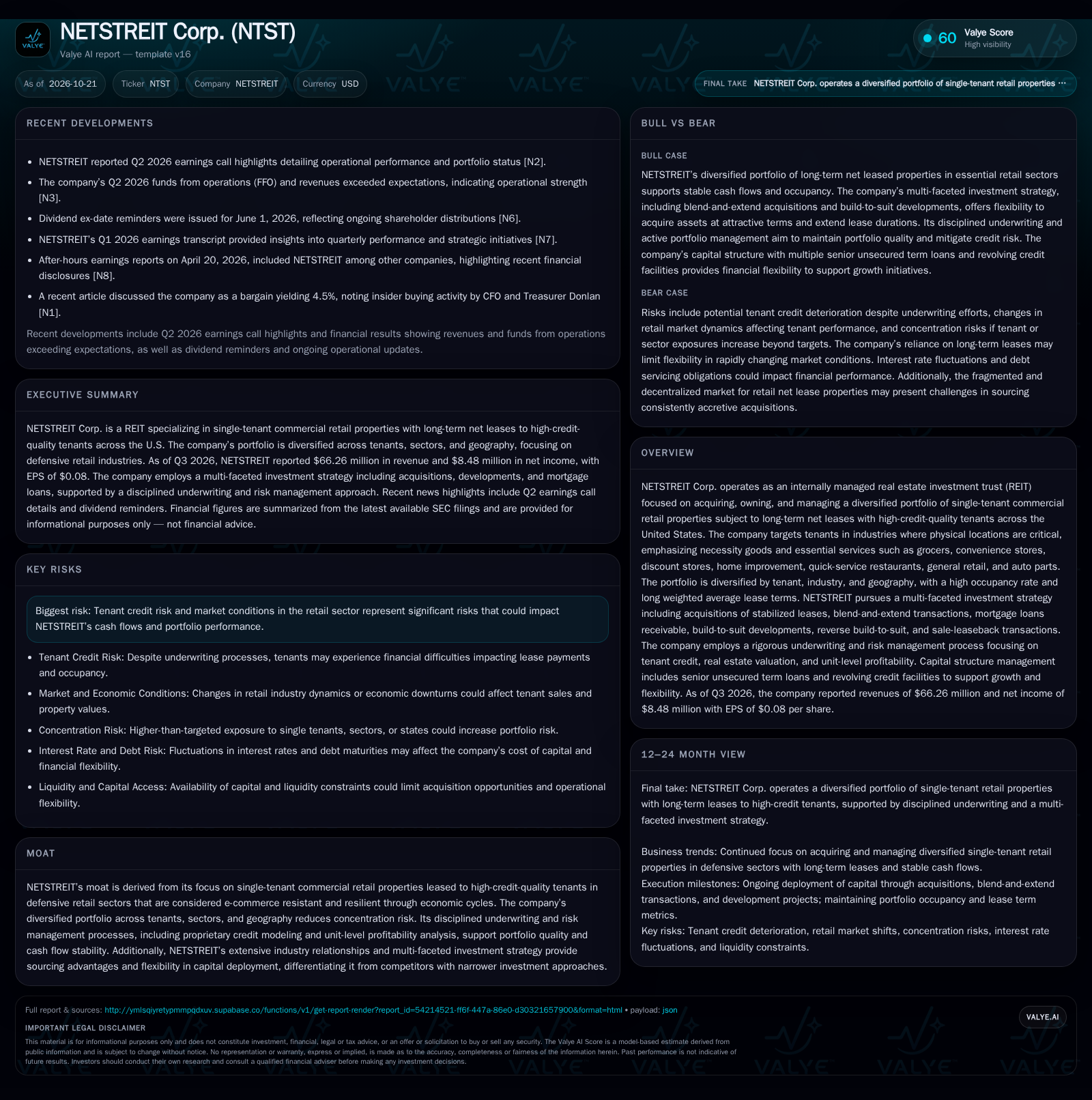
NETSTREIT’s latest results underscore resilient performance in a challenging retail landscape, with revenue of $66.26 million and net income of $8.48 million for Q3 2026. The company’s emphasis on high-credit, necessity-based tenants and long-term net leases supports stable cash flows, but future growth and risk management will depend on acquisition discipline, tenant diversification, and capital structure flexibility. Key watchpoints include tenant credit trends, acquisition pace, lease term management, and debt cost exposure. [S2] [N2] [N3]
NETSTREIT Corp. stands out in the REIT universe for its focus on single-tenant, necessity-driven retail properties under long-term net leases with high-credit tenants. The company’s Q3 2026 results show stable revenue and earnings growth, underpinned by a diversified portfolio and disciplined acquisition strategy. However, as the REIT sector contends with rising rates and shifting retail dynamics, NETSTREIT’s future performance will hinge on its ability to sustain tenant quality, secure accretive acquisitions, and manage its capital structure. Investors must weigh the strength of current cash flows against evolving risks in tenant credit, acquisition competition, and debt costs. [S2] [N2] [N3]
Recent Financial Performance and Portfolio Strategy in Focus
NETSTREIT reported Q3 2026 revenue of $66.26 million and net income of $8.48 million, translating to EPS of $0.08. These results reflect continued operational strength, as confirmed by Q2 2026 FFO and revenue exceeding expectations. The company maintains a diversified portfolio of single-tenant retail properties, emphasizing necessity-based industries such as grocers, discount stores, and quick-service restaurants. Its investment strategy continues to span acquisitions, build-to-suit developments, and blend-and-extend transactions, all supported by a focus on tenant credit quality and long lease durations. The cited source reports dividend-related activity; that disclosure alone does not establish dividend-policy continuity, management confidence, or a material constraint on capital flexibility. [S2] [N2] [N3] [N6]
How NETSTREIT’s Net Lease Model Drives Cash Flow Stability
NETSTREIT’s economics are rooted in the triple-net lease structure, where tenants cover most property-level expenses, providing the REIT with predictable rental income and lower variable costs. The company reported cash and liquidity metrics for the period; these figures do not by themselves establish operating runway, investment capacity, financial flexibility, or financing capacity. The company’s ability to source and underwrite accretive acquisitions at attractive yields is central to earnings and dividend growth. Operating leverage is modest: while incremental acquisitions can boost revenue with limited additional overhead, overall returns are constrained by the cost of capital, especially as interest rates rise. Capital needs are ongoing, as external debt and equity financing often fund portfolio expansion. The blend of fixed and floating-rate debt, along with revolving credit facilities, impacts the REIT’s sensitivity to interest rate fluctuations and refinancing risk. [S2]
The triple-net lease model inherently transfers many operational risks to tenants, which enhances predictability of cash flows for NETSTREIT but also concentrates the REIT’s exposure on tenant solvency and lease enforceability. This structure means that while property-level expenses are minimized, any deterioration in tenant financial health can directly impact rent collection and, consequently, distributable cash flow. Moreover, the REIT’s capital allocation decisions must carefully balance acquisition yield against the risk profile of tenant credits, especially in an environment where rising interest rates elevate the cost of capital. Maintaining a portfolio weighted toward necessity-based tenants with resilient cash flows can mitigate some volatility, but the company’s underwriting rigor and lease covenant strength remain critical to preserving income stability.
Defensive Positioning Amid Fragmented Retail Net Lease Competition
NETSTREIT’s competitive edge derives from its focus on necessity retail tenants and rigorous underwriting. By prioritizing sectors like grocery, discount retail, and auto parts—where physical presence remains essential—the REIT seeks to insulate its portfolio from e-commerce and cyclical downturns. The U.S. retail net lease market is highly fragmented, with competition from both public REITs and private investors. Sourcing accretive deals is increasingly challenging as capital chases stable, necessity-driven assets. While NETSTREIT’s diversification by tenant and geography reduces concentration risk, its ability to maintain portfolio quality depends on disciplined acquisition pricing and tenant diligence. Substitutes include other net lease REITs, sale-leaseback investors, and private equity, all vying for similar asset types. In this context, underwriting discipline and industry relationships become key differentiators, but scale advantages are less pronounced than in other real estate subsectors.
In a fragmented retail net lease market, NETSTREIT’s ability to maintain competitive advantage hinges on its underwriting discipline and tenant selection rather than scale alone. The competition for high-quality, necessity-based retail assets often leads to yield compression, which can erode future returns if acquisitions are not accretive relative to the company’s cost of capital. Additionally, the REIT must navigate the trade-off between geographic and tenant diversification to reduce concentration risk versus the benefits of deep market knowledge and operational efficiencies in core regions or tenant categories. The cited source reports dividend-related activity; that disclosure alone does not establish dividend-policy continuity, management confidence, or a material constraint on capital flexibility.
Portfolio Quality and Accretive Acquisitions Fuel Outperformance
The most favorable scenario for NETSTREIT involves sustained success in acquiring high-quality, long-term net lease assets with strong tenant credits and attractive yields. Successful blend-and-extend strategies may further lengthen lease durations and reduce near-term rollover risk. Evidence supporting this scenario would include rising occupancy rates, higher average lease terms, and consistent outperformance of FFO and revenue relative to guidance. A stable or declining cost of debt—despite rate volatility—would also validate the REIT’s ability to finance growth efficiently. Falsification would occur if acquisition volume slows, yields compress, or tenant credit quality deteriorates, leading to higher rent concessions or vacancies. [N2] [N3]
Disciplined Growth Amid Competitive and Macro Uncertainties
The most likely outcome is moderate portfolio and earnings growth, as NETSTREIT navigates an increasingly competitive acquisition environment and potential headwinds from tenant credit risk. The company is expected to maintain a diversified, high-occupancy portfolio with gradual expansion through selective acquisitions and development projects. Confirming evidence would include stable or improving occupancy, steady weighted average lease terms, and a consistent pace of accretive deal activity. If acquisition yields compress materially or tenant credit events increase, it may pressure cash flows and dampen future dividend growth. [S2] [N2]
Tenant Credit Events and Acquisition Slowdown Pressure Stability
A negative scenario could unfold if tenant credit quality erodes—due to macroeconomic shocks or sector-specific disruptions—leading to missed rent payments, higher vacancies, and increased lease renegotiations. Simultaneously, if acquisition competition further compresses yields or capital costs rise sharply, NETSTREIT could struggle to deploy capital accretively, stalling portfolio growth. This would likely result in lower FFO, constrained dividend coverage, and greater volatility in cash flows. Evidence of this scenario would include a spike in tenant delinquencies, declining occupancy, shortened lease durations, or a material slowdown in announced acquisitions. Rising interest expenses or challenges in refinancing debt would further exacerbate downside risks. [S2]
Should tenant credit deterioration coincide with a tightening acquisition environment, NETSTREIT may face compounded challenges as capital deployment slows and portfolio cash flows become more volatile. In such a scenario, the REIT’s leverage profile and debt maturity schedule will be critical factors influencing potential financial flexibility. Rising interest rates could increase borrowing costs and refinancing risk, potentially pressuring dividend coverage if earnings growth stalls. Furthermore, increased vacancy or rent concessions could necessitate higher capital expenditures or tenant improvement allowances, which are less common in net lease structures but may become necessary to retain or attract tenants. These dynamics underscore the importance of proactive risk management and balance sheet resilience in mitigating downside outcomes.
Monitoring NETSTREIT’s Resilience: Metrics That Will Define the Thesis
Quarterly and annual tenant credit quality trends, including any disclosed tenant downgrades or bankruptcies, will be critical for assessing portfolio resilience.
Acquisition volume, average cap rates, and the pace of new deal announcements should be tracked to gauge ongoing growth and discipline.
Occupancy rate and changes in weighted average lease term will signal portfolio health and rollover risk.
FFO per share growth versus guidance and sector peers provides a clear read on operational performance and dividend sustainability.
Interest expense trends and the proportion of fixed versus floating-rate debt will show exposure to rate volatility and refinancing risk.
Geographic and tenant concentration metrics, if disclosed, would help assess evolving portfolio risk.
If available, same-store rent growth or renewal spreads would add insight into underlying property-level economics.
Disclaimer: This is research-only, informational analysis and not investment advice. It may include AI-generated interpretation and general industry context. Always verify important details using primary sources.

Comments