
NextEra Energy: Utility Scale, Renewable Ambitions, and the Capital Complexity of Energy Transition
NextEra Energy’s Q3 2026 results highlight the interplay between regulated utility stability, major renewable initiatives, and new gas asset acquisitions, set against the backdrop of below-par liquidity ratios and ongoing capital management. The company’s ability to navigate regulatory, funding, and execution risks will shape its value proposition as the energy landscape evolves.
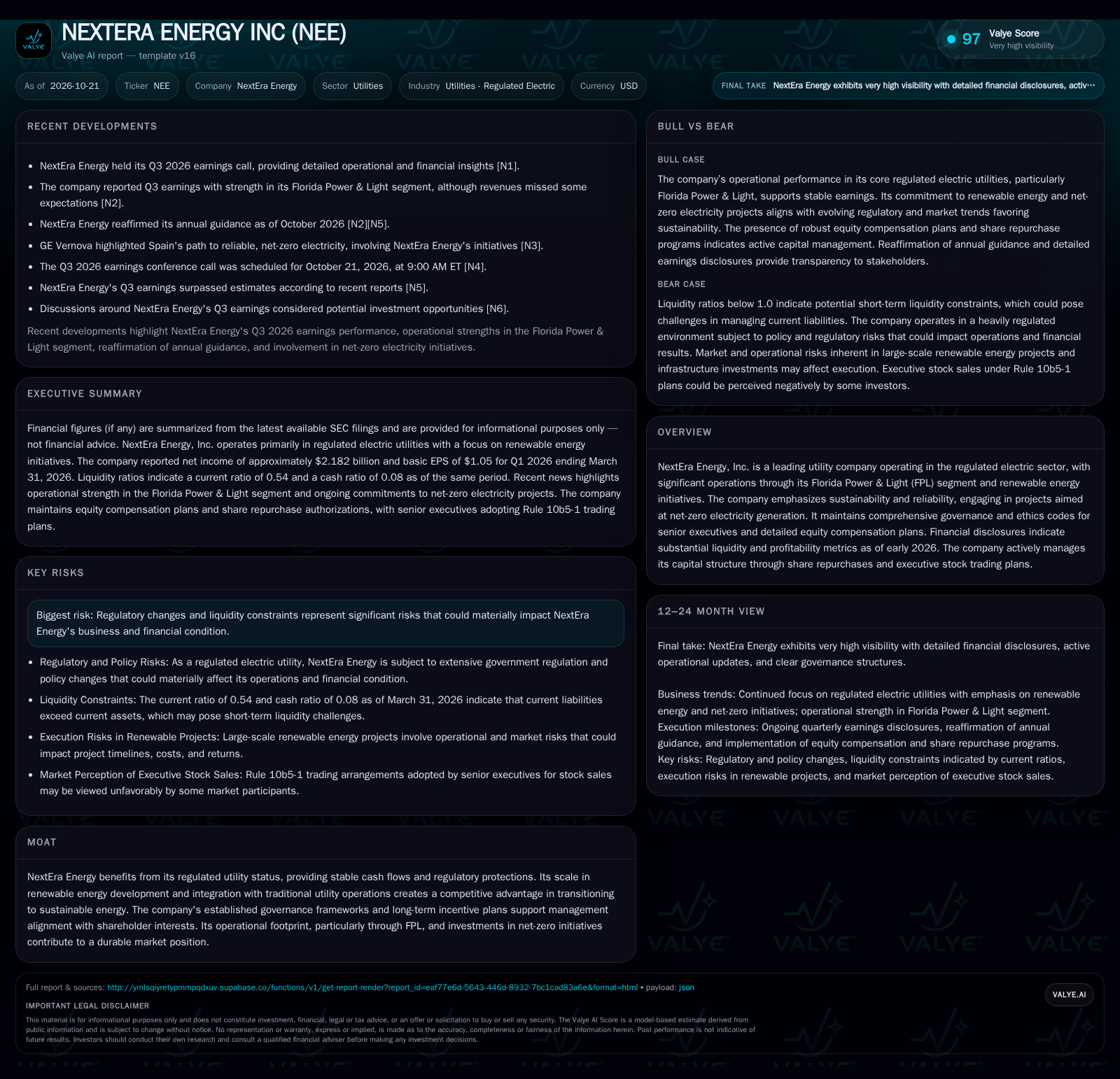
NextEra Energy reported strong net income of $2.182 billion for Q1 2026 and demonstrated continued operational strength, especially in its Florida Power & Light segment. The company has made significant acquisitions in natural gas and energy assets during 2026, expanding its commercial and industrial offerings. Ongoing regulatory and execution risks remain central to the investment case. [S2]
NextEra Energy’s Q3 2026 performance and recent acquisition activity underscore its dual strategy: leveraging the stability of regulated electric utilities through Florida Power & Light, while expanding aggressively into renewable and natural gas assets. The company’s ambitious capital allocation comes at a time when liquidity ratios are below typical utility norms, heightening the importance of disciplined execution and regulatory navigation. NextEra’s future trajectory hinges on how effectively it can balance short-term capital pressures with long-term infrastructure and energy transition objectives.
Recent Acquisitions and Financial Position Define the 2026 Backdrop
NextEra Energy reported net income of $2.182 billion for the quarter ended March 31, 2026, with basic and diluted EPS of $1.05 and $1.04, respectively. [S2] These results reflect the underlying strength of its regulated utility operations, particularly through the Florida Power & Light segment, which continues to anchor the company’s earnings base. [S2]
In 2026, NextEra completed two notable acquisitions: Symmetry Energy Solutions, a commercial and industrial gas supplier, for $0.8 billion in cash (plus $0.3 billion in adjustments), and Caliber Resource Partners, with interests in over 7,500 producing wells, for $1.0 billion in cash. [S2] These deals mark a material expansion into natural gas-related activities, positioning the company to serve a broader range of commercial and industrial customers and potentially hedge against transitional risks in the evolving U.S. energy landscape.
Earnings Stability Meets Capital-Intensive Growth: The Economic Puzzle
NextEra’s core regulated utility business provides relatively predictable cash flows, given the cost-of-service model and rate base structure typical of the sector. This stability enables the company to finance large-scale infrastructure investments, but also places constraints on returns due to regulatory oversight. Florida Power & Light, as the principal earnings engine, benefits from scale, operational efficiency, and favorable regulatory treatment in its home state.
The push into renewable energy and recent natural gas acquisitions introduces a more complex economic profile. Renewable projects often require significant upfront capital, with returns realized over long asset lives and sometimes dependent on tax credits or power purchase agreements. The economics of the Symmetry and Caliber deals hinge on the ability to extract synergies, secure long-term supply contracts, and manage commodity price exposure. However, the company’s below-average liquidity ratios suggest a need for careful working capital management and potentially increased reliance on external financing or asset recycling to support ongoing growth. If NextEra can maintain rate base growth and achieve attractive returns on invested capital from its new assets, operating leverage could increase—but execution risk is amplified by the capital intensity and long-dated payback periods inherent in these investments.
Scale, Regulatory Status, and Energy Mix Shape Competitive Dynamics
NextEra’s regulated utility status confers a degree of moat, with stable returns, high barriers to entry, and regulatory protections. The company’s scale in both traditional electric utility and renewables provides cost advantages in procurement, project development, and access to capital. Its expansion into commercial and industrial gas supply through Symmetry and Caliber diversifies its energy mix and broadens its customer base, potentially creating cross-selling opportunities and a hedge against renewables intermittency.
However, the competitive landscape is evolving. Peer utilities and independent power producers are scaling their own renewables and gas portfolios, while distributed generation, storage, and demand-side management technologies threaten to erode traditional load growth. Policy changes, especially around net-zero mandates, could accelerate or disrupt the economics of both legacy and newly acquired assets. NextEra’s advantage may rest on its ability to integrate renewables, gas, and grid operations at scale, but the company must also navigate regulatory scrutiny and the risk of stranded assets as the energy transition accelerates.
Synergy Capture and Policy Tailwinds Could Accelerate Value Creation
If NextEra successfully integrates its new gas businesses, achieving cost synergies and leveraging customer relationships to cross-sell electricity and gas solutions, the company could unlock new earnings streams and enhance its competitive position. Strong execution on renewable projects—delivering on-time, on-budget, and with high asset utilization—would allow NextEra to capitalize on policy incentives such as production and investment tax credits, further supporting rate base and EPS growth.
A favorable regulatory environment, with supportive rate cases and continued emphasis on grid modernization and decarbonization, could enable above-peer returns. Evidence confirming this scenario would include sustained or rising EPS, improved free cash flow, higher regulated asset base, and disclosure of successful integration milestones or new long-term commercial contracts in gas and renewables.
Balancing Growth Ambitions with Capital Constraints in a Regulated Framework
The most plausible outcome is that NextEra continues to generate stable earnings from its regulated utility base, with incremental growth from renewables and the recent gas acquisitions. Liquidity remains tight relative to current liabilities, necessitating disciplined capital allocation—possibly prioritizing the highest-return projects and relying on a mix of external financing and asset recycling to fund growth.
Regulatory outcomes are generally constructive but could limit the pace of rate base expansion or returns on new investments. Renewable project execution is mixed: some projects deliver as planned, while others face delays or cost overruns. The acquired gas businesses contribute meaningfully but do not fundamentally alter the company’s risk/return profile. Confirmation of this scenario would be steady EPS and dividend growth, manageable leverage ratios, and limited evidence of major regulatory or execution setbacks.
Liquidity Pressures and Execution Missteps Could Erode Resilience
If short-term liquidity constraints worsen—due to misaligned project timing, unexpected regulatory disallowances, or cost overruns in renewables and gas integration—the company could face increased borrowing costs or be forced to defer critical investments. A less favorable regulatory environment, with delays in rate recovery or adverse policy changes, could further stress cash flows.
Integration challenges with Symmetry and Caliber, such as customer attrition, commodity price volatility, or operational disruptions, could dilute earnings and increase risk. Evidence of downside would include declining or volatile EPS, negative free cash flow, credit rating downgrades, reduction in capital spending plans, or asset sales at unfavorable terms. Any regulatory penalties or major project delays would further confirm the downside thesis.
Crucial Markers for Testing NextEra’s Strategic Execution and Capital Discipline
Actual and projected free cash flow, particularly after dividends and capital expenditures, would clarify the company’s ability to self-fund growth.
Progress reports on the integration of Symmetry Energy Solutions and Caliber Resource Partners, including synergy realization, customer retention, and margin trends, would provide critical evidence.
Regulatory outcomes in Florida and other jurisdictions, such as approved rate cases and allowed returns, will shape the company’s earnings visibility.
Updates on renewable project backlog, construction timelines, and cost performance, if disclosed, would help test execution capabilities.
Disclosure of new long-term commercial or industrial contracts in gas and renewables would indicate success in cross-selling and customer expansion.
Any public commentary or filings regarding credit rating changes, debt covenant compliance, or refinancing activity would be material in assessing financial resilience.
Disclaimer: This is research-only, informational analysis and not investment advice. It may include AI-generated interpretation and general industry context. Always verify important details using primary sources.

Comments