
RLI CORP: Specialty Insurance Profit Volatility and the Test of Underwriting Discipline
The core question is whether underwriting discipline and capital flexibility can offset industry volatility and sustain long-term returns.
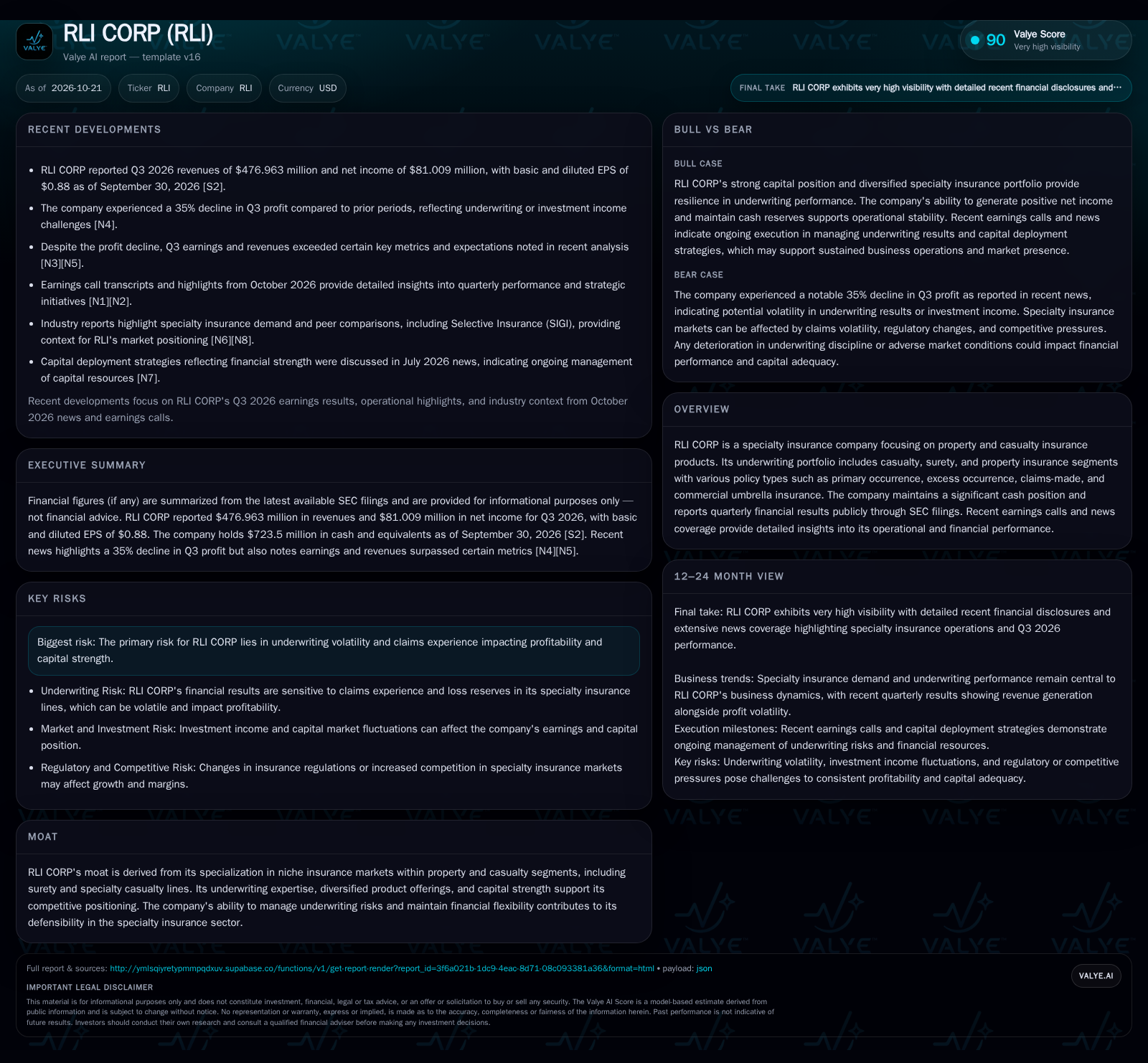
RLI CORP reported Q3 2026 revenues of $476.963 million and net income of $81.009 million, with a notable 35% profit decline versus prior periods [S2] [N4]. Despite this, earnings and revenues exceeded some expectations [N5]. RLI’s business model centers on underwriting specialty property and casualty insurance, supported by significant cash reserves [S1] [S2]. The company faces the challenge of underwriting and investment volatility but maintains competitive positioning through niche expertise and financial strength.
RLI CORP’s latest quarter underscores a defining tension in specialty insurance: robust revenue generation and a reported cash position exist alongside pronounced profit volatility. The company’s 35% profit decline in Q3 2026 is a stark reminder of the sector’s exposure to unpredictable claims and investment swings. Yet, RLI’s ability to beat certain expectations signals underlying operational strengths. The key analytical challenge is to determine whether RLI’s underwriting discipline, product mix, and capital management are enough to navigate the sector’s inherent uncertainty and deliver sustainable returns.
Recent Financial Results Highlight Profit Volatility and Resilience
RLI CORP reported third-quarter 2026 revenues of $476.963 million and net income of $81.009 million, translating to $0.88 per share on both a basic and diluted basis [S2]. This quarter saw a 35% year-over-year profit decline, a result likely linked to increased claims activity, loss experience, or investment income pressures [N4]. Nevertheless, both earnings and revenues exceeded certain analyst expectations, suggesting that the company’s core operations may have outperformed consensus even amid headwinds [N3] [N5]. The company reported cash and liquidity metrics for the period; these figures do not by themselves establish operating runway, investment capacity, financial flexibility, or financing capacity. [S2] These results sharpen the focus on RLI’s ability to manage underwriting risks and maintain operating flexibility in a volatile specialty insurance environment.
How RLI Makes Money: Specialty Underwriting and the Economics of Risk Selection
RLI’s core business is underwriting specialty insurance products—primarily in casualty, surety, and property lines—with policy types that include primary occurrence, excess occurrence, claims-made, and commercial umbrella coverages [S1]. The essence of the model is risk selection: underwriting profits are driven by the difference between premiums earned and claims plus expenses paid. Specialty insurers like RLI often target niche or complex risks that are underserved by larger carriers, enabling them to command higher premiums relative to expected losses.
Revenue growth can be achieved through increased volume (more policies or higher limits), improved pricing, or favorable risk selection. However, the specialty nature of RLI’s book means that claim frequency and severity can be volatile, with isolated large losses having outsized impacts on quarterly results. Operating leverage is present, but the fixed-cost base is typically lower than mass-market insurers, as specialty lines often require less infrastructure but more underwriting expertise. Investment income from RLI’s float (premiums collected before claims are paid) can provide a secondary earnings stream, but this is subject to capital market conditions and interest rate cycles.
The company’s ability to sustain margins depends on pricing discipline, claims management, and judicious capital allocation.
Competitive Differentiation Hinges on Underwriting Discipline and Niche Focus
RLI’s defensibility comes from its focus on specialty and niche insurance segments, where deep expertise and underwriting discipline are critical. Unlike mass-market insurers, specialty carriers can carve out defensible positions by developing tailored products, understanding unique risk pools, and building broker relationships that are hard to replicate. This focus can create a modest moat, as switching specialty insurers often involves retraining brokers, educating customers, and overcoming trust barriers.
However, RLI faces several counterforces. Other specialty insurers and larger multiline carriers with specialty divisions can compete aggressively on price or capacity, especially when capital is abundant in the reinsurance market. Technological advances—such as data-driven risk modeling and automated underwriting—could erode traditional expertise advantages unless RLI continues to invest in its own capabilities. Substitutes include alternative risk transfer mechanisms (like captives or parametric insurance) that may appeal to sophisticated buyers seeking to bypass traditional insurance structures.
In this environment, RLI’s competitive positioning will be tested by its ability to maintain underwriting discipline, avoid adverse selection, and quickly adapt to market shifts. Peer performance, particularly from specialty insurers with similar portfolios, provides a relevant benchmark for assessing RLI’s relative execution.
Outperformance If Underwriting Margins Recover and Capital Is Deployed Accretively
The most favorable scenario for RLI involves a rebound in underwriting profitability—either through improved claims experience, successful repricing of business, or a benign catastrophe environment. If management can demonstrate that the Q3 profit decline was an anomaly rather than the start of a negative trend, and if loss ratios return to historical norms, RLI could deliver outsized earnings growth relative to peers.
Accretive capital deployment—such as selective acquisitions, expansion into new specialty lines, or share repurchases—could further enhance returns on equity. Confirmation of this scenario would come from a sustained improvement in combined ratios (loss plus expense ratios), rising underwriting profits, and evidence from future earnings calls that premium growth is being achieved without sacrificing pricing discipline.
Volatility Remains, but Core Specialty Insurance Model Persists
The most plausible outcome is that RLI continues to experience earnings volatility—driven by the inherent unpredictability of specialty insurance claims and investment results—but remains fundamentally profitable over the cycle. The company’s diversified product mix and underwriting expertise could allow it to absorb occasional adverse quarters while maintaining its overall market position.
In this scenario, quarterly results would likely fluctuate, but the full-year combined ratio would remain competitive with specialty peers. RLI would continue to generate positive, if uneven, net income and maintain a robust balance sheet. Premium growth may track industry trends, and capital deployment would focus on organic growth and selective risk-taking rather than transformative acquisitions.
Evidence for this scenario would be continued positive net income, stable or slightly improved loss ratios over several quarters, and management guidance that emphasizes risk-adjusted returns rather than market share growth at any cost. An absence of major reserve charges or regulatory setbacks would also support this base case.
Sustained Underwriting Deterioration or Market Disruption Threatens Capital Strength
The adverse scenario for RLI would involve persistent underwriting losses, adverse reserve development, or a major claims event that erodes profitability and capital. If competitive pressures force pricing below sustainable levels, or if RLI misjudges risk in new product segments, the company could face a multi-quarter or multi-year earnings drag.
A prolonged low-interest-rate environment or poor investment performance could compound the problem by reducing investment income, further squeezing margins. Regulatory changes or an influx of new entrants into specialty lines could intensify competition and compress returns. In this scenario, RLI might be forced to curtail growth, raise additional capital, or even exit certain lines to protect solvency.
Confirmation would come from a string of quarterly losses, a rising combined ratio well above peer averages, negative reserve development disclosures, and management guidance indicating a retrenchment or significant restructuring. A decline in cash and equivalents or ratings agency downgrades would further signal stress.
Milestones and Metrics That Will Define RLI’s Specialty Insurance Trajectory
Quarterly and annual combined ratios (loss plus expense ratios) versus specialty insurance peers—if disclosed—will be a primary indicator of underwriting discipline and profitability.
Year-over-year changes in gross written premiums and net premiums earned can signal whether RLI is achieving growth through disciplined risk selection or sacrificing margins for volume.
Reserve development trends—positive or negative—would provide insight into the accuracy of prior loss estimates and the potential for future earnings volatility.
Quarterly investment income and changes in portfolio yield will reveal the contribution of float returns to overall profitability, especially in a changing rate environment.
Management’s commentary on capital deployment—whether focused on organic growth, acquisitions, or shareholder returns—will indicate strategic priorities and risk appetite.
Any material changes in regulatory capital ratios or ratings agency outlooks should be monitored as signals of emerging balance sheet stress or resilience.
Peer group performance, particularly from other specialty insurers, will help contextualize RLI’s results and test whether challenges are idiosyncratic or industry-wide.
If disclosed, retention rates and new business growth by major product line would help test the stickiness of RLI’s broker and customer relationships.
Disclaimer: This is research-only, informational analysis and not investment advice. It may include AI-generated interpretation and general industry context. Always verify important details using primary sources.

Comments