
Hexcel: Composite Materials Scale, Aerospace Demand, and the Test of Long-Term Program Visibility
Hexcel’s profitability and liquidity remain intact despite recent stock volatility, as the company leans into aerospace recovery and expanded share repurchases. The evolving mix of long-term agreements, supply chain pressures, and the durability of its composite technology franchise will determine whether earnings momentum can persist through the next cycle.
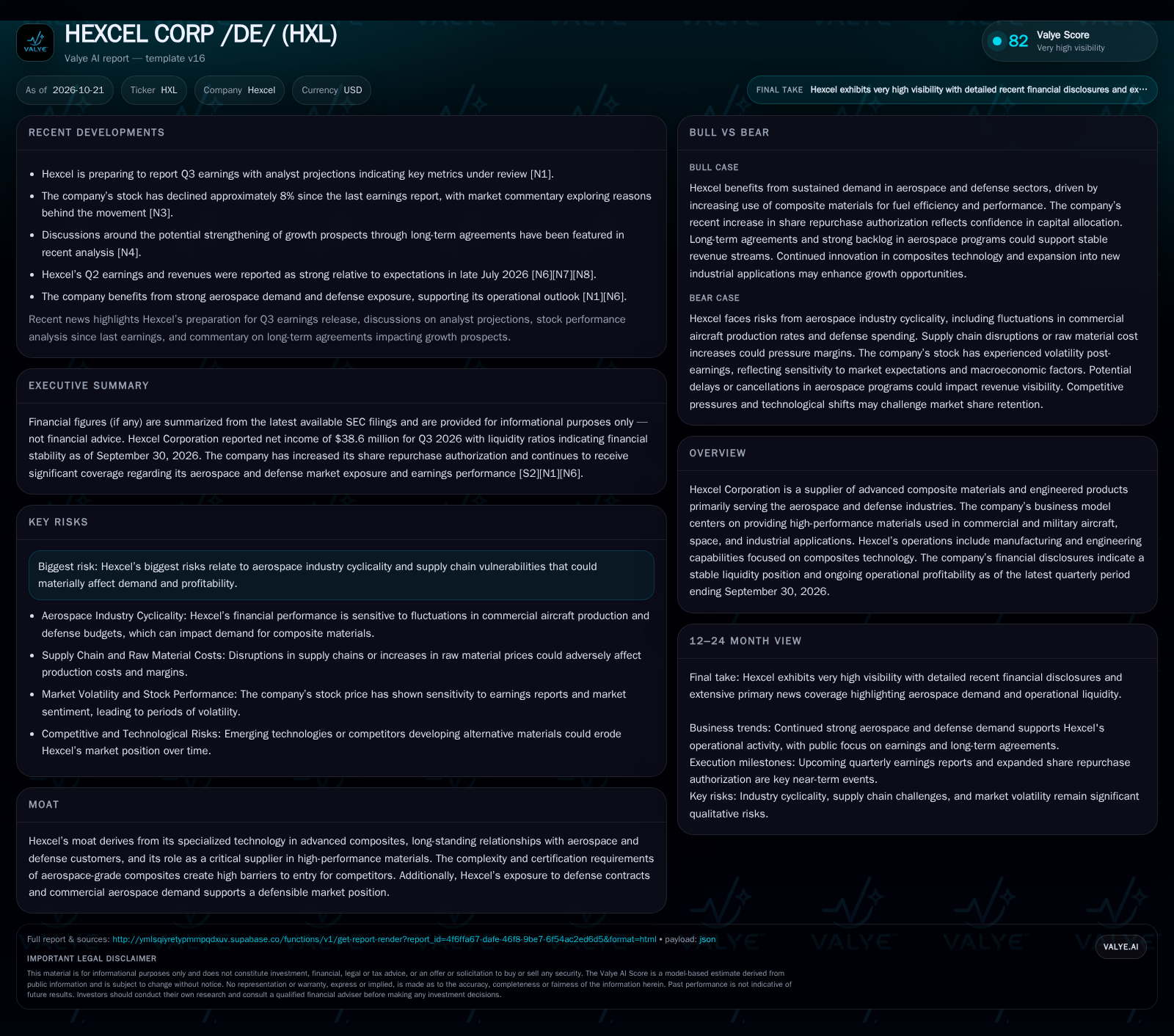
Hexcel reported Q3 2026 net income of $38.6 million and reported liquidity-ratio trends of 2.57, underscoring operational profitability and liquidity. The board expanded share repurchase authorization to $750 million, signaling capital allocation confidence. Recent stock declines and analyst debate focus attention on whether long-term agreements and aerospace demand can offset cyclicality and margin pressures [S2] [N3] [N4].
Hexcel Corporation stands at a pivotal juncture as the aerospace and defense sector rebounds, yet market skepticism lingers. The company’s solid Q3 2026 earnings and reported liquidity position are countered by an 8% stock drop and renewed scrutiny of its exposure to industry cyclicality. With an expanded share buyback plan and ongoing public discussion about the impact of long-term agreements, the key question is whether Hexcel’s composite materials franchise can deliver durable growth and margin stability through the next cycle.
Recent Results Spotlight Profitability and Capital Allocation Amid Stock Volatility
Hexcel reported net income of $38.6 million for Q3 2026, extending its track record of profitability in a sector known for pronounced cycles [S2]. The company reported cash and liquidity metrics for the period; these figures do not by themselves establish operating runway, investment capacity, financial flexibility, or financing capacity. [S2] In a notable capital allocation move, Hexcel’s board more than doubled its share repurchase authorization to $750 million in October 2026, up from $380.6 million [S2]. Despite these strengths, Hexcel’s stock declined about 8% since the last earnings report, with market commentary centering on the durability of growth and the role of long-term agreements in securing future revenue [N3] [N4]. These developments crystallize the tension between the company’s operational resilience and persistent investor concerns about cyclicality and growth visibility.
Composite Materials Economics: Scale, Mix, and Margin Dynamics
Hexcel’s core business model relies on supplying advanced composite materials and engineered products, primarily to commercial aerospace and defense manufacturers. Revenue is largely driven by the volume of composite structures embedded into new aircraft and ongoing demand for replacements, upgrades, and spares. Pricing power in this market is typically strongest for highly engineered, certified materials with critical performance attributes—especially those specified into long-term aerospace programs. However, the economics are exposed to fixed-cost leverage, as high R&D, certification, and production investments are amortized over large program volumes.
The company’s margin profile is sensitive to both the mix of commercial versus defense contracts and the cadence of new aircraft production. Commercial aerospace tends to be higher volume but more cyclical, while defense and space offer steadier demand but may be subject to budgetary risk. Variable costs include raw materials (such as carbon fiber precursors), energy, and logistics—areas that have experienced persistent inflation and supply chain disruption in recent years. Hexcel’s ability to lock in multiyear supply agreements and pass through input cost increases to customers will be critical for protecting margins through the cycle.
On the capital side, Hexcel’s manufacturing footprint and certification requirements demand ongoing investment but also create high barriers to entry for new competitors. [S2]
Barriers to Entry and the Competitive Landscape in Aerospace Composites
Hexcel benefits from meaningful competitive advantages rooted in technology, customer relationships, and regulatory requirements. Aerospace-grade composites require years of development, rigorous certification, and close integration with aerospace OEMs—factors that favor established suppliers. Long-standing supply relationships with major aircraft and defense manufacturers embed Hexcel into multi-year programs, increasing switching costs and providing a degree of revenue visibility.
However, the competitive landscape is not static. Peer companies in the advanced materials sector, including both large diversified industrials and specialized composites firms, continually invest in new formulations, automation, and cost reduction. The risk of substitution by alternative materials—such as advanced aluminum alloys, titanium, or new polymer technologies—remains a long-term threat, especially if performance or regulatory standards shift. Additionally, the emergence of new aerospace entrants or regional suppliers could erode market share if Hexcel fails to innovate or maintain cost competitiveness.
While Hexcel’s moat is durable due to certification complexity and program stickiness, the company’s long-term position will depend on its ability to anticipate and respond to shifts in materials science, manufacturing automation, and customer procurement strategies.
If Long-Term Agreements Lock in Growth, Margin Expansion Could Follow
The most favorable scenario for Hexcel envisions commercial aerospace production accelerating, with defense programs remaining robust and long-term agreements providing a reliable revenue base. If the company is able to convert recent customer discussions into multi-year supply contracts with price escalation clauses or cost pass-through mechanisms, margin expansion could be realized even in the face of input cost volatility. This would be further bolstered if supply chain normalization allows for better inventory turns and reduced working capital needs.
Confirmation of this scenario would include public disclosure of multi-year program wins, backlog growth, or improved revenue guidance tied to specific contract extensions. Conversely, failure to secure new long-term agreements or margin compression despite revenue growth would call this upside case into question.
Aerospace Recovery Supports Steady Earnings—but Cyclicality and Cost Pressures Persist
The most plausible scenario is that Hexcel experiences steady, moderate growth as commercial aerospace demand recovers post-pandemic and defense spending remains resilient. Revenue visibility is supported by embedded positions in major aircraft programs, but growth is capped by the underlying production rates of OEM customers. Input cost inflation and periodic supply chain disruptions continue to pressure gross margins, partially offset by operational efficiencies and selective pricing actions.
Evidence supporting this scenario would include stable or slightly rising quarterly earnings, a consistent current ratio, and incremental increases in share repurchase activity. Falsification would come from a sharp contraction in commercial aircraft production, significant defense program delays, or a marked deterioration in gross margin, all of which would suggest greater vulnerability to external shocks than currently anticipated.
Cyclical Downturn or Disrupted Supply Chains Could Erode Earnings Power
In an adverse scenario, a downturn in commercial aerospace—driven by global economic weakness, airline bankruptcies, or a pause in aircraft deliveries—could sharply reduce volumes for Hexcel’s core products. Simultaneously, persistent or worsening supply chain bottlenecks and raw material inflation could squeeze margins, especially if price increases cannot be passed through to customers on existing contracts.
Further risk emerges if defense procurement slows or major program awards are delayed, reducing baseline demand. Competitive encroachment or technological substitution could also accelerate, undermining Hexcel’s pricing power and customer stickiness. Confirmation of this downside would come from declining sales, margin contraction, negative operating cash flow, or a reduction in the company’s liquidity ratios.
Metrics and Developments to Scrutinize as Hexcel’s Cycle Plays Out
Quarterly disclosure of new or renewed long-term supply agreements, including contract duration, value, and pricing mechanisms, if disclosed.
Gross margin trends, particularly evidence of margin recovery or further compression in the face of input cost fluctuations.
Backlog figures and program participation updates, especially with respect to next-generation commercial and defense platforms.
Quarterly cash flow from operations, as a test of earnings quality and the company’s ability to self-fund capital needs.
Updates on capital expenditures and R&D outlays, which would indicate ongoing commitment to technology leadership and capacity.
Any reported supply chain disruptions, raw material shortages, or logistics cost spikes affecting production schedules.
Evidence of market share gains or losses, either through disclosed customer wins, losses, or new competitive entrants.
Disclaimer: This is research-only, informational analysis and not investment advice. It may include AI-generated interpretation and general industry context. Always verify important details using primary sources.

Comments