
Intuitive Surgical: Strong Revenue Growth, Mounting Competitive Frictions, and the Test of Installed-Base Economics
Intuitive Surgical’s robust Q3 2026 revenue growth underscores the power of its installed da Vinci platform, but profit pressures, third-party competition, and regulatory uncertainty raise questions about the durability of its economic moat and future margin trajectory.
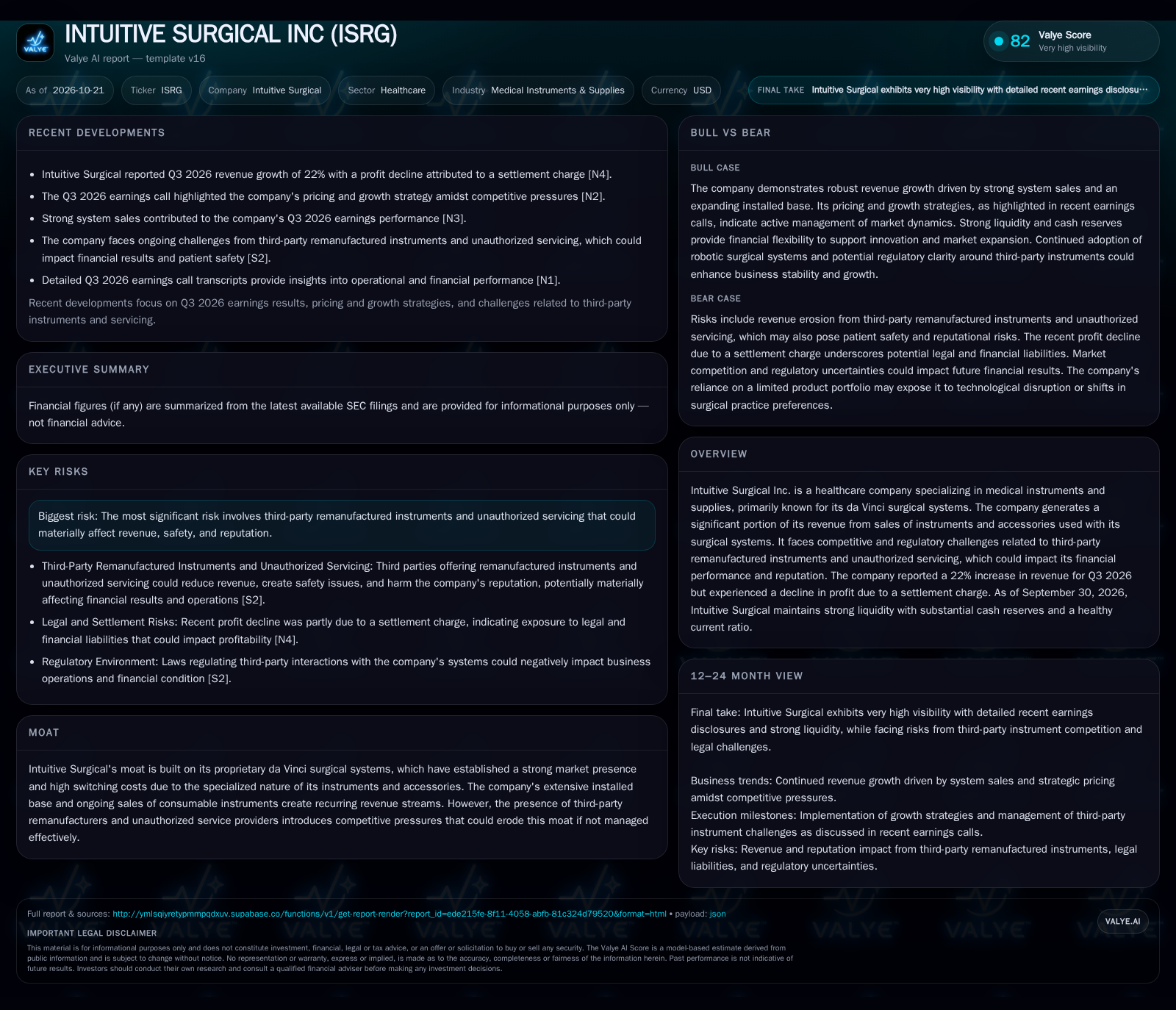
Intuitive Surgical posted 22% revenue growth in Q3 2026, driven by strong system sales and ongoing instrument demand, but saw profits decline due to a settlement charge. The key debate is whether Intuitive’s platform and installed base can maintain their competitive edge as regulatory, legal, and market dynamics shift. [S2] [N2] [N4]
Intuitive Surgical’s Q3 2026 results highlight the company’s enduring strength in robotic-assisted surgery, posting a 22% revenue increase anchored by system placements and instrument sales. Yet, this momentum is shadowed by profit pressures from legal settlements and the persistent encroachment of third-party remanufacturers and unauthorized service providers. With a robust balance sheet as a buffer, Intuitive faces a pivotal period: Can its proprietary technology and installed base continue to generate recurring, defensible revenue—or will regulatory shifts and market competition erode its economic advantages?
Q3 2026 Snapshot: Revenue Growth, Profit Pressure, and Competitive Frictions
Intuitive Surgical delivered a 22% year-over-year revenue increase in Q3 2026, propelled by strong system sales and sustained demand for instruments and accessories tied to its da Vinci surgical platform. However, net income for the quarter fell to approximately $523 million, reflecting the impact of a significant settlement charge. The company reported cash and equivalents of $2.98 billion and short-term investments of $1.06 billion as of September 30, 2026, yielding a current ratio of 3.33 and a cash ratio of 1.6. These financials indicate substantial resources available for investment and operational needs, but they also underscore mounting profit pressures. Meanwhile, third-party remanufactured instruments and unauthorized servicing continue to threaten both revenue streams and patient safety, introducing new legal and reputational risks. [S2] [N2] [N4]
Installed-Base Economics: Recurring Revenue and Shifting Margin Dynamics
Intuitive Surgical’s business model centers on the high upfront sale of da Vinci robotic systems, followed by a recurring stream of revenue from proprietary instruments, accessories, and service contracts. This installed-base model historically provides strong visibility and operating leverage: as the number of deployed systems grows, so does the repeat demand for consumables and maintenance. Pricing power has been supported by the proprietary nature of instruments and the clinical integration required to switch platforms. However, the emergence of third-party remanufacturers and unauthorized service providers could pressure both pricing and volumes in these high-margin categories, especially if hospitals—facing their own financial constraints—seek lower-cost alternatives. If Intuitive is forced to adjust pricing, or if third-party penetration accelerates, incremental margins on instrument and service revenue could compress. Capital requirements remain moderate, with significant cash reserves supporting continued R&D, regulatory compliance, and potential legal settlements. The balance between platform expansion and margin protection will be central to future value creation.
The installed-base model's resilience also depends on the degree to which Intuitive Surgical can continually innovate its consumables and service offerings to create differentiated value that third-party providers cannot easily replicate. If the company can introduce proprietary enhancements that improve clinical outcomes or streamline surgical workflows, it may sustain pricing power despite competitive pressures. Conversely, if third-party providers successfully mimic core instrument functionalities without compromising quality, hospitals may increasingly weigh cost savings over incremental performance benefits. Additionally, the capital intensity and complexity of robotic systems mean that long-term service contracts and software updates can become critical levers for maintaining customer lock-in, provided Intuitive can demonstrate superior reliability and support.
Another layer influencing margin dynamics is the potential shift in hospital procurement strategies under tightening healthcare budgets. Hospitals might adopt more centralized purchasing or group purchasing organizations (GPOs) that negotiate aggressively on pricing and service terms, potentially diluting Intuitive’s direct pricing power. If these entities favor bundled contracts or multi-vendor sourcing, the company may face pressure not only from third-party remanufacturers but also from alternative robotic platforms offering competitive total cost of ownership. Monitoring changes in hospital procurement behavior and contract structures will be essential to anticipate margin trajectories and the sustainability of recurring revenue streams.
Platform Dominance Meets New Entrants and Substitution Risk
Intuitive Surgical’s competitive position has long been anchored by its proprietary da Vinci platform, clinical validation, and deep integration into hospital workflows. High switching costs—stemming from surgeon training, workflow disruption, and capital investment—have historically deterred customers from moving to alternative systems. The platform’s extensive installed base also creates powerful network effects: as more procedures are performed robotically, the argument for further adoption grows. However, the rise of third-party remanufacturers and unauthorized service providers introduces a new dimension of price-based competition, particularly around consumables and servicing. Regulatory and legal actions will determine how aggressively these third parties can compete. Additionally, established medical device companies and new entrants are investing in alternative robotic platforms, which, if they achieve regulatory approval and clinical acceptance, could erode Intuitive’s market share, especially in price-sensitive segments or geographies. The risk of technological disruption—whether from new robotics paradigms, AI-enabled surgery, or non-robotic minimally invasive techniques—remains a long-term consideration.
Reinforcing the Moat: Regulatory Clarity and Platform Expansion Drive Durable Growth
The most favorable scenario for Intuitive Surgical involves a confluence of regulatory and market outcomes that reinforce its competitive advantages. If regulatory authorities take a firm stance against third-party remanufacturers—citing patient safety or intellectual property protection—Intuitive could retain exclusive control over instrument and service revenue, defending its high-margin recurring streams. Simultaneously, continued innovation and successful expansion into new surgical specialties could grow the installed base, deepening customer lock-in and increasing procedure volumes. Evidence supporting this scenario would include a decline in third-party market share, favorable regulatory or legal decisions, and sustained growth in both system sales and instrument revenues. Confirmation would also come from stable or rising instrument margins and customer retention rates, along with expansion into new markets or clinical indications.
Installed Base Grows, but Margin Compression and Legal Uncertainty Persist
The most plausible path forward is one in which Intuitive Surgical continues to grow its installed base and procedure volumes, but faces ongoing margin pressure from competitive and legal headwinds. Hospitals, under financial strain, may selectively adopt third-party instruments or services where permitted, eroding some of Intuitive’s pricing power in consumables and maintenance. Legal and regulatory outcomes remain mixed, with some jurisdictions favoring original manufacturers and others allowing limited third-party participation. Evidence for this scenario would include continued double-digit revenue growth but slower profit growth, periodic legal expenses or settlements, and signs of gradual price competition in the instrument and service categories.
Moat Erosion Accelerates: Third-Party Competition and Regulatory Headwinds Undermine Economics
A more adverse scenario emerges if regulatory bodies broadly permit third-party remanufactured instruments and unauthorized servicing, either on cost grounds or due to insufficient enforcement. This would accelerate price-based competition, leading to a rapid erosion of Intuitive’s high-margin recurring revenue streams. Hospitals, under ongoing financial pressure, may shift significant portions of their instrument and service spend to lower-cost alternatives, forcing Intuitive to lower prices or lose share. Legal expenses could mount, and reputational damage from any safety incidents linked to third-party products could further weaken market confidence. In this scenario, evidence would include a sharp deceleration in instrument revenue growth, margin compression, rising legal costs, and negative commentary from hospital customers or regulatory authorities regarding the proprietary model.
Testing the Durability of the Installed-Base Model in a Shifting Regulatory Landscape
Growth rate of instrument and accessory revenue versus system sales—divergence may signal competitive leakage or pricing pressure.
Gross and operating margin trends, especially in the instrument and service categories, as a proxy for pricing power and competitive intensity.
Legal and regulatory developments regarding third-party remanufacturers and unauthorized servicing, including court decisions or new legislation.
Hospital customer retention and renewal rates, if disclosed, to gauge satisfaction and switching behavior.
Evidence of price concessions or changes to contracting terms with major hospital systems.
Penetration of competing robotic platforms in core markets—new regulatory approvals or large hospital wins would help test the threat of substitution.
R&D spending as a percentage of revenue, to assess ongoing investment in platform innovation and defense.
Reported safety incidents or recalls linked to third-party instruments, which could influence regulatory and customer attitudes toward proprietary versus remanufactured solutions.
Disclaimer: This is research-only, informational analysis and not investment advice. It may include AI-generated interpretation and general industry context. Always verify important details using primary sources.

Comments