
STAK Inc.: Strategic Diversification Meets Execution Risk in Oilfield, Power, and New Energy Vehicles
STAK Inc. is navigating the transition from a specialized oilfield equipment supplier to a broader energy technology platform, pursuing AI-ready distributed power and new energy vehicles. Recent financial results show positive earnings and active governance, but modest margins and liquidity underscore the importance of successful execution and market adoption for new initiatives.
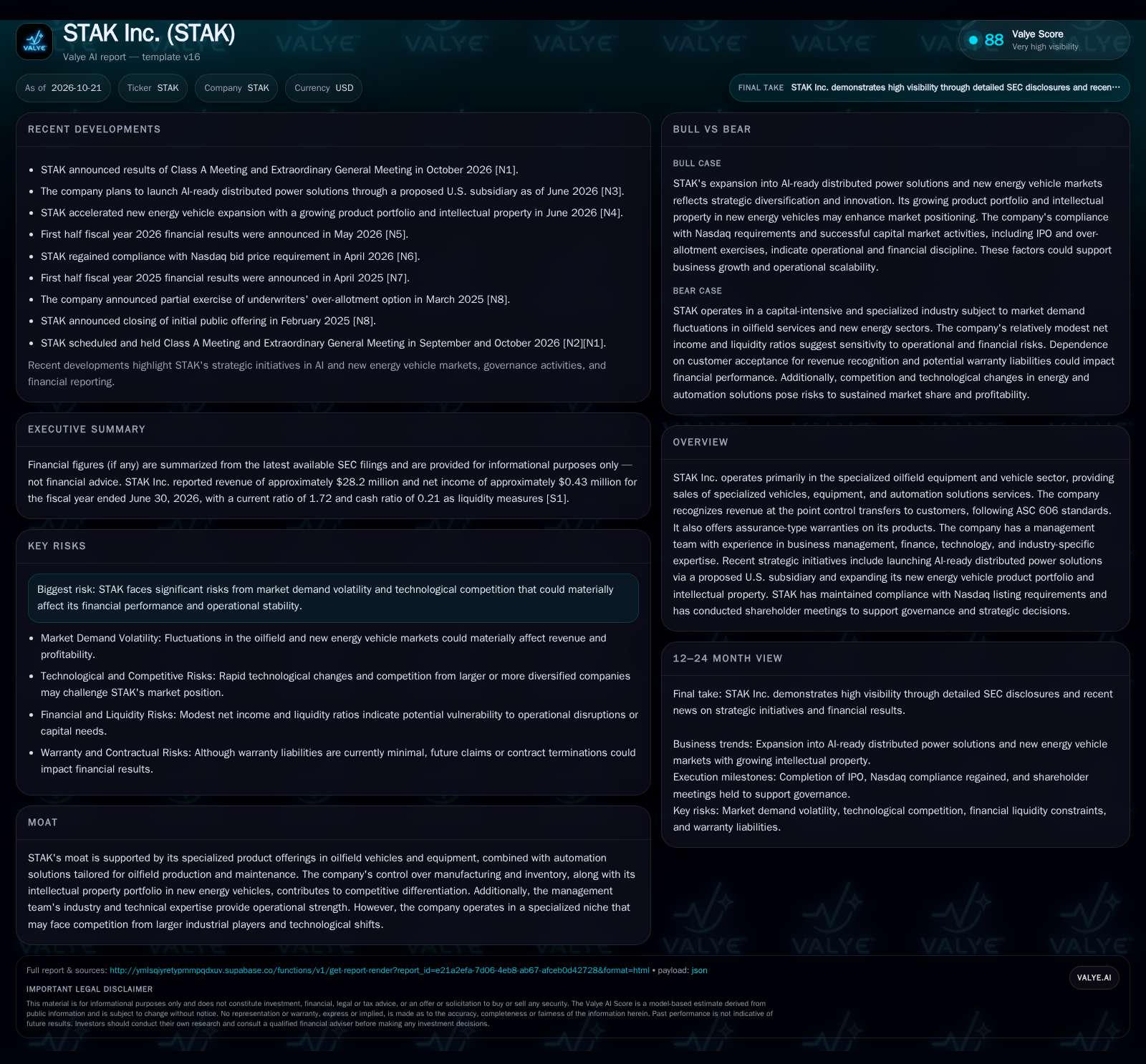
STAK Inc. reported $28.2M in revenue and $0.43M in net income as of June 2026, while launching AI-ready distributed power and expanding its new energy vehicle portfolio. [S1] [N3] [N4]
STAK Inc. sits at a strategic crossroads: historically rooted in the specialized oilfield vehicle and equipment market, the company is now pushing into AI-enabled distributed power and new energy vehicles. The next phase will test whether STAK can translate new product launches and intellectual property into durable, higher-margin growth—or whether legacy sector cyclicality and capital intensity will constrain its ambitions. [S1] [N3] [N4]
Recent Financials and Strategic Moves Define STAK’s Critical Inflection Point
STAK Inc. reported $28.2 million in revenue and $0.43 million in net income for the fiscal year ending June 30, 2026, with basic earnings per share of $0.03 and diluted EPS of $0.02. The company’s current ratio stood at 1.72 and cash ratio at 0.21, with cash and cash equivalents totaling $4.16 million as of June 2026. These figures indicate a profitable but thinly margined business with only reported liquidity position. [S1]
Strategically, STAK launched AI-ready distributed power solutions through a proposed U.S. subsidiary in mid-2026, targeting the growing demand for flexible, intelligent energy infrastructure. In parallel, it accelerated expansion into new energy vehicles (NEVs), emphasizing a growing product portfolio and intellectual property base. These moves represent an intentional pivot beyond oilfield equipment, aimed at capturing opportunities in broader energy transition and automation markets. [N3] [N4]
Governance developments include completion of Class A and Extraordinary General Meetings and regained compliance with Nasdaq bid price requirements, supporting operational continuity and market presence. [N1] [N2] [N6]
Revenue Mix, Margin Structure, and Capital Demands in Transition
STAK’s revenue streams are anchored in the sale of specialized oilfield vehicles, equipment, and automation solutions, with revenue recognized at the point of control transfer under ASC 606. This model typically results in lumpy, project-driven sales and places a premium on winning new orders and maintaining customer relationships. Gross and net margins are likely constrained by the capital intensity of manufacturing, inventory risk, and the need for ongoing R&D in both legacy and new business lines.
The expansion into AI-ready distributed power solutions and NEVs could alter both the revenue mix and margin profile. Distributed power solutions—especially those leveraging AI and automation—may offer higher software or service content, potentially improving gross margins and creating more recurring revenue if service/maintenance contracts or software subscriptions are incorporated. However, the upfront R&D and commercialization costs, coupled with the need to scale manufacturing or integration capabilities, will drive significant capital requirements.
The NEV segment is similarly capital- and R&D-intensive, with success contingent on achieving sufficient scale to offset high fixed costs and on managing supply chain complexity. If STAK can differentiate through proprietary technology or vertical integration, it could improve unit economics—but this remains unproven at current scale.
Specialization Versus Scale: STAK’s Niche Play in a Rapidly Evolving Landscape
STAK’s competitive position is grounded in its specialized product offerings for oilfield applications, combining hardware, automation solutions, and related services. This specialization confers a degree of customer stickiness in niche markets where technical requirements and field reliability are paramount. The company’s control over manufacturing and inventory, as well as its growing intellectual property in NEVs, provides some differentiation.
However, the broader landscape is marked by intense competition from larger, diversified industrial and technology firms—especially as energy transition and automation attract more capital and new entrants. In distributed power and NEVs, global players with deeper R&D budgets and established distribution networks may outpace STAK unless it carves out defensible niches or forms strategic partnerships.
Switching costs in oilfield equipment can be moderate, especially if customers require specialized service or integration. By contrast, in NEVs and distributed power, customer loyalty is less assured unless supported by proprietary technology, regulatory certifications, or integrated service ecosystems. The question is whether STAK’s investments in IP and software can translate into sustainable switching frictions or pricing power as product lines mature.
If New Energy and AI Initiatives Gain Traction, Margin Expansion Could Follow
The most favorable outcome for STAK is a successful ramp in both its AI-ready distributed power solutions and new energy vehicle lines. If the company can demonstrate early customer wins, secure repeat business, and establish a reputation for reliability and technical sophistication, revenue growth could accelerate and margin structure improve.
Confirmation would come in the form of rising revenue and gross margin contribution from new business lines, evidence of multi-year service or software contracts, and expansion of the IP portfolio leading to licensing or strategic partnerships. The shift toward more software or service-based economics could reduce cyclicality and improve cash conversion.
Falsification would be indicated by stalled adoption, persistent reliance on legacy oilfield revenue, or new initiatives consuming cash without demonstrable commercial traction.
Hybrid Model: Incremental Diversification Amid Ongoing Sector Cyclicality
The most plausible scenario is gradual diversification, with legacy oilfield equipment sales remaining the core revenue driver while new initiatives contribute incrementally. In this case, revenue would show moderate growth, but margin improvement would be limited by ongoing investment requirements and competitive pricing pressure.
Supporting evidence would include continued profitability, stable or slowly growing cash balances, and a rising (but not dominant) revenue share from distributed power or NEVs. A hybrid revenue mix could help smooth sector volatility, but capital constraints and execution risk would persist until new segments reach critical mass.
This scenario would be challenged if new product development outpaces commercial adoption or if oilfield demand weakens sharply, exposing the company’s reliance on its legacy base.
Execution Missteps or Market Headwinds Could Trigger Liquidity Strain
Adverse outcomes could result from weak adoption of new offerings, intensifying competition, or a downturn in oilfield capital spending.
Evidence of this scenario would include declining or flat revenue, shrinking margins, increased short-term borrowings, or the need for dilutive capital raises. Warranty claims or contract disputes could further pressure financial results.
A rapid deterioration in sector demand—especially if coupled with execution missteps—could force the company to retrench, refocus on core products, or pursue strategic alternatives from a position of weakness.
Milestones That Will Shape STAK’s Energy Transition Ambitions
Revenue breakdown by segment: Tracking the proportion of revenue generated from distributed power solutions and NEVs versus legacy oilfield equipment would clarify the pace and success of diversification if disclosed.
Gross margin trends: Improvement in blended or segment-specific gross margins would indicate successful commercialization and better pricing power for new offerings.
Order backlog or signed contracts: Evidence of multi-year or recurring revenue commitments, especially for distributed power or NEV solutions, would support visibility and test customer adoption.
R&D and SG&A expense trajectory: Monitoring investment levels relative to revenue will reveal whether spending is driving scalable growth or pressuring profitability.
Intellectual property milestones: Filings, patents granted, or licensing activity in NEVs and automation could validate differentiation and long-term moat potential.
Customer concentration: Changes in top customer exposure could affect revenue predictability and bargaining leverage, especially during sector transitions.
Warranty and service claims: Any material increase would suggest product reliability or execution risks impacting customer relationships and cost structure.
Disclaimer: This is research-only, informational analysis and not investment advice. It may include AI-generated interpretation and general industry context. Always verify important details using primary sources.

Comments