
Intelligent Bio Solutions: Regulatory Milestones, Cartridge Economics, and the Challenge of Scaling Fingerprint Drug Screening
Intelligent Bio Solutions is at a critical inflection point, leveraging clinical progress and manufacturing partnerships to commercialize its fingerprint-based drug screening platform. As the company advances toward FDA clearance and scales cartridge-driven revenues, the interplay of regulatory timing, funding sufficiency, and intellectual property rights will determine the speed and sustainability of its transition from development to commercial execution.
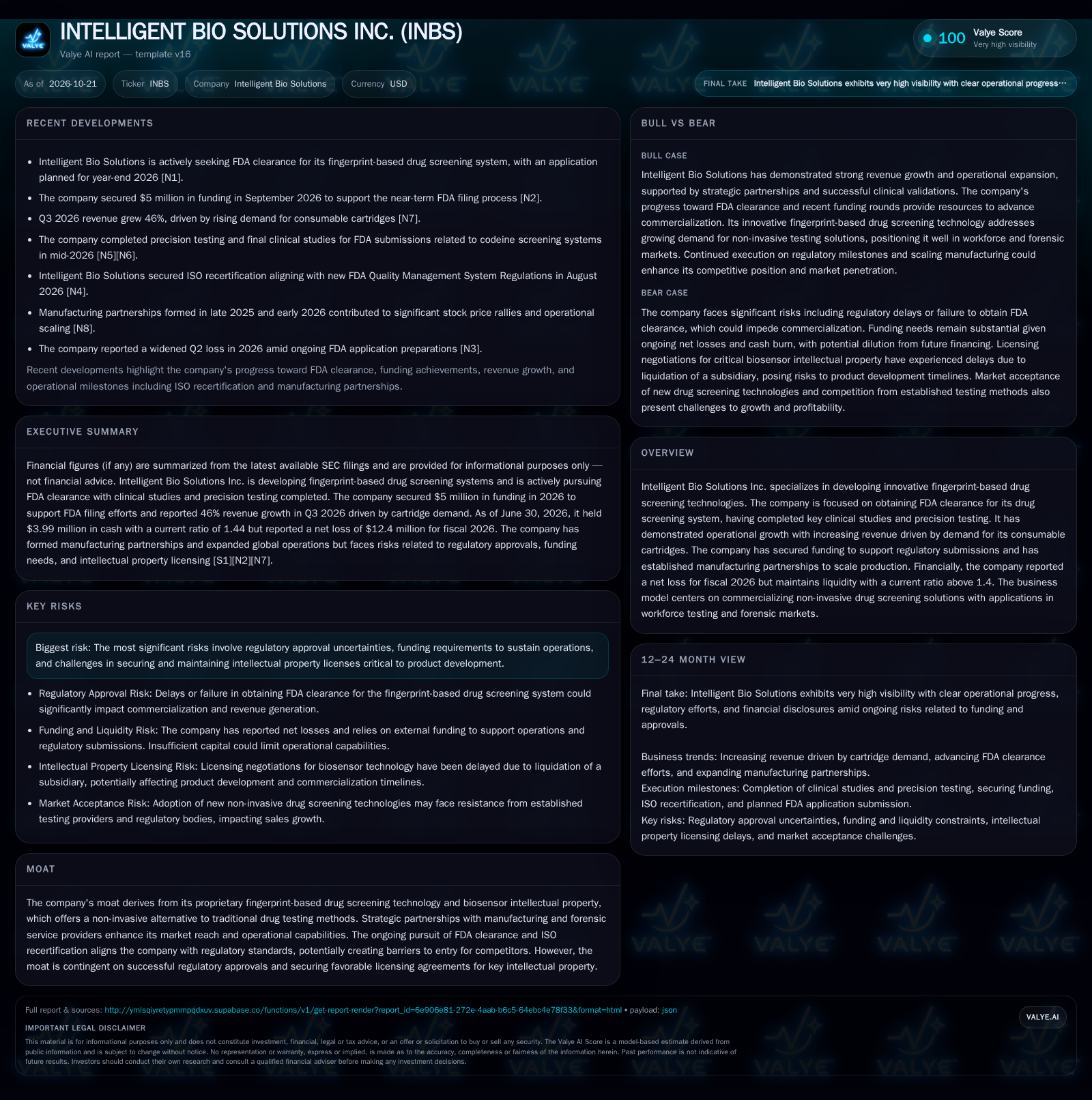
Intelligent Bio Solutions is advancing its non-invasive drug screening platform with a planned FDA submission by year-end 2026, supported by recent clinical and precision testing milestones. Q3 2026 revenue grew 46% on cartridge demand, and $5 million in new funding bolsters near-term regulatory efforts. The company’s commercial model hinges on cartridge economics and manufacturing scale, but faces acute risks around regulatory timing, IP licensing, and ongoing losses, making execution on FDA and funding milestones pivotal for future growth and market access. [S1] [N2] [N5] [N6] [N7] [N8]
Intelligent Bio Solutions stands at a commercialization crossroads, having achieved critical technical and operational milestones in its quest to bring fingerprint-based drug screening systems to market. With a planned FDA application by year-end 2026 and a fresh $5 million in funding, the company has demonstrated accelerating cartridge demand and expanded manufacturing capabilities. Yet, the path forward is highly sensitive to regulatory outcomes, the economics of cartridge-based testing, and the resolution of biosensor IP licensing hurdles. The next year will test whether Intelligent Bio Solutions can convert technical momentum into a sustainable and scalable commercial franchise.
FDA Submission, Revenue Acceleration, and Funding: The Latest Inflection Points
Three developments define the current juncture for Intelligent Bio Solutions. First, the company is preparing an FDA submission for its fingerprint-based drug screening system by the end of 2026, following the completion of both precision testing and final clinical studies for codeine detection earlier this year. This marks a pivotal regulatory milestone for U.S. market entry and broader commercial adoption. Second, Q3 2026 revenue grew 46%, attributed to rising demand for consumable cartridges—a signal that elements of the commercial model are gaining traction even pre-FDA. Third, the company secured $5 million in new funding in September 2026, earmarked for regulatory submission costs and bridging near-term liquidity. Together, these facts underscore a company transitioning from R&D to early commercialization, but with critical dependencies on regulatory clearance, continued funding, and the ability to scale operations. [N2] [N5] [N6] [N7] [S1]
Cartridge-Driven Recurrence: The Economics of Fingerprint Drug Screening
Intelligent Bio Solutions’ business model is anchored in the sale of proprietary, single-use cartridges used in conjunction with its fingerprint-based drug screening readers. This approach, if successfully commercialized, offers a classic razor-and-blade dynamic: initial hardware placement enables recurring revenue from consumable cartridges, which are required for each test performed. Revenue growth in Q3 2026 was explicitly driven by cartridge demand, suggesting that early adopters are beginning to generate repeat testing volumes. [N7]
The economics of this model can be attractive in health diagnostics, provided cartridge unit costs can be managed and gross margins improve with manufacturing scale. Fixed costs remain high during the pre-commercial and early commercial phases due to R&D, regulatory, and overhead outlays, as reflected in the company’s $12.4 million net loss for fiscal 2026. Operating leverage could be realized if cartridge volumes ramp post-FDA clearance, but the path to profitability is likely to be nonlinear given the need for ongoing investment in regulatory, manufacturing, and commercial infrastructure.
The company reported cash and liquidity metrics for the period; these figures do not by themselves establish operating runway, investment capacity, financial flexibility, or financing capacity. The company’s ability to convert cartridge-driven revenue growth into sustainable positive cash flow is unproven and will depend on both regulatory timing and successful market penetration. [S1]
Differentiation and Barriers: Proprietary Technology Meets Market Realities
The company’s principal differentiator is its proprietary, non-invasive fingerprint-based drug screening platform—a potential alternative to traditional urine, saliva, or blood-based tests. If validated at scale, this technology could offer faster, less intrusive, and potentially more secure testing, appealing to employers, law enforcement, and clinical markets.
However, the competitive landscape is formidable. Established diagnostic companies already supply a broad range of drug screening solutions with robust distribution, regulatory experience, and customer relationships. Barriers to adoption for new modalities include not only regulatory clearance, but also trust, workflow integration, and demonstrated accuracy in real-world settings.
Intelligent Bio Solutions’ moat is predicated on both its underlying biosensor intellectual property and successful regulatory alignment, as suggested by its ISO recertification and manufacturing partnerships. Yet, delays in licensing key IP from a liquidated subsidiary highlight the fragility of this advantage. Without clear, uncontested IP rights and timely regulatory approval, the moat could prove shallow—particularly if competitors pursue similar non-invasive or rapid-testing innovations. [S2] [N4] [N8]
Rapid FDA Clearance Unlocks Scalable Cartridge Adoption and Market Expansion
In the most favorable scenario, Intelligent Bio Solutions secures FDA clearance by mid-2027, leveraging completed clinical and precision testing as robust evidence of efficacy and safety. This regulatory win would catalyze commercial contracts with employers, clinics, and forensic agencies seeking non-invasive, rapid screening solutions—especially where traditional methods are cumbersome or stigmatized.
Cartridge sales would scale rapidly as installed reader bases grow, driving recurring, high-margin revenue. Manufacturing partnerships would facilitate production ramp, and the company could leverage ISO recertification to support quality and compliance in both U.S. and international markets. Success in resolving biosensor IP licensing would eliminate a major overhang, potentially opening the door to additional product variants and geographic expansion.
Evidence confirming this scenario would include: formal FDA clearance, a sharp uptick in cartridge shipments and active accounts, new multi-site customer wins, and disclosure of improved gross margins as manufacturing volumes rise. Conversely, any sign of regulatory delay, tepid cartridge reorder rates, or renewed IP disputes would quickly falsify the bullish case.
Commercial Progress Moderated by Regulatory, Funding, and Licensing Frictions
The most plausible trajectory is a mixed outcome: Intelligent Bio Solutions continues to grow cartridge sales in select international or pilot markets, but U.S. commercial scale is gated by the pace of FDA review and the resolution of biosensor IP licensing. Revenue growth remains healthy but volatile, reflecting lumpy hardware placements and variable cartridge adoption rates.
Manufacturing partnerships and ISO recertification support operational readiness, but the company must continue raising capital to bridge ongoing losses, risking further dilution. The company’s ability to negotiate favorable IP terms and manage regulatory correspondence efficiently will determine the speed of expansion.
This scenario would be confirmed by steady, if unspectacular, quarter-on-quarter cartridge revenue growth, incremental customer wins, and a clear regulatory update cadence. Delays in FDA process, slow uptake in core U.S. markets, or unresolved IP negotiations would reinforce the base case and limit upside optionality.
Regulatory Delays, Funding Shortfalls, and IP Uncertainty Stall Commercialization
An adverse scenario unfolds if FDA review is delayed or negative, leaving the company unable to access the U.S. market for an extended period. Ongoing net losses deplete available cash, forcing Intelligent Bio Solutions to seek additional dilutive capital or restructure operations. If biosensor IP licensing negotiations stall—especially given the complexities arising from the liquidation of a key subsidiary—the company may be unable to commercialize core technology or defend its differentiation.
In this environment, manufacturing partnerships and ISO recertification provide limited value without regulatory approval and clear IP rights. Competitive pressure intensifies as larger diagnostics players advance their own non-invasive or rapid-testing solutions, crowding out Intelligent Bio Solutions in key verticals.
This scenario would be confirmed by missed regulatory milestones, negative FDA feedback, disclosure of cash constraints, down-round financings, or the loss of critical IP rights. Prolonged absence of new customer wins or declining cartridge reorder rates would further validate downside risks.
Milestones That Will Define Intelligent Bio Solutions’ Transition to Scale
Pace and outcome of FDA review for the fingerprint-based drug screening system, including any formal clearance or deficiency letters.
Quarterly cartridge shipment volumes and reorder rates, if disclosed, to gauge true recurring demand.
Gross margin trends on cartridge sales as manufacturing scales, which would indicate progress toward operating leverage.
Resolution, timing, and terms of biosensor IP licensing negotiations, especially regarding assets from the liquidated subsidiary.
Updates on new multi-site or enterprise customer contracts, particularly in the U.S. workforce and forensic testing markets.
Cash burn rate and timing of additional capital raises, as persistent net losses may necessitate further funding.
Expansion or renewal of manufacturing partnerships, and their impact on production capacity and cost structure.
Disclaimer: This is research-only, informational analysis and not investment advice. It may include AI-generated interpretation and general industry context. Always verify important details using primary sources.

Comments