
Acco Group Holdings: Regional Expansion, Governance Tradeoffs, and the Economics of Corporate Services
Acco Group Holdings Ltd’s recent expansion to Singapore and solid first-year post-IPO financials spotlight its ambitions in Asia’s corporate services market. Yet, controlled-company governance, informal cybersecurity practices, and competitive industry dynamics frame a nuanced risk-reward equation.
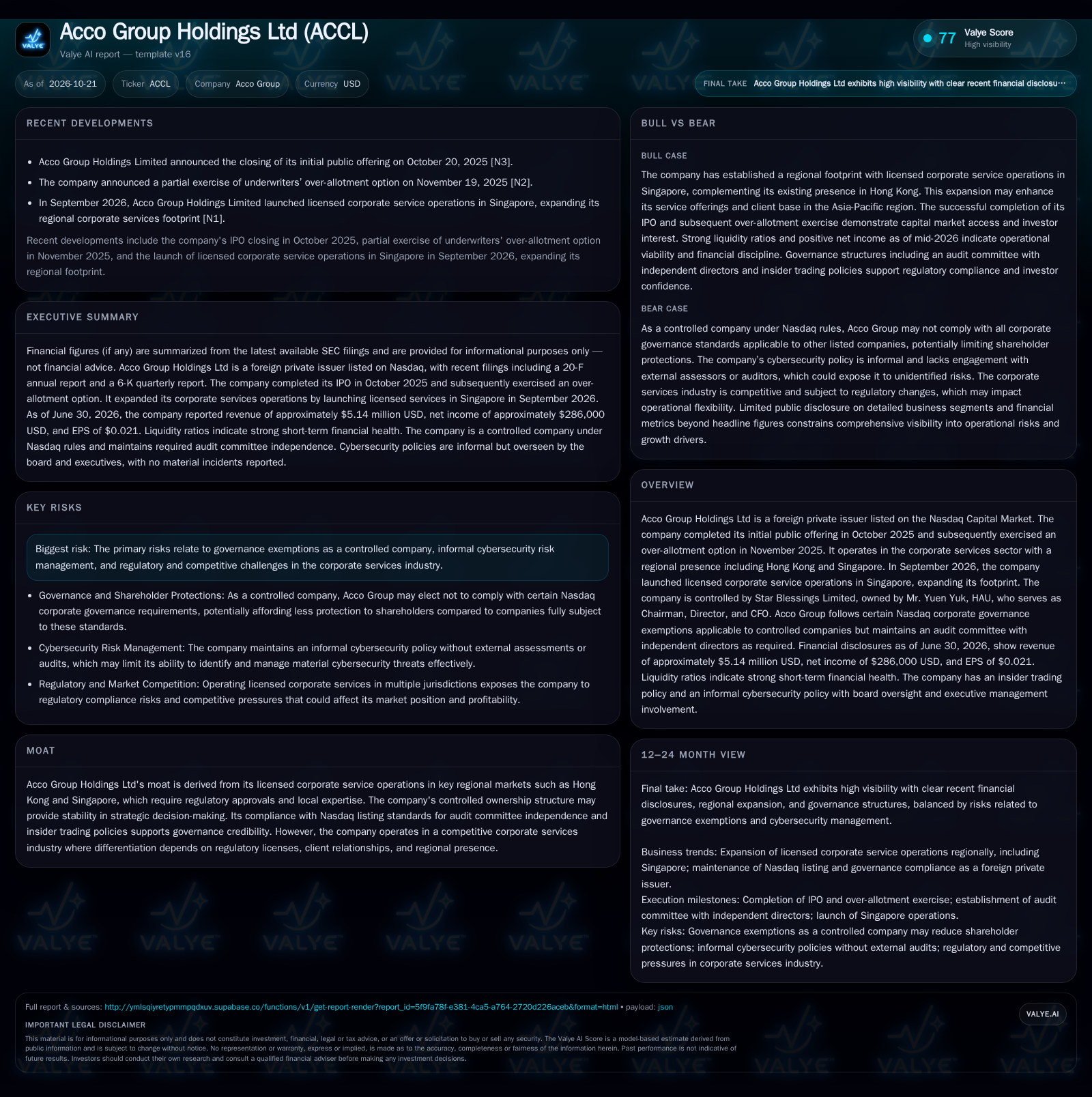
Acco Group Holdings Ltd, a foreign private issuer listed on Nasdaq, recently expanded its licensed corporate services to Singapore and reported $5.14 million in revenue with positive net income for the period ending June 30, 2026. Majority control by Star Blessings Limited enables strategic continuity but brings governance tradeoffs. The key questions are whether regional scale can drive sustained profitability and how governance and risk management evolve as the business grows. [S1] [N1]
Acco Group Holdings Ltd has moved quickly since its Nasdaq debut, completing an IPO and over-allotment, and pushing into Singapore’s regulated corporate services sector. With $5.14 million in revenue and positive net income as of mid-2026, the company is showing early traction in a market where regulatory know-how and local presence are strategic assets. However, its status as a controlled company and reliance on informal risk management practices present both operational latitude and governance challenges. The next phase hinges on Acco’s ability to translate regional expansion into durable economics while addressing the evolving demands of transparency, cybersecurity, and competitive differentiation. [S1] [N1]
Recent Expansion, Financial Performance, and Governance Structure: What’s Changed in 2026
Three developments define Acco Group’s current context: first, the September 2026 launch of licensed corporate service operations in Singapore, which extends its regional reach beyond Hong Kong and signals a growth-oriented strategy in Asia’s competitive professional services market. Second, as of June 30, 2026, Acco reported $5.14 million in revenue and $286,000 in net income, marking a positive first-year post-IPO performance. Third, its governance remains tightly held, with Star Blessings Limited—owned by Chairman, Director, and CFO Mr. Yuen Yuk, HAU—retaining majority voting power. This controlled structure permits certain Nasdaq governance exemptions, influencing both strategic agility and shareholder oversight. These facts set the stage for evaluating Acco’s evolving business model, risk profile, and prospects for scaling its regional platform. [S1] [N1]
Dissecting the Corporate Services Profit Engine: Revenue, Margins, and Operating Leverage
Acco Group’s business model monetizes compliance, incorporation, and ancillary support services for regional and international clients navigating complex regulatory environments in places like Hong Kong and Singapore. In this sector, revenue is typically driven by a mix of fixed-fee annual retainers and transaction-based charges for ad hoc legal, accounting, or administrative work. The $5.14 million in revenue and $286,000 in net income imply a modest but positive net margin, suggesting that the firm’s initial scale is sufficient to cover fixed costs and yield operating profit. [S1]
Corporate services are generally attractive for their recurring revenue potential—if client retention is high—and relatively low capital intensity, as much of the value-add is derived from human capital and regulatory expertise rather than heavy fixed assets. The company reported cash and liquidity metrics for the period; these figures do not by themselves establish operating runway, investment capacity, financial flexibility, or financing capacity. Still, as the company expands, its ability to achieve operating leverage will depend on scaling client volume faster than personnel and compliance costs—a challenge in a highly relationship-driven industry. [S1]
The capital requirements for further expansion remain modest compared to asset-heavy industries, but regional growth may require investment in local licensing, technology platforms, and regulatory compliance infrastructure, all of which could compress near-term margins if not managed carefully.
Advantages and Frictions in Asia’s Crowded Corporate Services Market
Acco’s competitive positioning is anchored by its newly expanded licensed presence in both Hong Kong and Singapore, two of Asia’s most regulated and internationally connected corporate hubs. Regulatory licensing in these jurisdictions creates moderate barriers to entry, as clients value compliance credibility and local expertise. The company’s ability to secure these licenses demonstrates operational competence and positions it to serve cross-border clients seeking a single provider for multiple jurisdictions. [N1]
However, the regional market is fragmented, with global accounting and legal firms, boutique consultancies, and technology-enabled service providers all vying for market share. Differentiation often hinges on breadth of service, speed and reliability, and trusted client relationships. Acco’s controlled company status may enable fast decision-making and strategic alignment, but it can also limit transparency and slow the adoption of governance best practices valued by institutional clients.
Technology is an emerging threat and opportunity. While Acco relies on third-party cloud infrastructure, its informal cybersecurity policy and lack of external audits may represent a competitive vulnerability if clients increasingly demand robust, externally-validated data protection. The company’s regional scale could confer cross-selling advantages, but sustaining a moat will require ongoing investment in both regulatory expertise and digital infrastructure.
How Regional Scale and Regulatory Expertise Could Drive Margin Expansion
In a favorable scenario, Acco leverages its dual presence in Hong Kong and Singapore to attract multinational clients seeking seamless corporate services across Asia-Pacific. As the company builds a larger base of recurring retainer clients, revenue visibility improves and fixed costs are spread over a broader volume, driving operating leverage and margin expansion.
Further, if Acco invests in technology-enabled service delivery and enhances its cybersecurity and compliance credentials, it could win larger mandates from risk-sensitive clients—potentially improving pricing power and retention. Confirmation of this scenario would come from sustained growth in higher-margin recurring revenue, improved net margins, and public disclosure of major cross-border client wins or high renewal rates. Increased investment in cybersecurity infrastructure and external attestations would also signal a shift toward institutional-grade operations.
This scenario would be challenged or falsified if expansion results in margin compression due to rising compliance or personnel costs, or if client acquisition fails to accelerate as the regional footprint grows.
Incremental Growth with Governance and Risk Management as Ongoing Headwinds
The most plausible trajectory for Acco Group is measured growth driven by incremental client additions in Hong Kong and Singapore, with profitability fluctuating as the company balances investment in expansion and compliance against the realities of a competitive, labor-intensive market. Revenue growth may continue at a modest pace as the firm deepens its local client base, but structural constraints—including limited differentiation and pricing power—could cap near-term margin upside.
Governance exemptions as a controlled company and the informal approach to cybersecurity risk management may not immediately impair operations, but could become friction points as the company seeks to attract larger or more risk-averse clients. Evidence that would confirm this scenario includes steady but unspectacular revenue and net income growth, continued reported liquidity position, and limited changes in governance or cybersecurity practices. A shift toward greater disclosure or external risk audits would suggest movement away from the base case.
Where Governance Gaps and Competitive Pressures Could Derail Progress
In an adverse scenario, Acco’s controlled structure and governance exemptions become liabilities, undermining shareholder confidence or limiting access to institutional capital. Regulatory scrutiny or client skepticism about informal cybersecurity practices could result in lost contracts or reputational damage, especially if a material incident occurs or if competitors invest more heavily in risk management.
Competitive pressures—from both established global providers and digitally native entrants—could compress pricing, raise client acquisition costs, or increase churn. If wage inflation or regulatory compliance costs outpace revenue growth, margins could erode, and the company could be forced to scale back expansion or seek additional funding under less favorable terms.
Confirmation of this downside would include stalled or declining revenue, margin compression, negative client retention trends, or the emergence of regulatory or cybersecurity incidents. Additional risk would be signaled by adverse governance developments or the inability to attract institutional clients due to transparency or oversight concerns.
Milestones and Metrics to Gauge Acco Group’s Path to Sustainable Value Creation
Growth in recurring revenue from retainer-based corporate services contracts, if disclosed, would indicate progress toward a more durable business model.
Changes in net margin or operating margin over subsequent reporting periods will show whether regional scale is translating into improved profitability.
Disclosure of major multinational or cross-border client wins would validate the value of the company’s expanded regional footprint.
Any public move to formalize cybersecurity policies or engage external auditors/assessors would reduce operational risk and signal greater institutional readiness.
Client retention and renewal rates, if reported, would help assess stickiness and competitive position in a relationship-driven industry.
Material regulatory changes or new licensing requirements in Hong Kong or Singapore could affect the company’s operating flexibility or cost structure.
Shifts in board composition, audit committee independence, or governance disclosures may indicate either tightening or loosening of shareholder protections.
Evidence of rising personnel or compliance costs outpacing revenue growth would suggest emerging margin pressure.
Disclaimer: This is research-only, informational analysis and not investment advice. It may include AI-generated interpretation and general industry context. Always verify important details using primary sources.

Comments