
CSX’s Freight Franchise: Asset-Heavy Rail Economics, Competitive Frictions, and the Test of Cost Discipline
CSX’s latest quarter underscores both the resilience and constraints of the U.S. rail model: strong core profitability, heavy capital intensity, and exposure to labor, regulatory, and modal competition risks. The company’s working capital deficit and debt reclassification highlight balance sheet realities that, while buffered by reported liquidity position sources, will require ongoing vigilance as the freight landscape evolves.
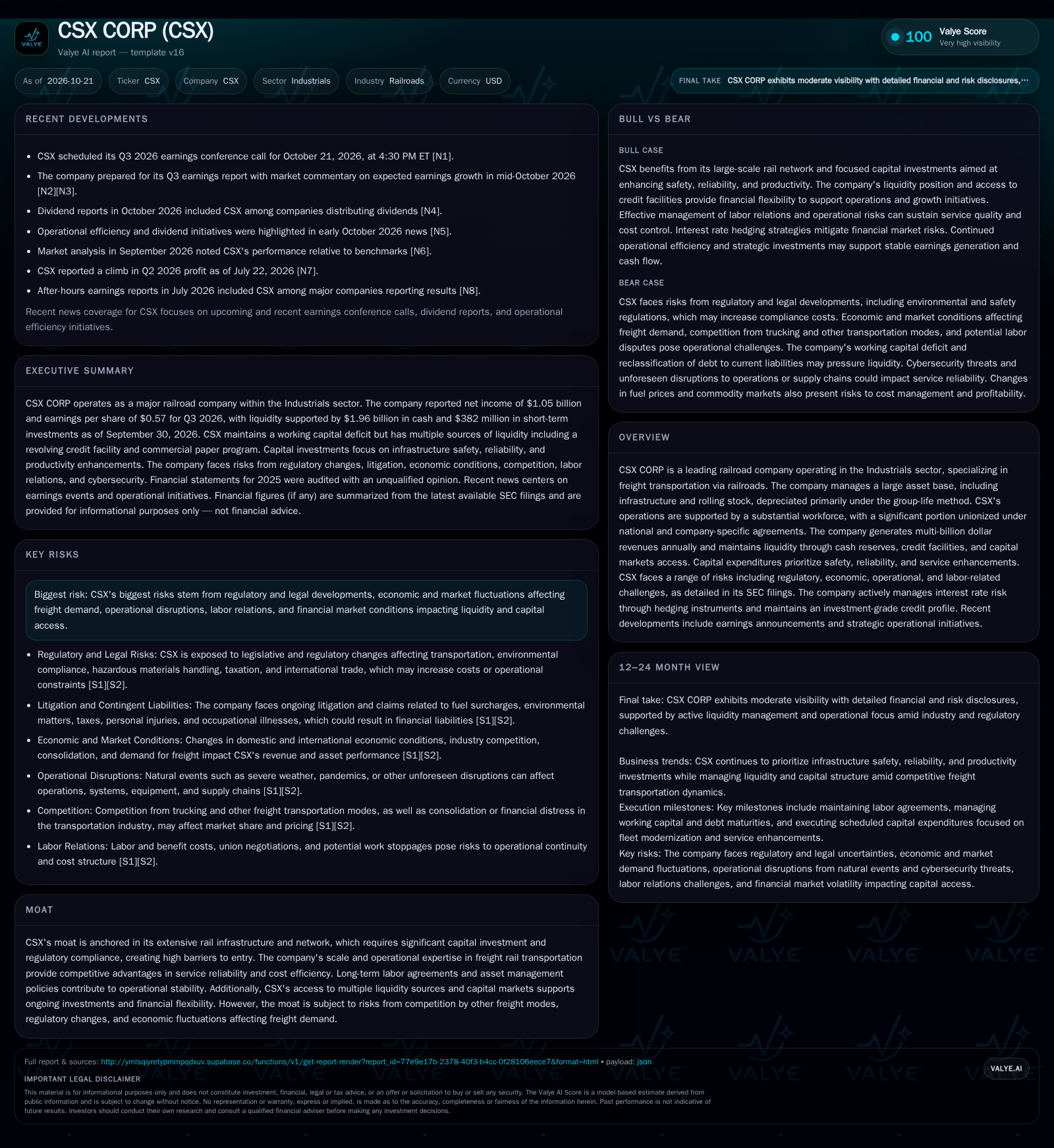
CSX reported Q3 2026 net income of $1.05 billion and maintains over $2.3 billion in liquid assets, but faces a working capital deficit and near-term debt maturities. The company’s capital investments remain focused on core infrastructure, with competitive and regulatory pressures persistent. The business model’s durability rests on network scale and cost discipline, but volume and pricing leverage will be tested if trucking competition or economic conditions deteriorate. [S2]
CSX’s Q3 2026 performance—anchored by over $1 billion in net income and a reported cash position—highlights the enduring strength of the Class I rail model, but also its persistent challenges. The company’s working capital deficit, shaped by the reclassification of debt and ongoing capital needs, underscores the delicate balance between scale-driven profitability and financial discipline. As CSX invests in core infrastructure and service reliability, the critical question is whether its network advantage and cost control can outpace rising regulatory, labor, and competitive pressures. The next phase will test both the resilience of the rail franchise and the company’s ability to adapt to shifting freight dynamics. [S2]
Recent Financial Performance and Liquidity Position: What’s Changed for CSX
For the quarter ended September 30, 2026, CSX reported net income of $1.052 billion and basic and diluted earnings per share of $0.57, reaffirming its position as a profitable core operator in the U.S. rail sector. The company’s liquidity stood at $1.96 billion in cash and $382 million in short-term investments, totaling $2.34 billion, but this is set against a working capital deficit of $676 million, up from $583 million at the end of 2025. The deficit primarily reflects the reclassification of long-term debt to current liabilities, rather than a sudden deterioration in cash flow. Notably, CSX has not issued new long-term debt in the first nine months of 2026, and continues to rely on robust operating cash flows, an undrawn $1.2 billion revolving credit facility (expiring 2028), and a $1.0 billion commercial paper program. This mix of strong profitability and active liquidity management frames the company’s current operating context and highlights both its strengths and the latent risks in its capital structure. [S2]
How CSX’s Rail Economics Drive Returns—and Where Margin Pressure Could Emerge
CSX generates revenue by transporting bulk commodities, intermodal containers, and merchandise freight across its rail network. Pricing is influenced by a combination of industry practices, including long-term relationships, spot market dynamics, and fuel surcharge mechanisms, though the specific mix at CSX is not fully detailed in the report. The business model is capital-intensive: over $53 billion in gross fixed assets are depreciated under the group-life method, and 2026 capital expenditures are projected below $2.4 billion, focused on maintenance, safety, and incremental service upgrades rather than network expansion. This structure creates high fixed costs, giving the model strong operating leverage—small changes in volume or pricing can materially impact margins. However, cost categories such as labor (with approximately 75% of employees unionized), fuel, and purchased services are variable and subject to inflationary or regulatory pressure. The company’s ability to control these costs, particularly during periods of flat or declining freight volumes, will be pivotal for sustaining profitability. While CSX reports significant liquidity and cash metrics, these do not by themselves establish the company’s operating runway, investment capacity, or potential financial flexibility, and should not be interpreted as such without further context.
Network Scale, Modal Competition, and Regulatory Overhang: CSX’s Strategic Landscape
CSX’s competitive advantage is rooted in its extensive, contiguous rail network across the eastern U.S., which delivers economies of scale and high barriers to entry for new rail competitors. However, the company faces ongoing competition from the trucking industry—especially for intermodal and shorter-haul routes—where service flexibility, speed, and point-to-point delivery can erode rail’s modal share. Technological advances in autonomous trucking and continued improvements in highway infrastructure could further pressure rail’s competitiveness, particularly if regulatory or environmental mandates increase rail’s compliance costs. Additionally, CSX’s service reliability and pricing power are shaped by relationships with large shippers, who increasingly demand integrated, digitalized logistics solutions. Regulatory scrutiny—spanning safety, labor, and environmental issues—remains a persistent threat to margin and operational flexibility. While CSX’s scale and asset base remain core strengths, its moat is not immune to disruption from outside the traditional rail sector.
Efficiency Gains and Stable Freight Demand Could Deliver Margin Expansion
The most favorable scenario for CSX involves a combination of steady or rising freight volumes, successful cost containment (especially in labor and fuel), and operational efficiency gains stemming from targeted capital investments. If the company’s ongoing infrastructure and fleet upgrades translate into improved service reliability and network productivity, CSX could capture incremental volume from trucking, especially for bulk and intermodal freight where rail retains an inherent cost advantage. Confirmation would come from sustained or rising operating margins, positive net cash generation after capital expenditures, and evidence of pricing discipline in contract renewals. A benign regulatory environment and the absence of major labor disruptions would further support this outcome. Falsification would occur if cost inflation outpaces productivity gains or if volume growth stalls despite capex investment.
Core Profitability Holds, but Margin Expansion Is Capped by Costs and Competition
The most plausible trajectory for CSX is continued core profitability, anchored by stable freight volumes and disciplined capital spending, but with limited room for significant margin expansion. Freight demand may remain flattish, as macroeconomic growth is offset by modal competition, particularly in intermodal and merchandise freight. Evidence supporting this view would include stable operating income, maintenance of investment-grade credit metrics, and continued execution of planned infrastructure investments without major cost overruns or service disruptions. A sudden shift in regulatory or labor cost structure, or a material drop in volume, would challenge this scenario.
Volume Weakness, Cost Inflation, and Balance Sheet Strain Could Pressure Valuation
In a negative scenario, CSX could face a convergence of softening freight demand—due to economic slowdown or loss of modal share to trucking—and rising variable costs, particularly labor and fuel. If contract negotiations stall or lead to wage increases, or if regulatory mandates drive up compliance costs, the company’s fixed-cost-heavy model could magnify margin compression. A persistent working capital deficit, if not offset by operating cash flow, could eventually force asset sales, reduced investment, or reliance on more expensive external financing. Confirmation of this scenario would include declining operating margins, negative free cash flow after capex, or a downgrade in credit metrics. A sharp increase in service disruptions, litigation, or regulatory penalties would further stress the business and weigh on valuation.
Milestones That Will Clarify CSX’s Ability to Sustain Rail Profitability and Defend Its Moat
Trends in operating margin and net income relative to freight volume growth or contraction, as evidence of operating leverage in action.
Updates on the status and terms of labor contract negotiations—particularly any wage increases, work rule changes, or strike threats.
Actual capital expenditures versus the planned $2.4 billion for 2026, and the impact on service metrics or network reliability.
Development of the working capital deficit: whether it stabilizes, widens, or narrows, and the specific drivers (receivables, payables, debt maturities).
Utilization or expansion of external liquidity facilities (credit revolver, commercial paper), especially if operational cash flow is pressured.
Volume and pricing trends in key segments (bulk, intermodal, merchandise), if disclosed, to assess modal competition and pricing power.
Any material regulatory, legal, or environmental developments affecting compliance costs or operational flexibility.
Evidence of service disruptions, major accidents, or cybersecurity incidents that could impact operations or trigger regulatory scrutiny.
Disclaimer: This is research-only, informational analysis and not investment advice. It may include AI-generated interpretation and general industry context. Always verify important details using primary sources.

Comments