
Netflix’s Strategic Dilemma: Pricing Power, Advertising Growth, and the Limits of Content Scale
Netflix remains the global streaming leader, but its Q3 2026 results highlight a delicate balance between leveraging pricing, expanding ad-supported tiers, and defending margins in a market brimming with alternatives. With content costs largely fixed and competition intensifying, the company’s next phase hinges on converting platform breadth and engagement into durable, multi-segment monetization.
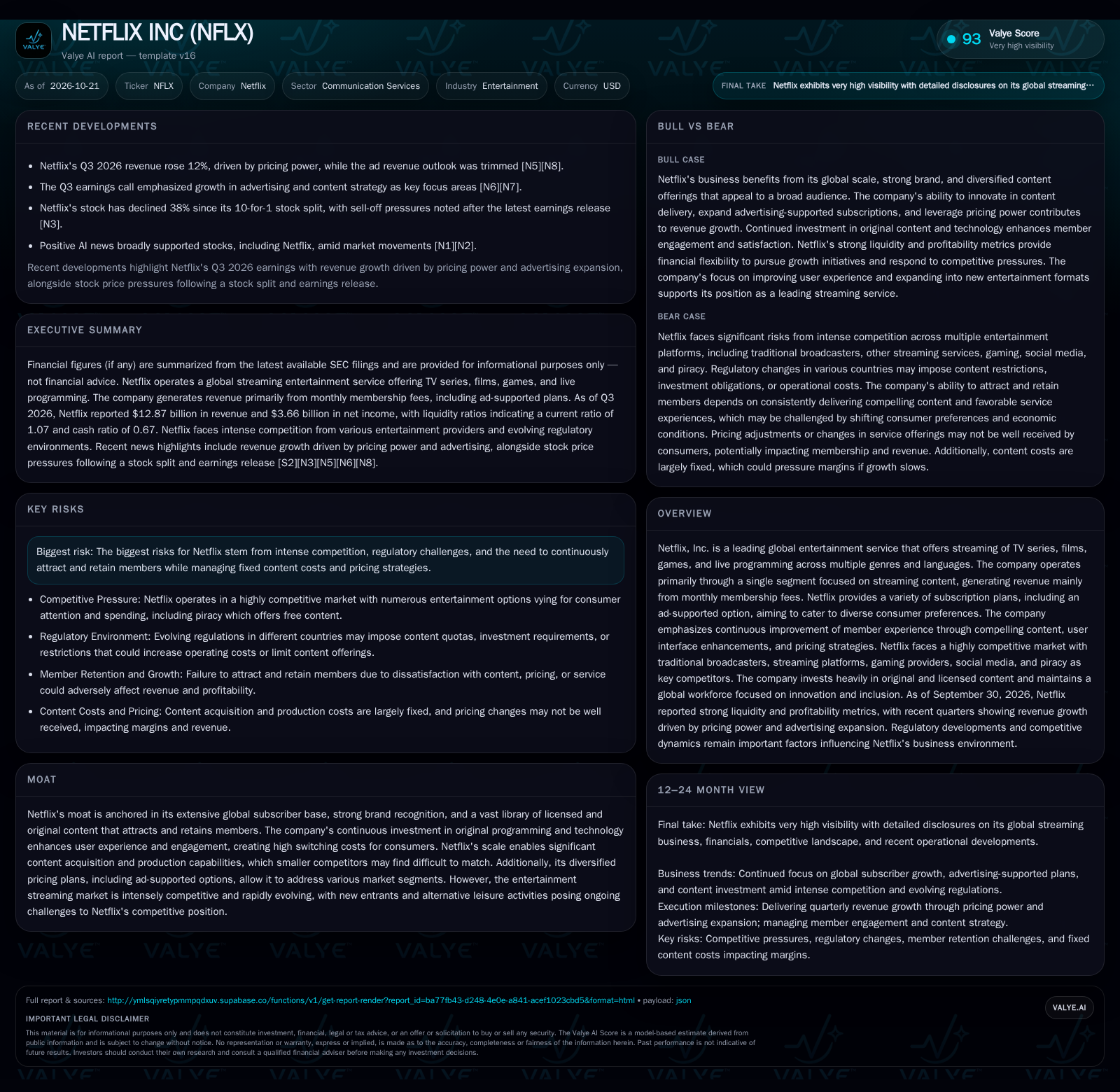
Netflix’s Q3 2026 performance underscores both its strengths—scale, profitability, and pricing power—and the persistent risks from fixed content costs, post-split stock volatility, and relentless competition. The company’s push into advertising and flexible pricing is essential but must overcome the rising costs and churn pressures endemic to the streaming landscape. Execution on ad-tier monetization, member engagement, and regulatory adaptation will be vital to sustaining growth.[S2] [N3] [N6] [N8]
Netflix’s third quarter 2026 results paint a picture of a mature streaming giant navigating the push-pull of growth and risk. Revenue and profitability remain robust, with pricing power and advertising expansion emerging as the primary levers. Yet the 38% drop in share price since the company’s stock split reveals deep market skepticism about Netflix’s ability to sustain momentum in the face of fixed content costs, fierce competition, and regulatory uncertainties. As the streaming ecosystem fragments and consumer attention spans splinter, Netflix’s challenge is to maintain its leadership through innovation in both content and monetization.
Q3 2026 Snapshot: Financial Strength and Market Volatility
Netflix reported $12.87 billion in revenue and $3.66 billion in net income for the quarter ended September 30, 2026, with basic and diluted EPS of $0.89 and $0.87, respectively. The company’s cash and equivalents stood at $8.19 billion, supporting a current ratio of 1.07 and a cash ratio of 0.67[S2]. These figures reflect the company’s continued ability to convert scale into profit, even as its business matures.
Despite these strong operating results, Netflix’s stock price has declined 38% since its 10-for-1 split, with investor concerns escalating after the latest earnings release[N3]. This disconnect suggests that markets are worried about the sustainability of growth and margin expansion, particularly as the company leans harder on pricing and ad-supported tiers to drive revenue.
The Q3 earnings call highlighted advertising and content strategy as central to future growth, but also revealed that ad revenue expectations were trimmed[N6] [N5]. These developments underscore the tension between Netflix’s operational momentum and the external pressures shaping its valuation.
Monetizing Attention: Subscription, Advertising, and the Content Cost Structure
Netflix’s business model is built on monthly membership fees, with a growing emphasis on ad-supported plans to capture price-sensitive segments and diversify revenue streams[S1]. The expansion of ad-tier subscriptions introduces a new monetization lever, but also demands significant investment in advertising technology, measurement, and brand relationships—areas where legacy linear TV and digital platforms retain advantages.
The company’s cost structure is heavily weighted toward fixed content costs, both for original productions and third-party licenses, often contracted over multi-year horizons. This structure delivers operating leverage when subscriber and ARPU growth are strong, but exposes margins if churn rises or pricing power wanes. Because content spending is largely committed in advance, Netflix’s ability to flex costs in response to revenue shocks is limited.
Variable costs, such as distribution and customer acquisition, have declined as a percentage of revenue with scale, but remain material—especially as the company pursues new international markets and seeks to offset churn with aggressive marketing. Capital needs are primarily directed toward content investment, with secondary allocations for platform enhancements and global expansion.
Defending the Moat: Scale, Content Breadth, and the Shifting Landscape
Netflix’s primary competitive advantages are its global subscriber base, brand recognition, and vast, ever-refreshing content library[S1]. Its scale enables it to outspend most rivals on originals and secure exclusive licenses, raising switching costs for consumers invested in ongoing series and platform ecosystems.
However, the competitive set is broad and intensifying, spanning traditional media (linear and pay TV), direct streaming rivals, gaming platforms, user-generated content (e.g., YouTube, TikTok), and piracy. Each category competes not merely for subscribers, but for consumer attention—a resource that is increasingly fragmented.
While Netflix’s diversified pricing, including ad-supported plans, aims to capture a broader audience, these same strategies are being adopted by major rivals. The absence of exclusive sports rights and the challenge of regional content quotas further constrain differentiation. In markets where regulatory and cultural barriers are high, local competitors may be better positioned to adapt quickly.
If Advertising and Pricing Power Deliver: The Path to Multi-Segment Monetization
A favorable scenario for Netflix would see its ad-supported tier achieving rapid uptake, with advertisers willing to pay premium CPMs for targeted, brand-safe inventory. If Netflix can leverage its data and engagement to deliver superior ad outcomes, the platform could capture incremental ARPU from both existing and new members, reducing churn among price-sensitive cohorts.
Sustained pricing power—demonstrated by minimal churn in response to periodic price increases—would further enhance margins, especially if paired with ongoing subscriber growth in international markets. If content investments yield global hits that drive engagement and viral growth, Netflix could maintain its leadership even as rivals proliferate.
Evidence supporting this scenario would include accelerating ad revenue growth, stable or declining churn rates after price hikes, and consistent outperformance in net subscriber additions relative to direct streaming peers.
Stability Amidst Challenges: Steady Growth Offset by Cost and Competitive Pressures
The most plausible path is one where Netflix continues to grow revenue at a moderate pace, balancing modest pricing increases and incremental ad-tier adoption against rising content costs and periodic subscriber churn. While the company is likely to sustain profitability and defend its leadership in most markets, margin expansion will be limited by the inflexibility of fixed cost commitments and the need to invest in new content and technology.
Competitive intensity will keep customer acquisition costs elevated, and regulatory developments—such as local content requirements or advertising restrictions—could periodically erode operating leverage. In this environment, Netflix’s global scale and brand should allow it to remain a top-tier platform, but without dramatic upside unless a new monetization vector (e.g., gaming, live events) achieves meaningful scale.
Confirmation would come from continued single-digit to low double-digit revenue growth, relatively flat operating margins, and stable subscriber trends, punctuated by occasional volatility around major content releases or pricing changes.
Churn, Regulation, and Margin Compression: Where the Model Could Unravel
A negative scenario materializes if pricing actions or content missteps trigger elevated churn, particularly among higher-value subscribers. If ad-supported tiers fail to deliver on revenue promises—whether due to weak advertiser demand, measurement challenges, or regulatory hurdles—the incremental ARPU benefit may prove illusory.
Rising competition from free or low-cost alternatives (including piracy and user-generated platforms) could cap pricing power, while regulatory actions—such as content quotas or investment mandates—drive up fixed costs without commensurate revenue gains. In this environment, Netflix’s fixed content obligations would amplify the impact of any revenue shortfall, compressing margins and limiting flexibility.
Signs of this scenario would include declining or stagnant net subscriber additions, a sharp rise in churn after price hikes, disappointing ad revenue growth, and evidence of regulatory or content-related disruptions in key geographies.
Metrics That Will Determine Netflix’s Ability to Sustain Its Streaming Leadership
Net subscriber additions by region and tier—especially movements in ad-supported versus premium plans—would help indicate the effectiveness of Netflix’s pricing and segmentation strategy, if disclosed.
Churn rates following price increases or major content releases would provide early warnings about elasticity and member loyalty.
Ad revenue growth and CPMs realized across geographies would test the scalability and competitiveness of the advertising business.
Content amortization and capitalized content spend trends would clarify whether fixed cost leverage is strengthening or eroding.
Operating margin trajectory in the face of rising content and technology investments would reveal the balance between growth and profitability.
Regulatory developments in large markets (e.g., content quotas, advertising restrictions) should be monitored for structural impacts on both costs and addressable market.
Engagement metrics—such as average viewing hours per user—would help assess the ability to defend attention against platform and non-platform competitors.
If disclosed, retention or lifetime value metrics by cohort could signal whether Netflix is building durable subscriber relationships or facing hidden churn risks.
Disclaimer: This is research-only, informational analysis and not investment advice. It may include AI-generated interpretation and general industry context. Always verify important details using primary sources.

Comments