
IRSA: Real Estate Exposure, Financial Maneuvers, and the Realities of Argentine Market Volatility
IRSA Inversiones y Representaciones faces a complex operating environment—balancing substantial real estate activities, active capital market participation, and persistent macroeconomic risks in Argentina. Recent financial disclosures and capital moves highlight both opportunities and the structural uncertainties that define its future trajectory.
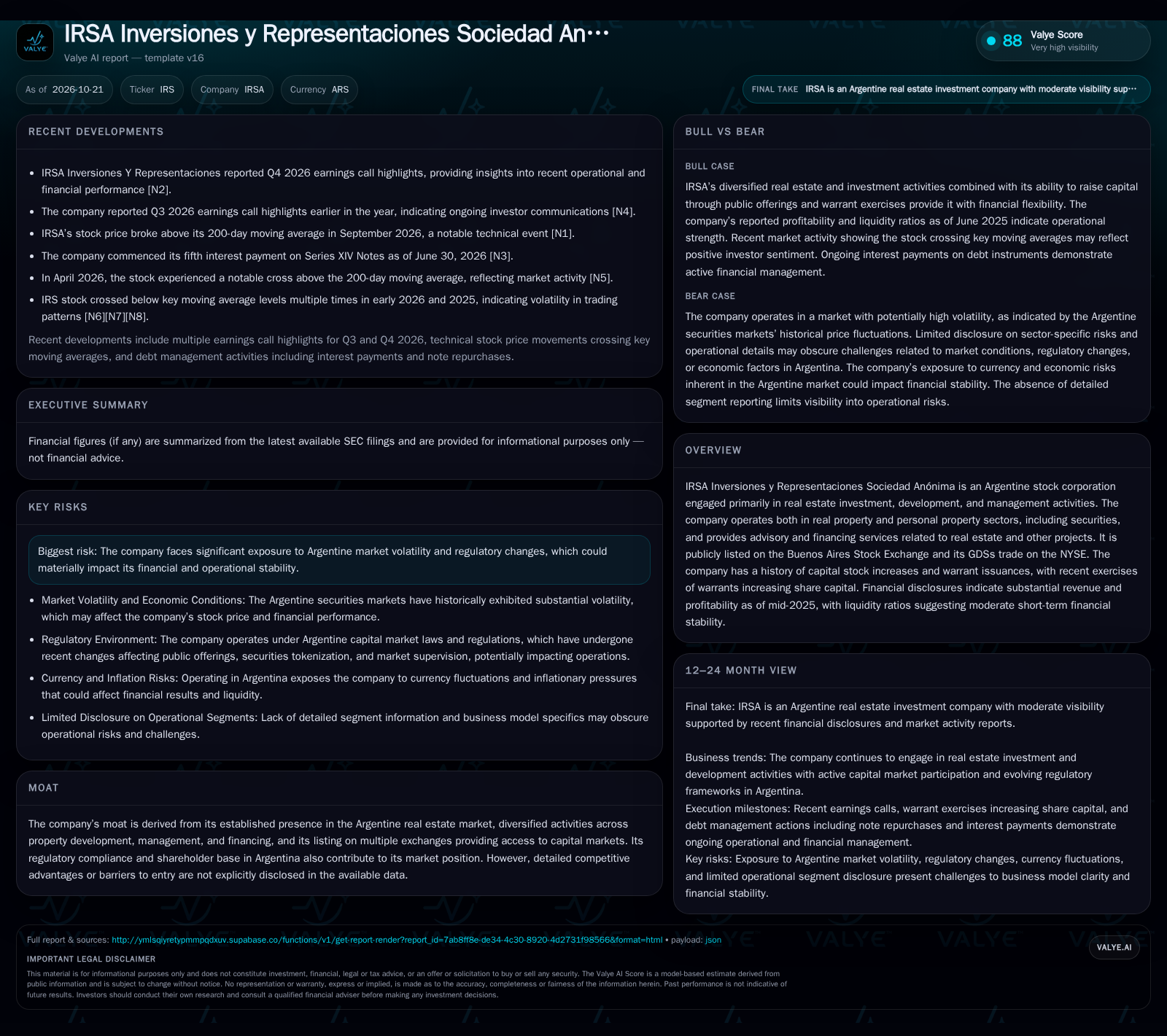
IRSA, a leading Argentine real estate investment and development company, reported ARS 468.5 billion in revenue and ARS 196.1 billion in net income for the year ended June 2025. The company has increased its capital base via warrant exercises and actively managed its debt, including a recent repurchase of Series XXV Notes. The company’s future hinges on its ability to navigate these macro and structural challenges while leveraging its capital markets access and real estate footprint. [S1] [N2] [N3]
IRSA Inversiones y Representaciones Sociedad Anónima (IRSA) stands as one of Argentina’s most prominent real estate investment and development platforms, operating across property, advisory, and financial services. Recent financials reveal impressive revenue and net income, and the company has demonstrated both capital-raising agility and active debt management. Yet, beneath these headline figures lies a business acutely exposed to Argentina’s volatile macro environment, with persistent regulatory, currency, and inflation risks. While IRSA’s market presence and financial maneuvers offer optionality, the company’s future resilience will depend on its ability to adapt to both external economic shocks and evolving sector dynamics. [S1] [N2]
Recent Financial Results, Capital Actions, and Market Volatility: What’s Changed for IRSA
IRSA reported ARS 468.5 billion in revenue and ARS 196.1 billion in net income for the fiscal year ended June 2025, underlining its scale in the Argentine real estate sector. Alongside these results, the company increased its share capital through the exercise of warrants, bringing outstanding shares to over 846 million as of June 2026. In October 2026, IRSA repurchased 18% of the outstanding principal of its Series XXV Notes, continuing a pattern of proactive debt management. The company also commenced its fifth interest payment on Series XIV Notes in mid-2026. Meanwhile, IRSA’s stock price has experienced significant volatility, repeatedly crossing technical moving averages throughout 2025 and 2026—a reflection of both company-specific and broader Argentine market dynamics. These developments collectively suggest a company with the financial and capital market tools to respond to changing conditions, but one that is fundamentally tethered to the volatility and uncertainty of its operating environment. [S1] [N1] [N2] [N3] [N5] [N6] [N7] [N8]
How IRSA’s Diversified Activities Shape Its Earnings Power—and Its Risks
IRSA’s business model encompasses real estate investment, development, property management, project financing, and advisory services. The economic engine is likely driven by rental income from commercial properties, capital gains from property sales or development, and fees from advisory or agency activities. In theory, this diversification could buffer against single-segment downturns, but in practice, Argentine real estate cycles and macroeconomic shocks often move in tandem.
The company’s ability to raise capital through public offerings and warrant exercises provides flexibility for new investments or debt reduction. However, the absence of detailed segment disclosures or recurring revenue metrics makes it difficult to assess the true sustainability or volatility of its cash flows. Fixed costs related to property management and development, as well as debt service obligations, create operating leverage, amplifying both upside and downside swings. Additionally, the Argentine context means that inflation, currency devaluation, and regulatory interventions can rapidly erode nominal gains—posing unique challenges to capital preservation and real returns.
The company’s ongoing debt management—such as repurchasing notes and making regular interest payments—suggests an awareness of refinancing and liquidity risks, but the ultimate test will be the durability of cash flows in a stressed environment. [S1] [N3]
Market Presence, Barriers, and the Challenge of Enduring Advantage in Argentine Real Estate
IRSA’s established presence in Argentina’s real estate market, with listings on both ByMA and NYSE, grants it visibility and capital access not enjoyed by all local peers. Its activities span property development, management, and financing, offering a broader set of capabilities than pure-play developers or asset owners. This breadth can create informational advantages and some operational synergies, particularly when structuring large, complex projects or navigating regulatory hurdles.
However, the company’s competitive position is fundamentally shaped by the broader forces affecting Argentine real estate: macroeconomic volatility, shifting regulations, and periodic capital controls. These factors can rapidly alter the competitive landscape, making scale and capital access as much a liability as an asset if market conditions deteriorate. International investors may view IRSA as a liquid proxy for Argentine real estate exposure, but this can also magnify volatility and reduce pricing power in weak markets.
Potential substitutes include direct investment in real assets, alternative asset managers, or international real estate vehicles operating in more stable jurisdictions. Without clear evidence of unique property holdings, exclusive development rights, or proprietary platforms, IRSA’s moat appears to rest on scale, established relationships, and regulatory compliance rather than durable structural advantages.
If Macro Stability Returns: How IRSA Could Leverage Its Platform in a More Favorable Cycle
A sustained period of macroeconomic stabilization in Argentina—characterized by lower inflation, improved currency stability, and regulatory predictability—could unlock significant value for IRSA. In this scenario, property values may appreciate, rental yields could recover, and investor appetite for Argentine real assets might return. IRSA’s capital markets access and large asset base would enable it to accelerate development projects, recycle capital more efficiently, and potentially attract international partners or tenants.
Evidence that would confirm this favorable scenario includes: rising occupancy and rental rates across IRSA’s property portfolio (if disclosed), increased property transaction volumes, and improving net operating income margins. Additionally, further successful capital raises or joint ventures with global real estate players would suggest renewed confidence in Argentine property markets.
Conversely, failure to see sustained improvement in macro indicators, continued peso devaluation, or persistent regulatory uncertainty would falsify this upside path.
Operating Amid Uncertainty: The Most Likely Course for IRSA in the Coming Quarters
The most plausible scenario is continued volatility—both at the macro and company level. IRSA is likely to maintain its focus on active asset management, opportunistic capital raising, and periodic debt refinancing, while navigating unpredictable cycles in property values and demand.
Confirmation of this middle path would include stable or slightly fluctuating reported revenues and net income, ongoing but not transformative capital actions (such as incremental share issuances or note repurchases), and continued technical volatility in the stock price linked to local economic news. A shift in government policy or a new macro shock would rapidly shift this trajectory.
When Macro Shocks Hit: How IRSA’s Exposures Could Turn into Liabilities
In an adverse scenario, a major deterioration in Argentine macro conditions—such as accelerating inflation, a sharp currency devaluation, or renewed capital controls—could severely challenge IRSA’s business. Property values would likely fall, rental and occupancy rates could drop, and refinancing risk would increase as funding sources dry up or become more expensive.
Evidence confirming this downside would include a sharp decline in reported revenues or net income, increased arrears or vacancies in the property portfolio (if disclosed), distressed asset sales, or the need for emergency capital raises at unfavorable terms. Regulatory interventions—such as rent freezes or foreign exchange restrictions—would further exacerbate operational and financial stress.
If IRSA manages to maintain profitability, execute debt repurchases, and service its obligations despite such shocks, this would falsify the depth of the downside scenario.
What Will Determine IRSA’s Resilience in a Volatile Real Estate and Macro Climate?
Reported trends in occupancy rates, rental yields, and property values across IRSA’s portfolio—if disclosed—would provide direct evidence of operating momentum or stress.
The pace and terms of capital raising (including further warrant exercises, new share issuances, or debt placements) will clarify IRSA’s ongoing access to funding and investor sentiment.
Future debt management actions—such as additional note repurchases or refinancing outcomes—will be critical in assessing the company’s balance sheet flexibility.
Net cash flow from operating activities (if disclosed) would help distinguish between headline profitability and true cash generation.
Material regulatory changes affecting real estate ownership, capital flows, or property taxation in Argentina could rapidly alter IRSA’s risk/return profile.
Currency movements and inflation trends in Argentina remain the most important external variables, directly impacting real asset values and financial results.
Disclosures or commentary on business segment performance (development vs. property management vs. advisory/financing) would help illuminate sources of resilience or vulnerability.
Evidence of strategic partnerships, asset sales, or expansions into less volatile markets would signal management’s approach to diversification and risk mitigation.
Disclaimer: This is research-only, informational analysis and not investment advice. It may include AI-generated interpretation and general industry context. Always verify important details using primary sources.

Comments