
Elevance Health: Carelon’s Outperformance, Cost Headwinds, and the Shape of Integrated Healthcare Profitability
Elevance Health’s Q3 2026 results highlight robust performance in its Carelon segment and an upwardly revised outlook, but persistent benefit cost inflation and regulatory exposure continue to shape the economics and risk profile of the business.
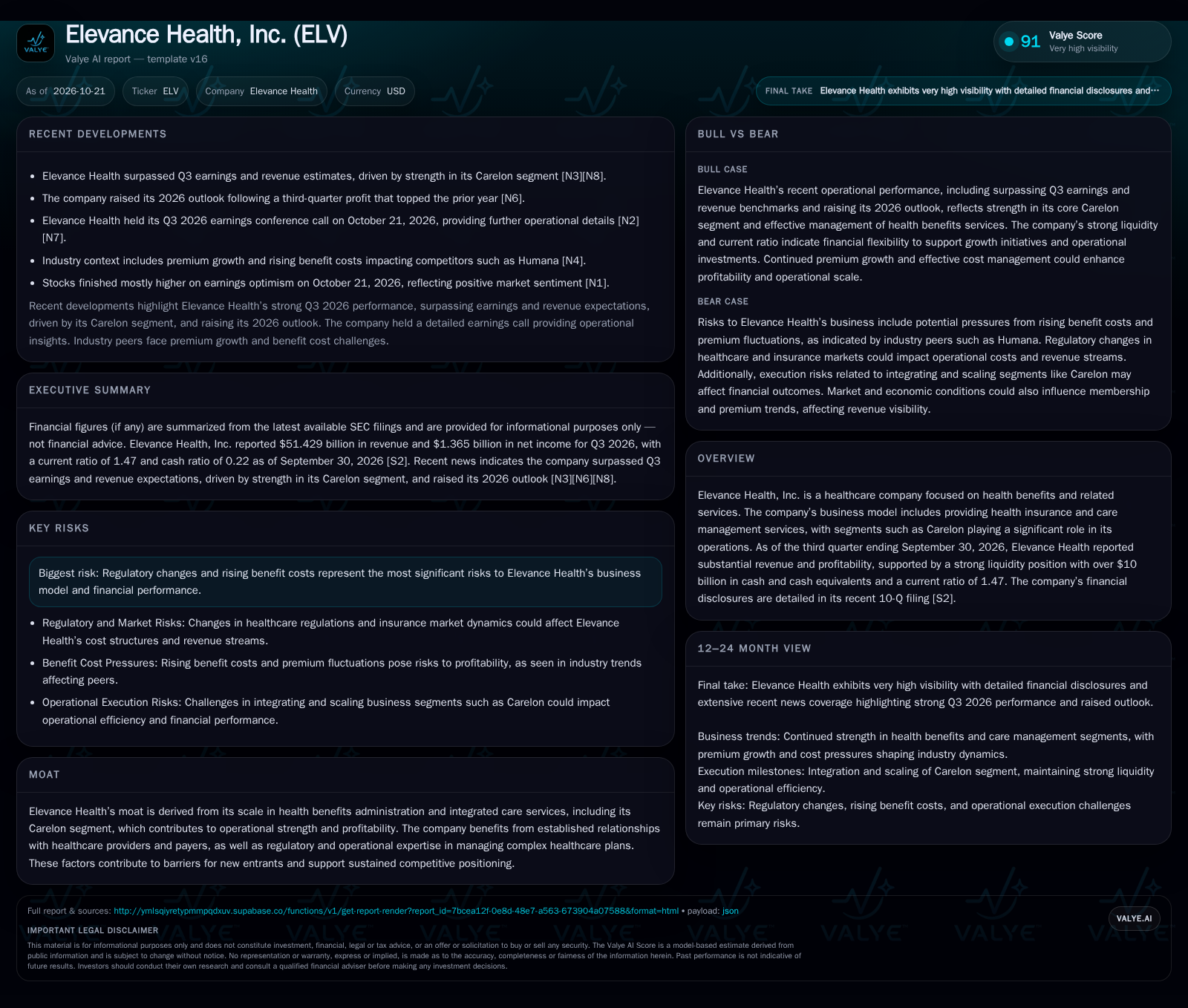
The next phase for Elevance hinges on Carelon’s execution, premium dynamics, and cost-containment effectiveness. [S2] [N3] [N6] [N8]
Elevance Health’s third-quarter 2026 performance underscores the operational leverage and segment momentum the company can achieve when its integrated care and health benefits strategies align. The strong showing in Carelon, combined with upwardly revised guidance, points to the potential of diversified healthcare services to buffer against cyclical pressures in insurance. Yet, the sector’s familiar headwinds—rising benefit costs and regulatory scrutiny—remain as relevant as ever, setting the stage for a complex battle between scale-driven efficiency and the need for constant adaptation.
Carelon’s Strong Quarter and Upward Guidance: What Changed for Elevance Health
Elevance Health reported Q3 2026 revenue of $51.429 billion and net income of $1.365 billion, translating to basic and diluted EPS of $6.30 and $6.27, respectively. Cash and equivalents totaled $10.348 billion, with a current ratio of 1.47 as of September 30, 2026. Most notably, the company’s Carelon segment was cited as the primary driver behind its earnings and revenue beat, prompting management to raise the full-year 2026 outlook. This marks a clear inflection point, as the company’s operational performance outpaced both internal targets and external expectations, signaling that Carelon’s integration and service expansion may be gaining traction at scale. [S2] [N3] [N6] [N8]
How Elevance Makes Money: Premiums, Care Management, and Margin Levers
Elevance Health’s core revenue is generated from collecting insurance premiums and providing care management services. The business model depends on balancing premium growth with the effective management of medical and administrative costs. Variable costs are dominated by claims and benefit payouts, which are highly sensitive to medical inflation and utilization trends. Fixed costs are related to technology infrastructure, compliance, and administrative overhead.
The economics of the Carelon segment (which likely includes pharmacy benefit management, care delivery, and analytics) have the potential to improve margins through vertical integration, reducing leakage to external vendors and capturing more of the healthcare value chain. Scale offers negotiating power with providers, but the ability to manage medical loss ratios (MLR) and extract operating leverage from technology and care coordination platforms is critical. Sustained margin expansion would require continued premium growth, stable or improving MLRs, and efficiency gains in non-claims costs.
Capital needs in this sector are significant but primarily revolve around maintaining regulatory reserves and funding technology or acquisition-driven growth. The company reported cash and liquidity metrics for the period; these figures do not by themselves establish operating runway, investment capacity, financial flexibility, or financing capacity.
Scale and Integration: The Double-Edged Sword in Health Benefits Competition
Elevance Health’s competitive position is rooted in its national scale, payer-provider integration, and breadth of services. Integrated platforms like Carelon can increase switching costs for large employers and government clients, as bundled offerings (insurance, pharmacy, care management) are difficult to replicate for smaller players. The company’s regulatory and operational expertise, combined with established relationships across the healthcare ecosystem, serve as meaningful barriers to entry.
However, these advantages are not absolute. Large peers—such as UnitedHealth Group, CVS Health/Aetna, and Cigna—operate with similar integration strategies and scale, making the market highly competitive and prone to price-based rivalry. Technology-first disruptors and regional managed care organizations also exert pressure, particularly in niche markets or through innovation in digital health and value-based care.
The key question is whether Elevance can leverage its scale and integration to drive lower medical costs and higher engagement, or whether it will be forced to compete primarily on price in a commoditizing market. The ability to demonstrate superior outcomes, member retention, and cost control will be decisive.
Unlocking Margin Expansion Through Carelon Synergies and Cost Containment
If Elevance Health can fully realize the operational and clinical synergies of its Carelon segment, it could see sustained margin expansion and superior growth relative to peers. This would likely occur if Carelon’s care management and pharmacy services demonstrably reduce medical costs, improve health outcomes, and drive higher retention in core insurance products.
Indicators confirming this scenario would include declining or stable medical loss ratios even as premiums grow, rising segment margins for Carelon, and evidence of cross-selling or expanded market share in integrated offerings. Announcements of new employer contracts, partnerships, or government program wins tied to Carelon’s integrated offerings would further validate this path.
Conversely, if segment margin improvement stalls, or if the benefits of integration are offset by higher-than-expected technology or compliance costs, this scenario would be falsified.
Stability Amid Cost Inflation: Managing Growth and Margin Pressures
The most plausible near-term outcome is that Elevance continues to grow at or slightly above the industry average, with periodic volatility in margins tied to benefit cost trends and regulatory changes. Premium growth is likely to remain solid, but medical cost inflation and utilization spikes could offset much of the operational leverage from scale and integration.
Carelon may contribute incremental margin improvement, but the benefit could be diluted by sector-wide cost pressures and the need to invest in digital infrastructure and compliance.
Confirmation would come from steady revenue and net income growth, stable MLRs, and incremental improvements in Carelon’s contribution. Falsifying evidence would include a reversal in Carelon’s performance, worsening loss ratios, or unexpected regulatory expenses that compress margins.
Rising Benefit Costs or Regulatory Shocks Undercut Profitability
The major risk is that sector-wide medical cost inflation, unexpected regulatory mandates, or adverse policy changes drive a spike in benefit costs that outpaces premium growth. This would compress margins and could force Elevance to compete more aggressively on price, eroding profitability.
If Carelon’s integration proves more costly or less effective than expected—due to execution issues, technology missteps, or provider resistance—the anticipated margin gains could evaporate. A sharp deterioration in the current ratio or persistent negative operating cash flow would signal deeper structural issues.
Downside confirmation would include reported increases in medical loss ratios, reductions in earnings guidance, regulatory fines or settlements, or capital raises to shore up liquidity. If disclosed, rising attrition in core membership or employer contract losses would further validate this scenario.
Testing the Elevance Thesis: Metrics and Milestones That Will Shape the Outcome
Carelon segment margin progression: Quarterly disclosure of Carelon’s operating margins would help test the sustainability of segment-driven profitability.
Medical loss ratio (MLR) trends: Monitoring whether MLRs remain stable or improve as Carelon expands will be critical for margin outlook.
Premium growth relative to benefit cost inflation: A useful metric would be the spread between premium increases and benefit cost rises, if disclosed.
Employer and government contract wins: Announcements of new integrated service contracts would indicate competitive traction.
Digital platform adoption and care management penetration: If disclosed, growth in digital engagement or care management enrollment would signal successful integration.
Regulatory events or policy changes: Tracking new federal or state mandates impacting benefit structures or reimbursement rates is essential.
Cash flow from operations: Sustained positive cash flow would confirm operating resilience and investment capacity.
Attrition and retention rates among insured members: If disclosed, changes in membership stability would illuminate competitive and operational dynamics.
Disclaimer: This is research-only, informational analysis and not investment advice. It may include AI-generated interpretation and general industry context. Always verify important details using primary sources.

Comments