
Wabtec’s Service Expansion: Profit Growth, Competitive Frictions, and the Next Leg of Rail Technology
Wabtec’s Q3 2026 profit climb and continued rail services push spotlight both its recurring revenue ambitions and the capital intensity of transportation technology.
Wabtec reported strong Q3 2026 profitability and is expanding its rail services business, aiming for more recurring revenue. The company’s moat rests on long-term relationships and technical know-how, but competitive and economic pressures remain material risks. Monitoring service revenue mix, contract wins, and cash generation will be critical to assess Wabtec’s ability to deliver on its growth ambitions.
Wabtec’s latest financial disclosures show a company balancing strong earnings momentum with a strategic pivot toward service-driven, potentially recurring revenue streams in the rail technology sector. The coming quarters will test Wabtec’s ability to scale services, defend margins, and weather swings in transportation demand.
Profitability Surges, Service Expansion Takes the Spotlight
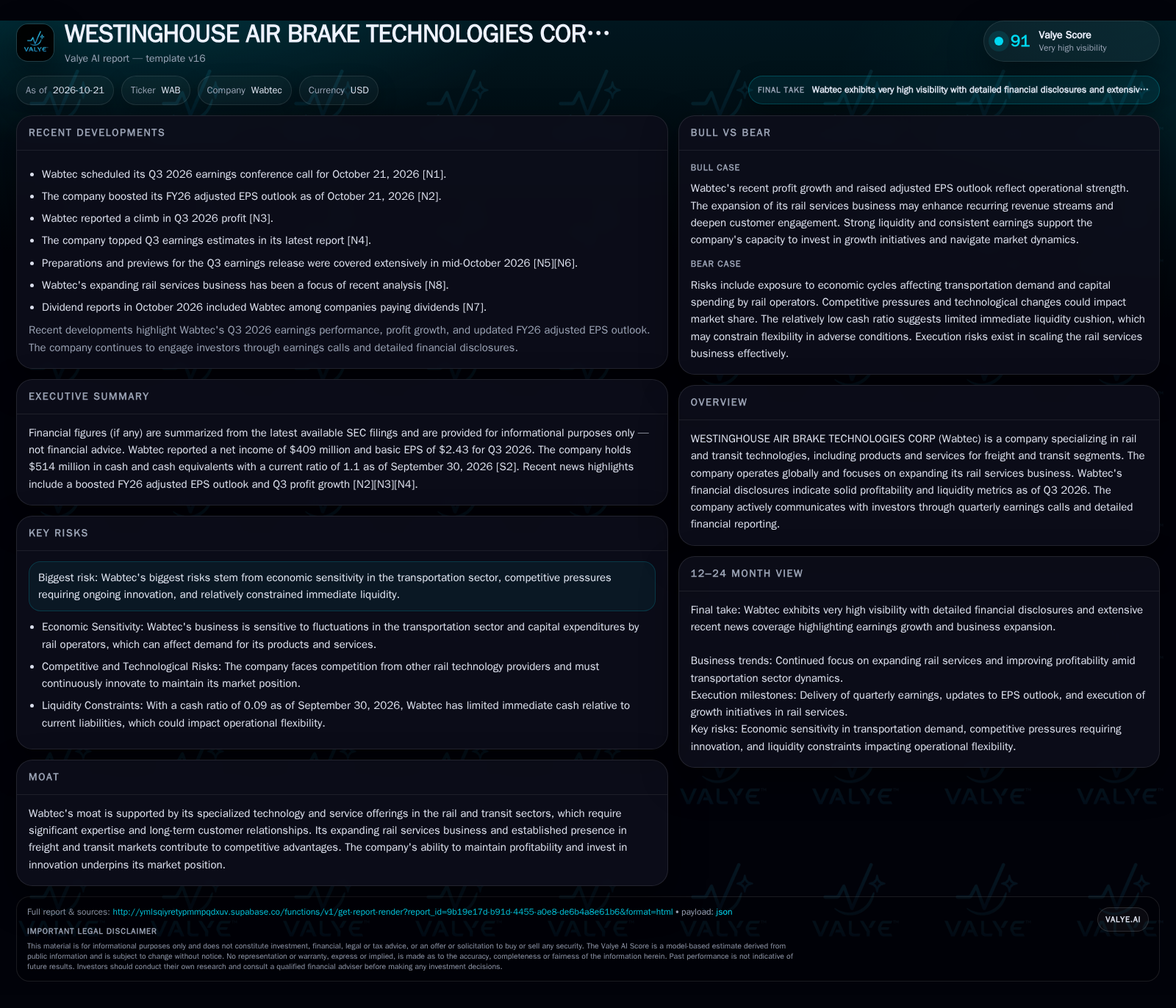
Wabtec reported a net income of $409 million for Q3 2026, with diluted earnings per share of $2.42, exceeding analyst expectations and highlighting a period of strong operational performance [S2] [N4]. This earnings beat comes as the company intensifies its focus on expanding its rail services business, a strategic shift aimed at driving more stable, recurring revenue streams [N8]. The company reported cash and liquidity metrics for the period; these figures do not by themselves establish operating runway, investment capacity, financial flexibility, or financing capacity. The cited source reports dividend-related activity; that disclosure alone does not establish dividend-policy continuity, management confidence, or a material constraint on capital flexibility. [S2] The interplay between robust recent profit, the push into services, and constrained liquidity frames the near-term risk/reward profile for Wabtec.
Recurring Revenue Ambitions and the Capital Intensity of Rail
Wabtec’s business economics are shaped by the dual realities of capital-intensive hardware sales and the growing importance of services and aftermarket support. Historically, the company has generated revenue through the sale of braking systems, locomotive components, signaling, and transit solutions—markets characterized by long sales cycles and lumpy, project-driven volumes. The expansion of its rail services segment could shift the revenue mix toward higher-margin, recurring streams, provided Wabtec can secure multi-year service contracts or maintenance agreements.
Recurring service revenue typically offers better visibility and operating leverage, as fixed infrastructure and technical expertise are spread over a larger base. The ability to price services at a premium—leveraging technical differentiation or proprietary data—could further enhance margins, but this will depend on customer willingness to pay and the competitive landscape. Ultimately, Wabtec’s economic model hinges on its ability to scale services profitably while managing the capital demands of its core business.
The capital intensity inherent in rail infrastructure and technology necessitates a careful balance between upfront investment and long-term service revenue potential. If Wabtec can effectively leverage its installed base to cross-sell services and upgrades, it may reduce customer acquisition costs and improve lifetime value per client. However, this depends on the durability of rail infrastructure assets and the pace at which operators adopt new technologies. Additionally, the capital tied up in inventory, tooling, and R&D for hardware development can constrain free cash flow, making the timing and scale of service expansion critical to sustaining financial health. Strategic partnerships or modular product designs could mitigate some capital demands by enabling more scalable service offerings.
Another consideration is the extent to which digital transformation and data analytics can enhance Wabtec’s service margins. If the company can integrate predictive maintenance and remote monitoring into its service contracts, it may shift from reactive to proactive models, improving operational efficiency for customers and creating higher switching costs. However, this requires ongoing investment in software capabilities and data security, as well as customer willingness to share operational data. The competitive landscape for digital rail services is evolving rapidly, so Wabtec’s ability to build proprietary platforms or secure exclusive data rights could determine whether these services become a meaningful margin driver or remain a commoditized offering.
Long-Term Relationships and Tech Depth Meet a Crowded Field
Wabtec’s competitive positioning is anchored by its technical expertise, broad portfolio, and entrenched relationships with major freight and transit operators. The company’s long operational history and integration into critical rail infrastructure provide it with switching cost advantages, as customers are often reluctant to disrupt established supply chains or risk operational downtime.
However, the rail technology sector is consolidating, with global equipment suppliers, niche service providers, and digital entrants all vying for share. Technological substitution—such as predictive maintenance, automation, and next-generation signaling—raises the bar for incumbents, requiring continuous investment in R&D and digital capability. While Wabtec’s expansion of rail services may deepen customer engagement and could create network effects, it also exposes the company to competition from both traditional OEMs and software-first disruptors. The question is whether Wabtec can leverage its installed base and technical know-how to defend and expand its share in a market where procurement cycles are long but innovation cycles are accelerating.
If Service Penetration Accelerates and Cash Generation Improves
The most favorable scenario for Wabtec is one in which its rail services business achieves significant penetration, resulting in a higher proportion of recurring, higher-margin revenue. This could occur if major freight and transit operators increasingly outsource maintenance, digital upgrades, and lifecycle management to Wabtec, locking in multi-year contracts and reducing revenue volatility.
Evidence that would confirm this trajectory includes a rising share of service revenue in total sales, increasing backlog or contract duration disclosures (if provided), and sustained or expanding operating margins even as hardware volumes fluctuate. Strong free cash flow generation and improvements in working capital efficiency would further validate the company’s ability to self-fund growth and absorb shocks. If Wabtec can demonstrate pricing power in services—perhaps via proprietary analytics or unique technical offerings—margin expansion could outpace peers. This scenario is supported by recent commentary on services expansion [N8] and would be falsified if service adoption stalls, contract wins prove fleeting, or cash conversion deteriorates despite top-line growth.
Economic Cyclicality and Service Growth Offset Each Other
The most plausible outcome is a balancing act: Wabtec grows its rail services business incrementally, but overall performance is tempered by the cyclical nature of rail capital spending and competitive pricing pressures. In this scenario, hardware sales remain lumpy, while service revenue rises but does not yet dominate the mix. Margins are stable to slightly improving as operational leverage from services partially offsets pricing and input cost headwinds.
Confirmation would come from steady, mid-single-digit revenue growth, modest improvements in operating margin, and stable or slightly improved liquidity metrics. Falsification would occur if economic weakness sharply curtails rail operator spending, or if competitive bids erode both service and hardware margins.
Liquidity Constraints and Economic Headwinds Disrupt Momentum
The adverse scenario for Wabtec unfolds if a downturn in rail sector capital spending coincides with execution missteps in scaling the services business. In this case, lumpy hardware demand is not offset by sufficient service revenue, leading to declining top-line growth and margin compression.
Evidence of this scenario would include deteriorating liquidity metrics (falling current or cash ratios), negative free cash flow, or announcements of cost-cutting and capital-raising measures. Missed earnings or guidance cuts—especially tied to weak service adoption or lost contracts—would further confirm the downside. This path is exacerbated if competitors win major service deals or if technological changes reduce Wabtec’s relevance in core markets.
What Will Determine Whether Wabtec’s Services Strategy Succeeds
The share of total revenue derived from rail services versus hardware—if disclosed—would clarify whether recurring revenue is truly expanding.
Gross and operating margin trends, particularly in the services segment, would help test whether service expansion is accretive to profitability.
Free cash flow and cash conversion metrics will indicate whether Wabtec can fund growth internally or must rely on external capital.
Any disclosures on multi-year service contract wins, backlog, or customer retention rates would illuminate the stickiness and visibility of future revenue.
Changes in current and cash ratios, as well as short-term debt levels, should be monitored for signs of liquidity pressure or improved resilience.
Competitive developments—such as new entrants, lost contracts, or technology partnerships—would reveal shifts in market share and strategic positioning.
Rail sector macro indicators, including freight volumes and capital expenditure trends among major operators, will influence underlying demand for Wabtec’s offerings.
Disclaimer: This is research-only, informational analysis and not investment advice. It may include AI-generated interpretation and general industry context. Always verify important details using primary sources.

Comments