
Winning Catering Group: Post-Restructuring Real Estate Shell Faces Scale, Control, and Market Access Hurdles
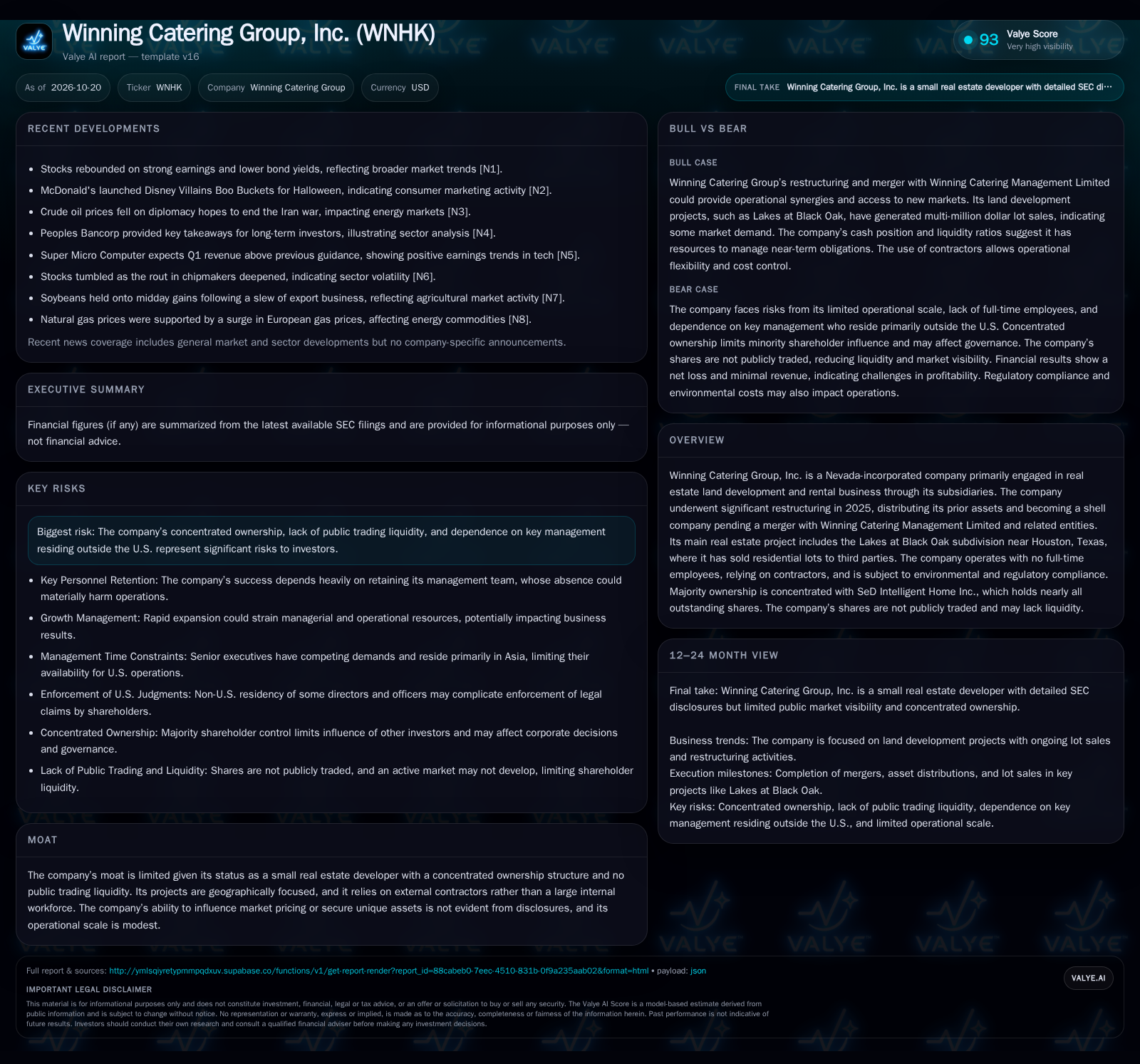
After divesting core assets and merging with Winning Catering Management Limited, Winning Catering Group, Inc. emerges as a shell entity with highly concentrated ownership, minimal operational footprint, and ongoing exposure to volatile real estate development economics.
Winning Catering Group has exited its principal real estate projects and undergone a merger, now operating as a shell with near-total majority ownership and no public trading market. Minority investors have little influence and face uncertain liquidity prospects. [S2]
Winning Catering Group, Inc. has radically reshaped its corporate structure over the past year, distributing its core real estate assets and entering into a merger that leaves it functionally as a shell entity with minimal ongoing operations. With all major development lots sold, no recurring revenue, and near-total control by a single shareholder, the company’s future hinges on successful execution of its merger and the ability to source and manage new projects—challenges compounded by limited internal resources and the absence of a liquid public market. For investors, the story is less about current earnings or asset base and more about potential value creation through new ventures under concentrated governance and uncertain market access. [S1] [S2]
Asset Divestiture and Shell Transition Define Present Reality
The most material recent development is the August 2025 distribution of Alset Real Estate Holdings Inc. to shareholders, which effectively stripped Winning Catering Group, Inc. of its principal operating assets and left it as a shell company pending a merger with Winning Catering Management Limited. This transformation means the company no longer has direct ownership of its previous land development projects. As of September 30, 2026, the company’s assets totaled only $5,912 and it reported no full-time employees, relying exclusively on contractors. The company’s shares are not publicly traded, and SeD Intelligent Home Inc. owns 99.99% of the outstanding shares, giving it effective control over all corporate decisions. These facts create a context where company value is driven almost entirely by future deal execution and the outcome of the planned merger. [S1] [S2]
Real Estate Shell Economics: Episodic Value Creation and High Dependency on Transactions
With the sale of all lots at Lakes at Black Oak and Alset Villas by the end of 2024, Winning Catering Group has no recurring revenue stream or ongoing project pipeline. Its business model now depends on the successful completion of mergers, acquisitions, or new development deals—each of which is inherently lumpy and unpredictable. The company’s reliance on contractors minimizes fixed costs and provides flexibility, but also means there is little in-house project management or development expertise to drive organic growth post-merger.
The absence of full-time staff and the lack of a diversified asset base suggest that fixed costs are low, but so is the company’s ability to capture operating leverage from future growth. Capital needs will likely be episodic, tied to the scale and nature of any new projects sourced through the merger. Since the company’s only recent revenue was $3,479 for the September 2026 quarter, and it reported a net loss of $5,648, there is no evidence of ongoing cash-generative operations. The company’s current ratio of 0.27 is low, but the cash ratio is anomalously high due to the very limited asset and liability base, reflecting the shell status post-divestiture. [S2]
If new projects are sourced and executed successfully, the economics could resemble those of a small, opportunistic developer: infrequent but potentially sizable gains on asset sales, punctuated by long periods of minimal activity. However, absent recurring income, the company remains acutely sensitive to deal flow and execution risk.
Governance, Scale, and Market Access: Core Competitive Constraints
Winning Catering Group’s competitive position is shaped less by traditional market dynamics and more by governance, scale, and access to new project opportunities. With 99.99% ownership concentrated in SeD Intelligent Home Inc., the company is insulated from proxy contests or activist intervention but also faces limited external accountability and little incentive to cater to minority shareholders. This concentrated governance could facilitate swift decision-making but may also deter outside investors and partners.
The absence of a public trading market for the company’s shares further restricts access to capital and visibility among potential partners or acquirers. The company’s project history—selling all lots at two Texas developments—demonstrates a capacity to execute small-scale land development, but the lack of ongoing projects and internal staff means it cannot compete with larger, vertically integrated real estate developers on cost, project scope, or market reach.
The company’s future competitive positioning will depend on its ability to leverage the merger with Winning Catering Management Limited to source new projects, potentially in new geographic or sectoral niches. However, without a clear demonstration of unique capabilities, differentiated assets, or recurring customer relationships, any future advantage will remain provisional.
Merger Integration Unlocks New Project Pipeline and Episodic Value
The most favorable scenario is that the merger with Winning Catering Management Limited proceeds smoothly, giving the combined entity access to new land development or catering-related projects, possibly with synergies in sourcing, capital allocation, or project management. If the new management team can identify and execute on attractive real estate or operating business opportunities—especially in markets with strong underlying demand for land or development services—then episodic but significant value creation is plausible.
Confirmation of this scenario would come from the announcement and successful execution of new project acquisitions, the establishment of a visible pipeline, or the return of meaningful quarterly revenue and positive operating cash flow. Evidence of new recurring revenue streams or strategic partnerships would further support this thesis. Conversely, failure to secure new projects or generate material operating income post-merger would falsify the upside case.
Sporadic Deal Flow, Limited Visibility, and Ongoing Minority Shareholder Disadvantage
The most plausible near-term scenario is one of sporadic deal activity, with the company opportunistically seeking new development or operating assets through the merged entity. Revenue and profitability will likely remain highly volatile, with long stretches of minimal activity punctuated by occasional asset sales or project launches. The lack of a public market and the overwhelming majority ownership mean that minority shareholders will have little influence, and the company will have limited ability to attract outside capital or partners unless it can establish a new, compelling business model post-merger.
This scenario would be confirmed by continued low or erratic revenue, persistent net losses, and a lack of regular project announcements. Evidence of continued reliance on contractors and the absence of internal operational build-out would further support the base case. A falsification would require the emergence of a robust project pipeline, recurring revenue, or a credible path to public trading liquidity.
Merger Integration Falters or Deal Pipeline Stalls, Leaving an Inactive Shell
The primary adverse scenario is that the merger with Winning Catering Management Limited fails to deliver operational integration or new project opportunities, leaving Winning Catering Group as a dormant shell with minimal assets and no ongoing business activity. In this case, the company would continue to report negligible revenue and recurring losses, with cash reserves gradually depleted by administrative costs and contractor fees.
This scenario would be confirmed by the absence of new project announcements, continued lack of full-time employees, and persistent financial losses. Any regulatory or legal challenges arising from the cross-border management structure, or inability to comply with environmental or real estate regulations, could accelerate the decline. The lack of a public trading market would prevent shareholders from exiting, compounding the downside risk.
Milestones That Will Define Value Creation Post-Merger
Progress on the merger with Winning Catering Management Limited: Announcement of closing, integration milestones, or disclosure of new project assets would indicate forward momentum.
Evidence of new project acquisitions or the establishment of a development pipeline: The company’s ability to source and execute new deals is the core driver of future value.
Quarterly revenue trends: Material increases or the emergence of recurring income would suggest successful business development post-merger.
Changes in management structure or the addition of full-time employees: Hiring or U.S.-based executive engagement would signal a shift toward operational build-out.
Public market developments: Any indication of pursuing a listing or improving share liquidity would alter the capital access and investor base.
Updates on cash flows and capital commitments: Disclosures of major expenditures, new financing, or cash burn rates would help assess sustainability.
Legal or regulatory filings: New litigation, regulatory actions, or changes in compliance posture could impact operational flexibility.
Shifts in ownership structure: Any dilution events or changes in majority control would reshape governance and minority shareholder prospects.
Disclaimer: This is research-only, informational analysis and not investment advice. It may include AI-generated interpretation and general industry context. Always verify important details using primary sources.

Comments