
Penguin Solutions: Riding the AI Memory Wave While Navigating Demand Shifts and Supply Chain Strain
Explosive growth in AI-driven memory demand has propelled Penguin Solutions’ Integrated Memory segment, but the company faces margin pressure, segment volatility, and the challenge of broadening its customer base beyond hyperscalers. Success will hinge on operational flexibility and execution amid evolving end-market dynamics.
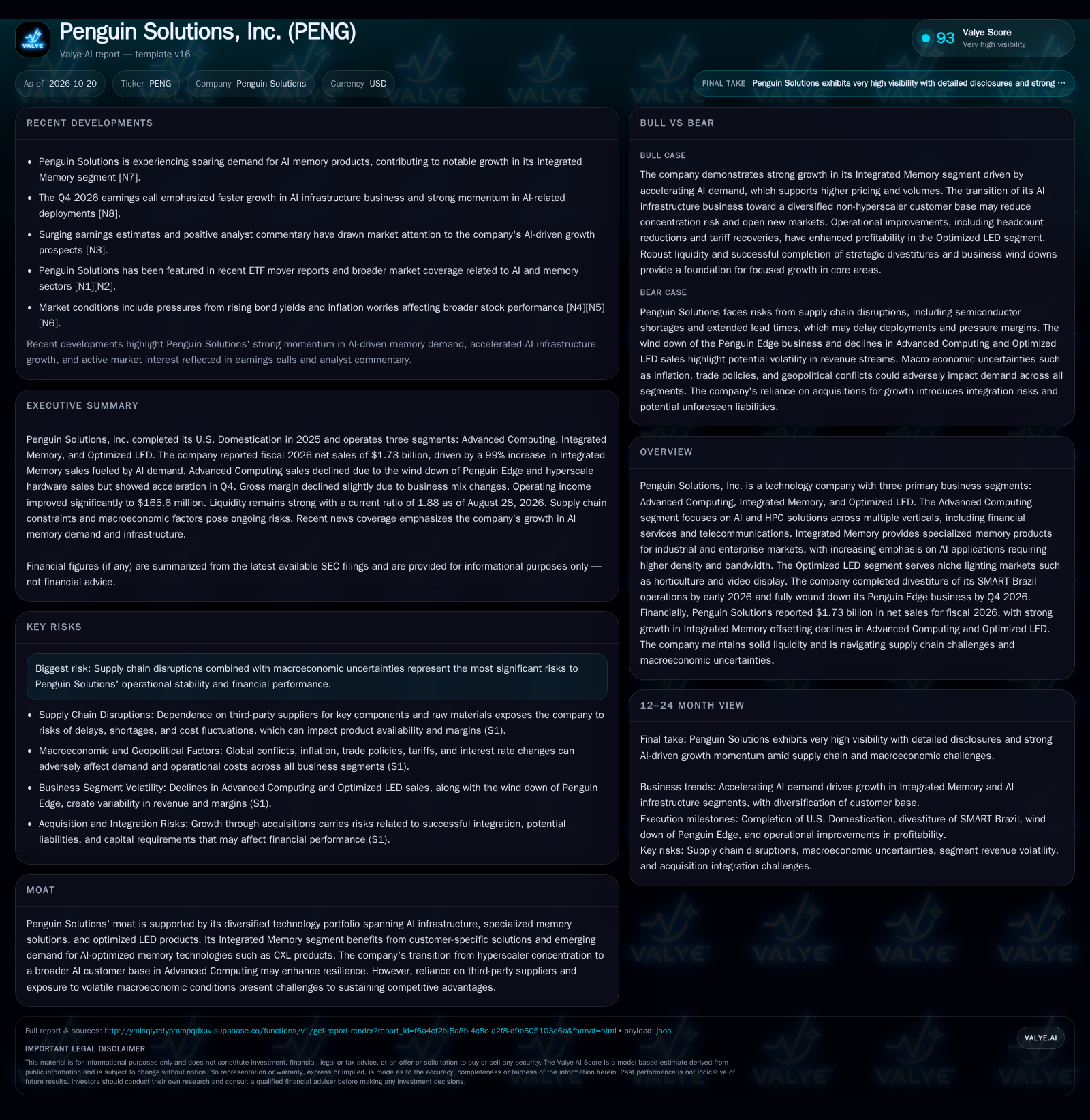
Penguin Solutions delivered 26.5% revenue growth in 2026, powered by a near-doubling of Integrated Memory sales as AI and high-bandwidth memory demand surged. However, Advanced Computing and Optimized LED segments declined, and overall gross margin slipped. The company is shifting its AI infrastructure focus from hyperscaler concentration to a more diversified customer base, but must manage supply chain risks and macroeconomic uncertainties while proving it can sustain profitable growth beyond the current AI cycle. [S1] [N7] [N8]
Penguin Solutions, Inc. has emerged as a standout beneficiary of the global AI boom, with its Integrated Memory segment nearly doubling revenue in 2026 on the back of surging demand for high-capacity, high-bandwidth memory. While this growth has lifted the company’s overall sales and operating income, Penguin faces a complex landscape: declining sales in Advanced Computing and Optimized LED, margin pressure from business mix shifts, and persistent supply chain and macroeconomic headwinds. The company’s strategic pivot away from hyperscaler concentration toward a broader AI customer base could reduce risk and open new growth avenues, but execution and adaptability will be critical as the AI infrastructure cycle matures and volatility persists. [S1] [N7] [N8]
AI-Driven Memory Growth Offsets Segment Declines and Reshapes Penguin’s Profile
In fiscal 2026, Penguin Solutions delivered $1.73 billion in net sales, up 26.5% year-over-year, propelled by a 99% surge in its Integrated Memory segment to $924 million. This explosive growth came as AI deployments drove both higher pricing and volume for advanced DRAM and Flash products, including CXL technologies. However, the Advanced Computing segment contracted by 13.8% to $559 million, reflecting the wind down of the Penguin Edge business and reduced hyperscale hardware sales, despite a late-year acceleration. The Optimized LED segment also shrank by 2.9%, signaling broad-based demand weakness. Gross margin slipped to 27.7%, and overall profitability improved, with operating income climbing to $165.6 million. These dynamics underscore a company riding a powerful AI wave but contending with deep structural shifts and margin headwinds. [S1] [N7] [N8]
How Penguin Solutions Monetizes AI Infrastructure and Memory—And Where Leverage Emerges
Penguin’s business model spans three segments with distinct economics. Integrated Memory’s growth is fueled by the AI cycle’s insatiable appetite for high-density, high-bandwidth memory—a market that typically rewards scale, customization, and tight integration with AI server platforms. Pricing power in this segment is highly cyclical and sensitive to supply-demand imbalances, but the current environment has enabled both volume and price increases. The Advanced Computing segment, now in transition after the Penguin Edge wind down, historically depended on large, lumpy hyperscaler orders, exposing Penguin to volatile revenue and margin swings. The company is now targeting a broader set of enterprise, neocloud, and sovereign AI customers to stabilize demand. The Optimized LED segment is smaller and more commoditized, subject to price competition and cyclical demand in markets like video display and horticulture. Penguin’s operating leverage improved in 2026, with operating income expanding faster than sales, aided by SG&A reductions post-U.S. domestication. However, gross margin erosion from mix shifts and supply chain pressures limits the upside. Capital needs are moderate relative to revenue, but ongoing R&D and potential M&A to keep pace with AI technology cycles could drive future funding requirements. [S1]
Competing for AI Infrastructure: Differentiation, Substitution, and the Limits of Scale
Penguin Solutions operates in intensely competitive markets. In Integrated Memory, it faces global DRAM and Flash suppliers, niche memory module firms, and potentially direct competition from OEMs and hyperscalers moving up the stack. Its value proposition rests on customer-specific solutions and the ability to deliver AI-optimized memory (such as CXL products) at scale and with integration expertise. However, barriers to entry are moderate: leading-edge memory supply is capital-intensive but not unique, and technology cycles can quickly erode differentiation. In Advanced Computing, the pivot from hyperscaler concentration to a more diversified customer base could reduce risk but may also mean smaller average deal sizes and higher customer acquisition costs. Competition comes from global systems integrators, specialized AI infrastructure providers, and cloud platform vendors. In Optimized LED, commoditization and Asian manufacturing dominance limit pricing power. Supply chain dependence further constrains Penguin’s ability to differentiate on cost or speed. The company’s moat is thus rooted in execution, customer intimacy in memory solutions, and the ability to evolve with AI hardware needs—none of which are unassailable if technology or customer preferences shift rapidly. [S1]
AI Infrastructure Diversification Unlocks Sustained Profitable Growth
If Penguin successfully broadens its AI infrastructure business beyond hyperscalers—winning enterprise, neocloud, and sovereign AI customers—revenue volatility could decline and margins stabilize. In this scenario, the company leverages its Integrated Memory leadership to cross-sell advanced computing platforms, capturing a greater share of the AI infrastructure stack. Continued AI-driven demand would support pricing and volumes in memory, while operational discipline preserves or expands margin. Confirmation would come from sustained double-digit revenue growth in both Integrated Memory and a rebounding Advanced Computing segment, improving gross margins, and a more diversified customer concentration profile. Additional evidence might include new customer wins in enterprise and sovereign AI, expanded product offerings tailored to non-hyperscaler needs, and positive analyst revisions tied to recurring or multi-year contracts. [S1] [N7] [N8] [N3]
AI Memory Boom Moderates, Revenue Mix Shifts, and Margin Pressure Persists
The most plausible near-term outcome is that Penguin continues to benefit from elevated AI memory demand, but growth rates normalize as industry supply catches up and pricing moderates. Integrated Memory remains the largest and most profitable segment, but Advanced Computing and Optimized LED see only modest recovery or continued stagnation. Gross margins remain under pressure from segment mix and supply chain costs, offsetting some operating leverage gains. Customer diversification in AI infrastructure reduces revenue concentration risk but does not fully replace lost hyperscaler volume. Evidence supporting this scenario would include mid-to-high single-digit annual revenue growth, stable (but not expanding) operating margins, and continued commentary from management and analysts about the need to balance growth with supply chain and margin management. [S1] [N8]
Supply Chain Disruptions and AI Demand Slowdown Expose Margin Vulnerabilities
A negative scenario for Penguin emerges if supply chain disruptions worsen—causing extended lead times, component shortages, or sharp cost increases—just as AI memory demand softens due to macroeconomic shocks or a cyclical correction. In this environment, Integrated Memory’s pricing power evaporates, volumes fall, and the company is left with excess inventory or underutilized capacity. Advanced Computing and Optimized LED remain weak, and gross margin compresses further. Operating income and cash flow deteriorate, potentially forcing cuts to R&D or delaying strategic investments. Confirmation would come from sequential revenue declines, significant margin contraction, inventory build-ups, or negative revisions to earnings estimates. Signs of customer order delays, lost share to lower-cost competitors, or supply chain bottlenecks that cannot be passed through would further validate the downside scenario. [S1]
Milestones That Will Reveal Whether Penguin’s AI Growth Is Durable or Cyclical
Sustained Integrated Memory revenue growth rates above industry averages, particularly in AI-optimized product lines, would indicate continued market share gains if disclosed.
Advanced Computing segment revenue trajectory: evidence of stabilization or renewed growth from non-hyperscaler customers would support the diversification thesis.
Gross margin trends: movement back toward or above historical levels would suggest successful mix management and/or easing supply chain pressures.
Customer concentration disclosures: a declining share of revenue from top hyperscaler clients and increased enterprise/neocloud wins would confirm effective diversification.
Inventory levels and days sales outstanding: rising figures could signal supply chain or demand issues; stable or improving metrics would show operational discipline if disclosed.
R&D spending direction and focus: increased investment in AI and memory technologies would support innovation-led growth, but cuts could signal margin stress.
Supply chain commentary: any updates on component availability, lead times, or input cost trends will be critical to margin outlook.
Forward guidance and analyst estimate revisions: sustained positive momentum in consensus forecasts would validate the bull case, while negative revisions would flag emerging risks.
Disclaimer: This is research-only, informational analysis and not investment advice. It may include AI-generated interpretation and general industry context. Always verify important details using primary sources.

Comments