
Northrop Grumman: Backlog Strength, Defense Innovation, and the Realities of Government Reliance
A surging backlog and standout Q3 execution underscore Northrop Grumman’s core strengths, but the company’s future will be shaped by its ability to deliver on advanced programs amid supply chain, workforce, and budgetary headwinds.
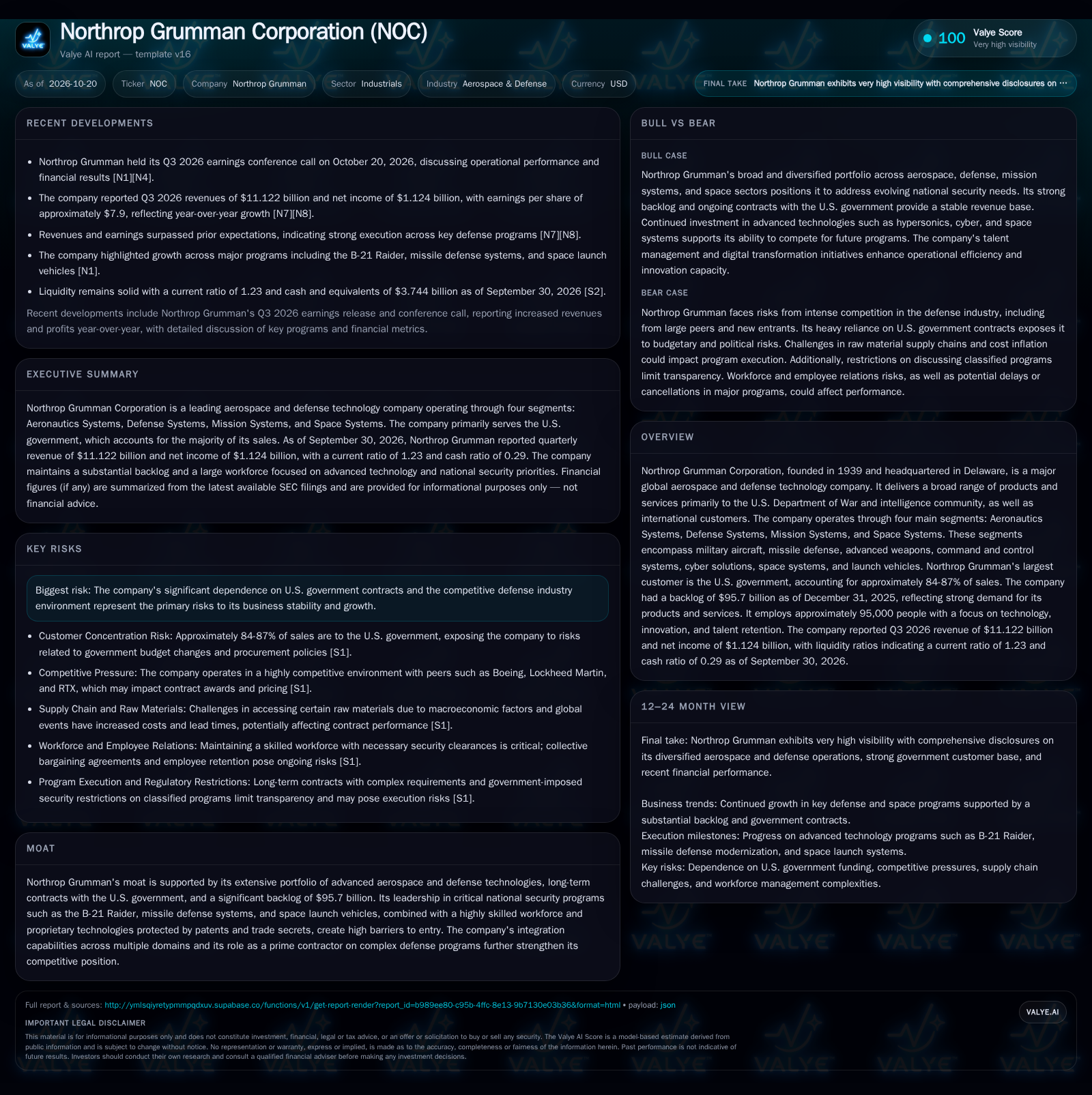
Northrop Grumman’s Q3 2026 results exceeded expectations, supported by robust growth in flagship programs and a record $95.7 billion backlog. The company’s fortunes remain tightly linked to U.S. government spending, with 84-87% of sales coming from this customer. While its diversified portfolio positions it well for evolving defense needs, execution risks around program delivery, workforce retention, and supply chain disruptions remain central to the investment debate. Monitoring program milestones, government budget trends, and segment-level performance will be critical in assessing the company’s ability to sustain growth and defend margins. [S1] [S2] [N1] [N4] [N7] [N8]
Northrop Grumman’s latest quarter showcased the strengths and vulnerabilities that define the modern defense contractor. With Q3 2026 earnings and revenue exceeding expectations, and a near-$96 billion backlog, the company is arguably better positioned than ever to capture the next wave of U.S. and allied defense outlays. Yet this momentum is inseparable from its heavy dependence on government budgets, the complexity of its advanced programs, and industry-wide supply chain and talent pressures. As defense priorities evolve and execution risks intensify, the company’s ability to translate backlog into profitable delivery will be the central question for stakeholders.
Recent Performance and Backlog Signal Strength, but Reliance on Government Remains Central
Northrop Grumman reported Q3 2026 revenue of $11.122 billion and net income of $1.124 billion, both surpassing analyst expectations and reflecting strong operational execution across major programs such as the B-21 Raider, missile defense, and space launch systems. As of December 31, 2025, the company’s backlog reached $95.7 billion, offering multi-year revenue visibility. Reported liquidity position, with $3.744 billion in cash and a current ratio of 1.23, though a cash ratio of 0.29 indicates a working-capital-intensive model. Importantly, approximately 84-87% of sales continue to come from the U.S. government, underscoring both the stability and concentration risk inherent in the business. [S1] [S2] [N1] [N7] [N8]
The concentration of sales within the U.S. government portfolio inherently ties Northrop Grumman’s performance to federal budget cycles and geopolitical priorities. While this provides a degree of revenue stability, it also introduces timing risks related to appropriations delays and shifting defense strategies. The company reported cash and liquidity metrics for the period; these figures do not by themselves establish operating runway, investment capacity, financial flexibility, or financing capacity. This dynamic underscores the importance of efficient working capital management and the potential vulnerability to disruptions in contract payment schedules or unexpected cost escalations.
How Northrop Grumman Turns Backlog into Profits: Program Economics and Cash Flow Dynamics
Northrop Grumman’s economics are shaped by long-term, large-scale government contracts—often cost-plus or fixed-price—spanning multi-year development and delivery cycles. These contracts can provide predictable revenue and margin visibility, but expose the company to substantial execution and cost-overrun risks, particularly as programs grow in complexity. Fixed costs (R&D, engineering, security-cleared labor, and advanced manufacturing infrastructure) are high, but successful scaling of flagship programs such as the B-21 Raider and Sentinel ICBM modernization can generate significant operating leverage as production ramps. Variable costs are driven by materials, supply chain, and subcontractor expenses, which have recently been pressured by global disruptions. Capital needs are substantial, with ongoing investment required in technology, talent, and production capacity to meet classified and technically demanding requirements. Cash conversion is often lumpy, depending on milestone payments, contract advances, and the timing of government appropriations.
The interplay between cost-plus and fixed-price contract structures significantly influences Northrop Grumman’s risk profile and margin stability. Cost-plus contracts offer reimbursement for allowable costs plus a fee, which can mitigate downside risk but may limit upside margin potential. Conversely, fixed-price contracts require disciplined cost control to avoid overruns, especially as program complexity increases. Economies of scale become pivotal as production volumes rise; however, the ramp-up phase often entails higher unit costs and investment outlays before efficiencies materialize. Furthermore, the company’s capital allocation decisions must balance near-term cash flow demands with strategic investments in innovation and infrastructure to sustain long-term competitiveness.
Defending Market Leadership: Advanced Technology, Barriers to Entry, and Shifting Threats
Northrop Grumman’s competitive edge lies in its portfolio breadth—spanning aeronautics, missile defense, mission systems, and space—and its status as prime contractor on some of the U.S. government’s most critical and classified programs. Proprietary technologies, integration capabilities, and a workforce skilled in security-cleared STEM roles create high barriers to entry. However, competition from other defense primes (e.g., Lockheed Martin, Boeing, RTX) is fierce, with contract awards often determined by technical merit, past performance, and cost competitiveness. Technological substitution is a latent threat, as government priorities shift toward cyber, hypersonics, autonomous systems, and space-based capabilities. Supply chain reliability and digital transformation may become differentiators as the complexity of defense systems grows. While the company’s backlog and entrenched customer relationships offer resilience, the question is whether Northrop Grumman can maintain its edge as defense procurement priorities—and the nature of warfare—evolve.
Northrop Grumman’s ability to maintain its market leadership will also hinge on its agility in adapting to evolving defense procurement models, which increasingly emphasize digital engineering, modular system designs, and rapid prototyping. These trends can lower barriers to entry for emerging competitors and require incumbents to accelerate innovation cycles. Moreover, the integration of artificial intelligence and autonomous capabilities into defense platforms demands continuous upskilling of the workforce and strategic partnerships. Supply chain resilience, including diversification of critical component sources and adoption of advanced manufacturing technologies, will further differentiate winners in a landscape marked by heightened geopolitical tensions and resource constraints.
If Advanced Programs Deliver: A Pathway to Margin Expansion and Portfolio Renewal
The most favorable outcome for Northrop Grumman would see flawless execution on major programs—such as the B-21 Raider, Sentinel ICBM, and space launch vehicles—leading to both revenue growth and margin expansion as production scales. Continued investment in next-generation technologies (hypersonics, cyber, missile defense, and autonomous systems) could secure additional contract wins and position the company as a key enabler of evolving national security strategies. Evidence confirming this scenario would include: consistent program milestone achievement, stable or rising segment-level margins, and incremental backlog growth from new awards in high-priority domains. The scenario would be challenged if major programs experience delays, cost overruns, or margin compression due to supply chain or labor issues.
Sustaining Growth Amid Execution and Budgetary Pressures
The most plausible trajectory is one where Northrop Grumman delivers steady growth by converting its substantial backlog into revenue, while managing execution risks and adapting to periodic government budget fluctuations. Some margin variability is likely as the company navigates supply chain costs and workforce pressures, but the core business remains anchored by its U.S. government relationships and diversified program portfolio. This scenario is supported if quarterly financials show stable revenue and net income trends, healthy order intake, and progress on key development milestones. It would be weakened by evidence of persistent cost inflation, program delays, or a marked slowdown in government contract awards.
When Government Budgets Tighten or Execution Falters: Risks to Revenue Visibility and Margin Stability
An adverse scenario would emerge if U.S. government defense spending contracts, major programs are delayed or canceled, or execution issues lead to sustained cost overruns and margin erosion. Given Northrop Grumman’s customer concentration, any significant shift in budget priorities, regulatory changes, or procurement delays could materially impact revenue and backlog conversion. Confirming evidence would include a sharp decline in backlog, missed program milestones, negative segment-level operating margins, or a spike in working capital needs that pressures liquidity. Persistent supply chain disruptions or workforce constraints could further amplify downside risks.
What Will Determine Northrop Grumman’s Next Act? Metrics to Track the Thesis
Quarterly progress on flagship programs (e.g., B-21 Raider, Sentinel ICBM, major space contracts) and related milestone disclosures.
Segment-level margin trends, especially in Aeronautics and Space Systems, as a test of execution and cost management.
Order intake and incremental backlog growth, particularly in emerging domains such as hypersonics, cyber, and space.
U.S. government budget appropriations for defense and intelligence priorities, and how these translate to contract awards.
Supply chain and labor cost inflation, as measured by disclosed cost-of-sales trends or management commentary.
Retention and hiring data for security-cleared STEM employees—if disclosed—to gauge workforce stability.
Working capital and cash flow metrics, including timing of milestone payments and advances.
Any evidence of contract cancellations, delays, or regulatory changes in government procurement policies.
Disclaimer: This is research-only, informational analysis and not investment advice. It may include AI-generated interpretation and general industry context. Always verify important details using primary sources.

Comments