
Transglobal Management Group: Golf Tech Ambitions, Profitability Flashpoints, and the Realities of Liquidity Constraint
Transglobal Management Group (TMGI) has reoriented its business toward cloud-based golf technology platforms, reporting modest revenue and net income for the August 2026 quarter following the acquisition of GetGolf.
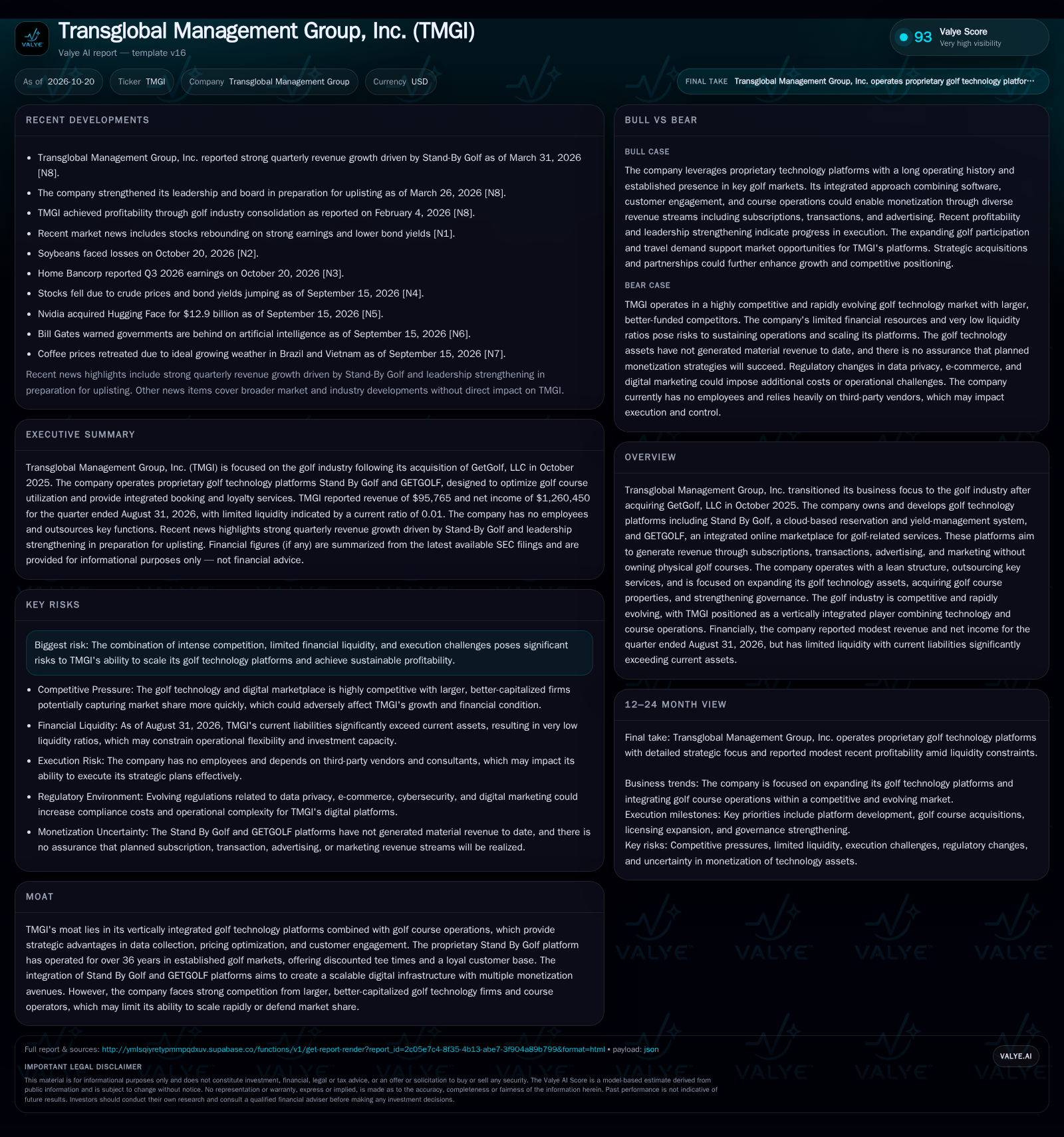
Transglobal Management Group (TMGI) has reoriented its business toward cloud-based golf technology platforms, reporting modest revenue and net income for the August 2026 quarter following the acquisition of GetGolf. While its Stand By Golf and GETGOLF platforms aim to monetize a growing online golf market via diverse digital channels, the company’s current assets are dwarfed by its liabilities, leaving it with a sharply negative liquidity position. Outsourced operations and no direct employees may keep costs low but create execution risks. The challenge: Can TMGI scale its technology and capture share before resource constraints or aggressive competition erode its opportunity? [S1] [S2] [N8]
Transglobal Management Group, Inc. (TMGI) is attempting to carve out a niche in the competitive golf technology landscape by leveraging proprietary booking and yield-management platforms, targeting both operators and consumers in a $95 billion market. After acquiring GetGolf in late 2025, the company reported a jump to modest profitability, but its balance sheet reveals a critical liquidity shortfall—current assets cover only a fraction of current liabilities. With no direct employees and a strategy built on outsourced execution, TMGI faces a race against time to scale its platform and secure recurring revenue before financial and operational constraints close the window of opportunity.
Liquidity Crunch and Platform-Driven Revenue: The Immediate Backdrop
The most material current facts shaping TMGI’s outlook are its severe liquidity constraints and the initial signs of profitability from its digital golf platforms. The company reported cash and liquidity metrics for the period; these figures do not by themselves establish operating runway, investment capacity, financial flexibility, or financing capacity. [S2] While the quarter delivered $95,765 in revenue and net income of $1,260,450, these headline numbers are modest in an industry where scale is critical, and the sustainability of profitability is unclear. The reported revenue surge was attributed to Stand By Golf, suggesting the platform can generate customer traction, but there is no evidence yet of recurring, predictable cash flows or sufficient scale to fund growth internally [N8]. The company’s strategy of outsourcing all core functions while having no direct employees keeps fixed costs low but may hamper its ability to respond quickly to competitive threats or operational challenges [S1].
How TMGI’s Platform Model Could Scale—If It Survives the Capital Squeeze
TMGI is attempting to monetize participation in the golf industry’s digital transformation without owning physical golf courses—a capital-light model that, in theory, can offer high operating leverage if digital platforms gain traction. Revenue streams are envisioned across subscriptions (from course operators or golfers), transaction fees (from tee-time bookings or travel packages), advertising, and marketing partnerships. This model can produce attractive margins if customer acquisition costs remain manageable and retention is high, as incremental costs for serving additional users are typically low after the platform is built.
However, the economics are sensitive to scale: the fixed costs of technology development, platform maintenance, and integration with third-party vendors must be covered by a growing and engaged user base. The company’s current lack of employees and reliance on vendors could help keep overhead low, but risks underinvestment in proprietary technology and customer service. Additionally, TMGI’s recent mention of acquiring cash-flow-producing golf properties suggests a possible hybridization of the model—introducing real estate and operational risk in exchange for potentially steadier cash flows. This move would require capital, which the company currently lacks.
The question is whether TMGI can achieve sufficient platform adoption and monetization before liquidity constraints force a retrenchment or dilutive capital raise.
Facing Well-Funded Rivals in a Fragmented but Fast-Consolidating Golf Tech Market
TMGI’s competitive landscape is defined by large, established booking platforms, integrated course management systems, golf content/media providers, and a growing cohort of AI-driven tech entrants targeting the same market opportunity [S1]. The company’s proprietary Stand By Golf platform, with a multi-decade operating history, provides some brand equity and a base of loyal users, but there is little evidence it has achieved scale comparable to major incumbents.
Larger rivals benefit from network effects, deeper data, and marketing budgets that can drive aggressive customer acquisition and retention. Many also partner directly with major course operators and resorts, embedding themselves into the operational backbone of the industry. TMGI’s vertically integrated approach—combining software with ambitions for course ownership—could differentiate its offering if executed well, enabling richer data capture, dynamic pricing, and tailored loyalty programs. However, with limited financial resources, TMGI risks being outpaced by better-capitalized players able to invest in product development, integrations, and marketing at scale.
Switching frictions in the market are moderate: while course operators and golfers may be slow to change technology platforms due to integration complexity and learning curves, aggressive pricing, superior user experience, or bundled offerings from larger rivals could accelerate churn away from smaller providers.
If Stand By Golf and GETGOLF Achieve Viral Adoption Before Funding Gaps Hit
The most favorable scenario for TMGI is one in which its digital platforms achieve rapid adoption among both course operators and golfers, creating a virtuous cycle of network effects, data-driven pricing improvements, and recurring revenue. In this pathway, Stand By Golf’s dynamic reservation and yield-management features could become industry standards, with GETGOLF aggregating demand and facilitating cross-sell opportunities for travel, retail, and loyalty programs.
Falsification would occur if adoption stalls, user retention is weak, or if the company is forced into distressed financing that dilutes existing shareholders or curtails platform investment.
Platform Monetization Progresses Slowly Amid Resource Constraints and Execution Risk
The most plausible near-term scenario is that TMGI achieves incremental platform growth but struggles to break out due to liquidity shortfalls and operational bottlenecks. Revenue may edge upward as Stand By Golf and GETGOLF expand their reach, but limited marketing spend, slower product development cycles, and an inability to invest in major integrations or property acquisitions keep overall scale and profitability capped.
In this scenario, TMGI may be forced to prioritize near-term survival over long-term vision—potentially deferring or downsizing strategic initiatives, seeking bridge financings on unfavorable terms, or focusing on a narrower set of core markets. Outsourced execution may help contain costs but could lead to missed opportunities, slower response to competition, and reduced customer satisfaction.
Evidence confirming this trajectory would be flat or modestly rising revenues, continued absence of substantial cash flow, ongoing liquidity warnings, and limited news of transformative partnerships or customer wins. Falsification would require either a dramatic increase in platform adoption and monetization or a rapid deterioration into insolvency or business discontinuity.
Liquidity Shortfall Forces Distressed Actions or Strategic Retreat
The adverse scenario is driven by the company’s extreme liquidity deficit, which could force TMGI into distressed capital raises, asset sales, or even insolvency if platform traction does not improve quickly. Failure to secure additional funding or generate sufficient operating cash could result in the curtailment of technology investment, loss of vendor relationships, or inability to service obligations, triggering a downward spiral.
Competitive pressure from larger, more resourceful rivals could accelerate customer churn or inhibit new customer acquisition, especially if TMGI cannot keep pace with product innovation or marketing. Outsourced execution, while cost-effective, may lack the flexibility and speed needed to navigate a rapidly evolving market under stress.
Confirming evidence would include deteriorating liquidity metrics, missed payments or vendor disputes, sudden changes to business strategy, or regulatory filings signaling financial distress. Falsification would require evidence of a credible turnaround: new funding, major customer wins, or operational improvements that restore confidence in TMGI’s ability to compete.
Early Warning Signs and Milestones for TMGI’s Digital Golf Ambitions
Quarterly user growth and transaction volumes on Stand By Golf and GETGOLF—if disclosed—would provide the clearest signal of platform adoption and network effects.
Gross margin trends and the emergence of recurring versus one-time revenues, which would indicate successful monetization and scalability of the digital model.
Progress on strategic partnerships or licensing deals with major golf course operators or travel aggregators, which would validate the company’s go-to-market strategy.
Evidence of successful acquisition or integration of cash-flow-generating golf course properties, if pursued, and the impact on overall cash flow and risk profile.
Retention rates for both course operators and end-user golfers—a metric that, if disclosed, would reflect platform stickiness and customer satisfaction.
Announcements of new product features, integrations, or technology partnerships that could extend platform differentiation or accelerate adoption.
Board, leadership, or governance changes that may signal shifts in strategic direction, capital allocation priorities, or preparation for major corporate actions.
Disclaimer: This is research-only, informational analysis and not investment advice. It may include AI-generated interpretation and general industry context. Always verify important details using primary sources.

Comments